


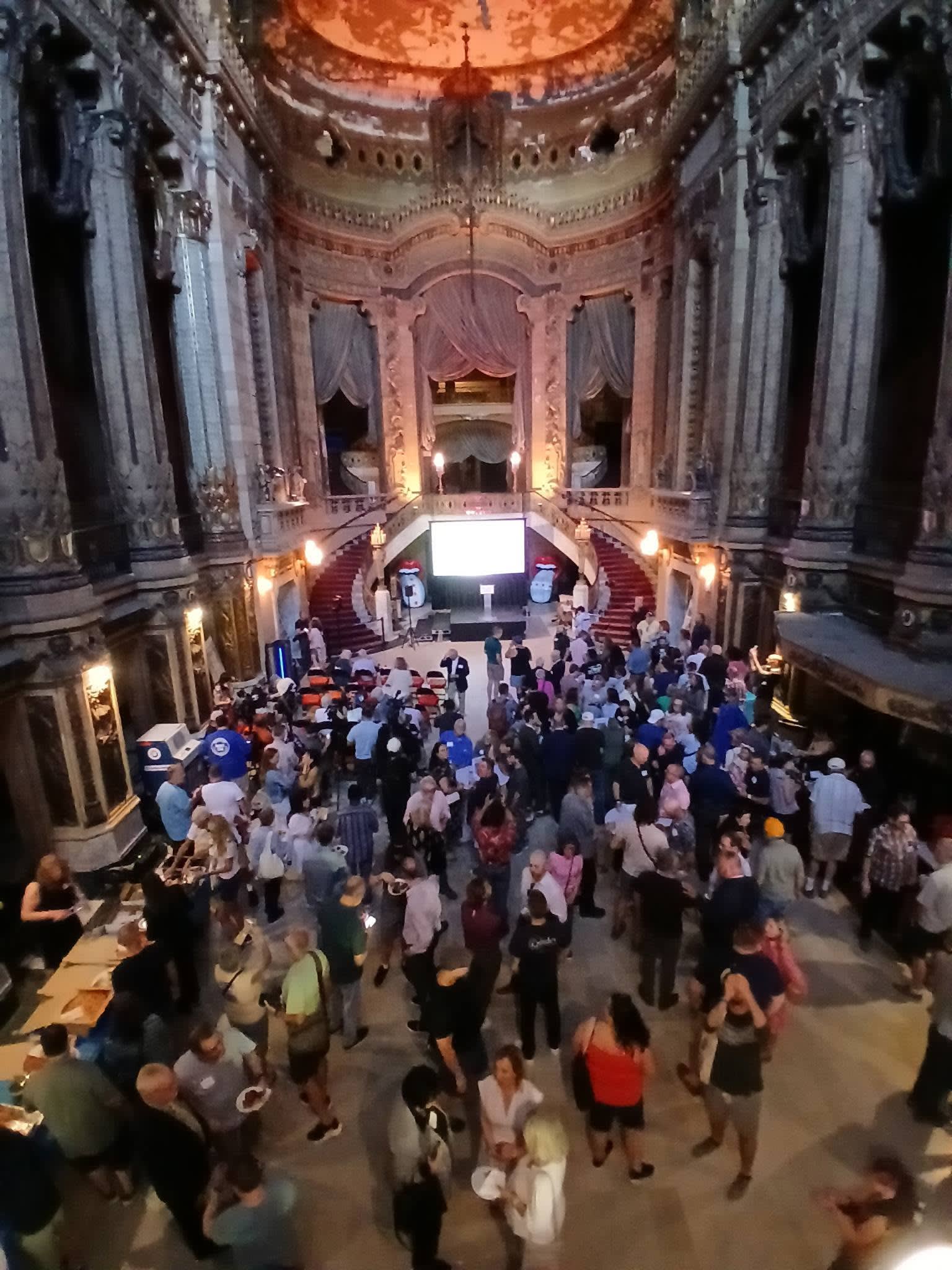


“It was an exciting trip back in time for Amanda Kennedy and her daughter, Rayanne Perez, just two of the many Chicagoans who flocked to the Uptown on Saturday, June 27, to catch a glimpse of the storied theater’s interior.
“The Uptown Theatre, 4816 N. Broadway, turned 100 last year but has been closed since 1981. It was built as a fantastical destination for movie screenings before the advent of home televisions and was later refashioned as a concert venue.
“Rep. Mike Quigley used the Uptown Theatre as the backdrop for the launch of his mayoral campaign, a canny strategy that drew both his political supporters and those who had no interest in his campaign — but did have an intense curiosity about the theater.
“Quigley did not vow to fix the theater if elected, but used the dilapidated movie palace as a metaphor for the action needed to realize the city’s full potential.
“Beyond the ticket booth where Perez and her mother snapped a picture and into the Uptown Theatre lobby, colossal columns adorned with shields and eagles line the second floor. Most of the columns have faded, but Wisconsin-based restoration masters Conrad Schmitt Studios painted at least one column in gold, offering modern audiences a look into the theater’s architectural heyday. Candelabras on the walls held bright bulbs, and golden torches flickered with electric candles.
“A movie palace like this would really pull out all the stops in terms of the decoration adorning the building,” Adam Rubin, senior director of public engagement at the Chicago Architecture Center, told Block Club. “So you’re going to have terracotta ornament, you’re going to have painted frescoes, you’re going to have columns and coffers on the ceiling, and really a more is more mentality. Everything is meant to draw your eye and give you a sense of awe and really a sense of inspiration.”
“There is some hope the Uptown will return to its former glory, though that depends on some $200 million in funding, said building owner Jerry Mickelson. Most of that money would need to come from the city, he said.
“‘That’s what we’re hoping to get, because that’s who does these kinds of projects,’ he told Block Club. ‘If you look at other theaters, the city’s come through, or other buildings. Look at the Downtown office building that’s being converted on LaSalle Street. The city gave them $98 million in [tax increment financing], they’ve offered me about half that.
“As I have demonstrated to the city, providing TIF assistance equal to only 35 percent of the project cost is simply insufficient,” Mickelson said in an email. “The restoration of the Uptown Theatre is an extraordinarily complex and expensive undertaking that requires a more robust public-private financing partnership. Without additional support, the project will remain financially infeasible, and the theatre’s doors will never reopen.”
“‘This is an incredibly endangered building type,’ said Adam Rubin, senior director of public engagement at the Chicago Architecture Center. ‘These are historic buildings that were built sparing no expense at a time right before the Depression made it untenable to build structures like this. So the examples that still remain are often quite expensive to maintain, expensive to operate and really require an incredible investment from local governments and communities and owners to make sure that they’re viable.'” (Giangreco, Block Club Chicago, 7/7/26)
The Uptown Theatre is one of Chicago’s greatest architectural gems — and one of the greatest surviving movie palaces in America. Designed by Rapp & Rapp and opened in 1925 as the flagship of the Balaban & Katz theater circuit, the Uptown was built to seat more than 4,000 people in an interior of extraordinary richness: terra cotta ornament, painted frescoes, coffered ceilings, columns adorned with shields and eagles, candelabras, and a lobby of a grandeur that few theaters anywhere in the country can match.
The City of Chicago recognized this significance with a Chicago Landmark designation in 1991; the building is also listed on the National Register of Historic Places. Fortunately, Designated Chicago Landmark status prevents the Uptown Theatre from being demolished, however it does not ensure restoration. The building is stable, but even in its mothballed state, is costly to maintain. There is urgency to assemble the necessary stakeholders, resources, and commitments to fully restore this extraordinary building to its original grandeur.
The Uptown Theatre has been vacant since December 1981, when the J. Geils Band played the final show. The forty-five years that have passed without a restoration are a measure not of indifference but of difficulty, complexity and cost associated with a restoration. The Uptown is a massive building with an interior of extraordinary intricacy, decades of deferred maintenance, and a restoration price tag that has challenged every financing structure attempted.
This is a genuinely difficult project, and the scale of the investment required should not be minimized. But neither should the opportunity restoration represents.
A restored Uptown, seating up to 5,600 in general admission, would fill a real gap in Chicago’s entertainment landscape between the intimate club circuit and the United Center. The acts that filled this stage from 1975 to 1981 — the Grateful Dead, Bruce Springsteen, Genesis, Frank Zappa — speak to the venue’s historic draw, and the Chicagoans who came through its doors on June 27 for Rep. Quigley’s campaign launch, drawn primarily by the building itself, confirm that the public appetite for the Uptown’s restoration remains very strong.
Preservation Chicago urges all stakeholders – the City of Chicago, owner Jerry Mickelson, the State of Illinois, federal partners, Friends of the Uptown, neighborhood partners, and preservation partners – to work together toward a viable financing solution. We recognize the genuine difficulty of what is being attempted and are encouraged by the sustained engagement of all stakeholders over many years. Every available financing tool deserves serious and creative exploration including federal Historic Tax Credits, Illinois Historic Preservation Tax Credits, state capital grants, New Markets Tax Credits, and the full capacity of the Lawrence/Broadway TIF district.
The Uptown Theatre is of the highest importance. Its restoration would be among the great preservation and economic development achievements in Chicago’s history, and we remain deeply committed to this effort alongside all who share the vision of bringing this remarkable building back to life.
Read the full story at Block Club Chicago
- Uptown Theatre Owner Says City Funding Needed For Renovations — But City Says He’s Asking For Too Much; Leigh Giangreco, Block Club Chicago, 7/7/26
- The Uptown: Chicago’s Endangered Movie Palace; Robert Loerzel, CityFiles Press, 2026
- Will Uptown Theatre Ever Reopen? Historic Movie Palace Turns 100 Amid Latest Revival Effort; Block Club Chicago, 8/14/25
- WIN: After 35 Years of Advocacy, Uptown Theatre Restoration Announced!; Preservation Chicago, 6/2018
- UPDATE: One Year Later — The Uptown Theatre Status; Preservation Chicago, 6/2019
- THREATENED: Uptown Theatre Restoration Stalled Again; Preservation Chicago, 3/2021
- It’s time to get the band back together for the Uptown Theatre; Andy Pierce, Chicago Tribune, 12/16/21
- West Loop Entertainment District Should Not Come at the Cost of Historic Venues Such as Chicago’s Uptown Theatre; Chicago Tribune Editorial Board, 1/27/25
- Uptown Theatre: 100 Years of Glory and Decay; Robert Loerzel, Chicago Tribune, 8/10/25