


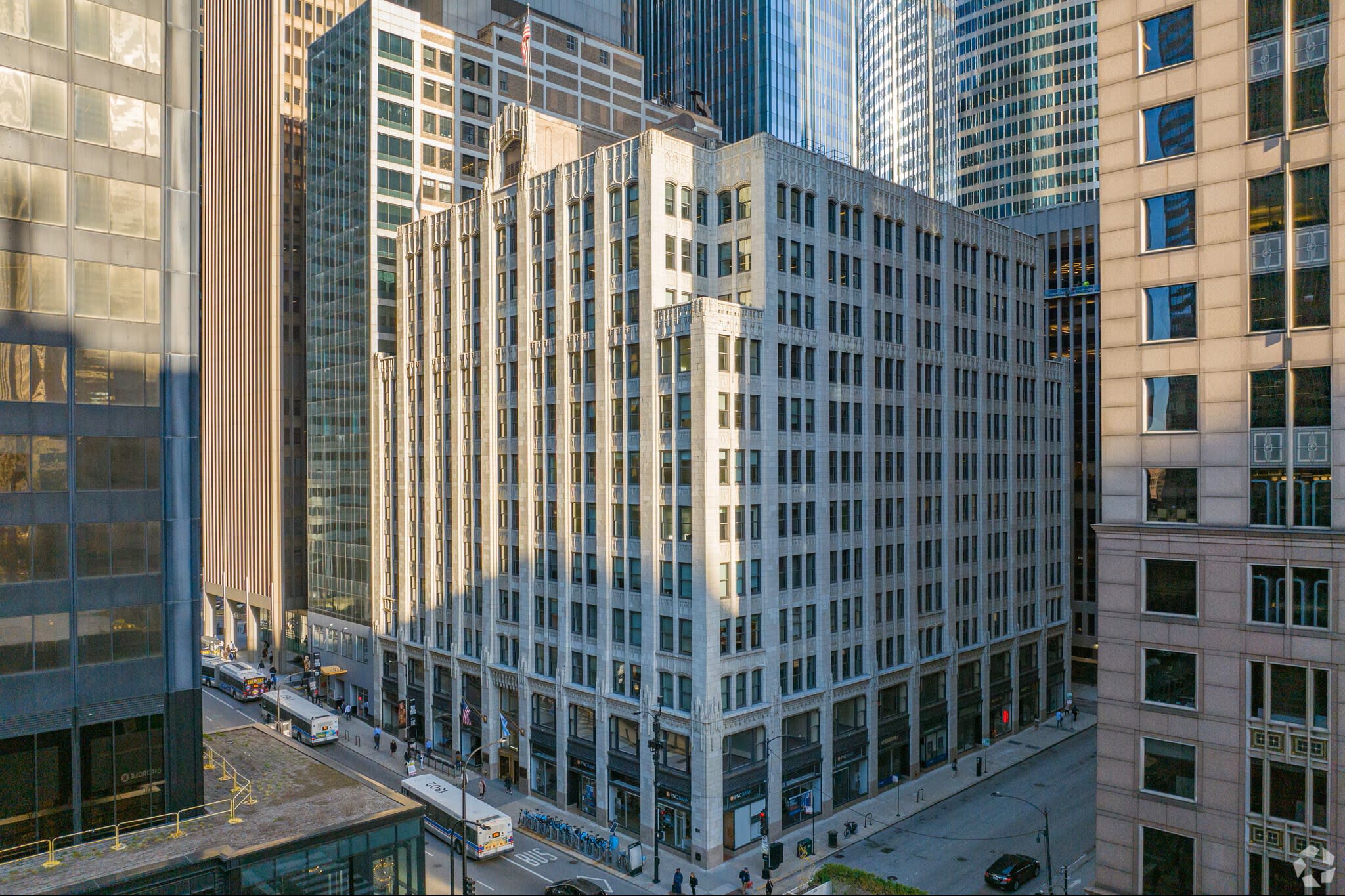

“A landmark Loop office building is a step closer to being partially converted into a data center despite pushback from a preservationist group that deems it a ‘dangerous precedent’ for historic buildings downtown.
“The Permit Review Committee of the Commission on Chicago Landmarks signed off yesterday on a plan to transform the lower half of the 12-story office building at 300 W. Adams St. into a data center. The approval moves the proposal forward to a review by the full commission and keeps the project on track to potentially begin work later this year.
“The plan is part of a wave of office building conversions sweeping across downtown as landlords and developers adapt to weakened demand for workspace. While dozens of properties downtown are poised to be turned into apartments, the owner of the Adams Street property sees a path forward in housing servers and technology that stores and processes data — betting that intense demand for artificial intelligence computing capacity is the building’s best path to stability.
“Yet data centers have been an increasingly contentious form of redevelopment, drawing scrutiny over their enormous demands on electricity and other local infrastructure. Ald. Maria Hadden, 49th, introduced an ordinance at last month’s City Council meeting that would require buildings with data centers to disclose energy and water consumption information.
“Chicago-based investor Igor Gabal, who leads a venture that bought the 240,000-square-foot building for $4 million in 2023, told committee members yesterday during a meeting at City Hall that he explored potential redevelopment opportunities at the property including residential and hotel uses.
“But ‘no one wants to lease space in (Class C) office buildings,’ he said, adding that pouring money into office amenities would not make sense in the soft post-pandemic office market.
“‘This building needs significant reinvestment. . . .I’m telling you, there is no industry under the sun today that exists that will go in and invest the kind of money that this kind of building (needs),’ Gabal said.
“But the data center plan for 300 W. Adams isn’t an appropriate way to breathe new life into the property, said Ward Miller, executive director of historic preservationist group Preservation Chicago.
“Miller asked committee members to defer a vote on the plan until Hadden’s ordinance is considered by the City Council and advocated for Gabal to further consider the creation of housing in the building.
“‘A historic and Chicago landmark building should be adaptively reused in other ways,’ Miller said during the meeting. ‘Specifically residential re-use and not for conversion of a Loop office building for an industrial use. We feel that’s really a dangerous precedent for (Chicago’s) other world-renowned buildings in the future. That really concerns us.’
“Committee members acknowledged concerns about adding equipment to the building that could create a substantial amount of heat, but noted those issues were outside of its purview.
“Gabal’s plan would consolidate existing office tenants on floors seven through 12 and partially fill in an interior light court to create full floors on levels two through six for the data center. A retail space on the ground floor would be turned into a new ComEd vault to supply power for the project, and 10 backup generators would be installed atop new steel support structures built on the roof.
“Gabal said the data center would include a maximum electrical load of 50 megawatts, relatively modest in size compared to hundreds of megawatts at massive data center campuses. The Adams Street facility would be more suitable for so-called ‘last mile’ data processing, creating internet infrastructure to deliver faster connections for downtown businesses and users.
“Gabal’s purchase price for the building in 2023 was a staggering 89% less than the property’s appraised value when it previously changed hands in 2012.
“The Gabal-led entity sold the property last month for $12.5 million to a new joint venture he formed with Greenwich, Conn.-based Strategic Value Partners, according to Illinois property records. Gabal said SVP is partnering with him to develop the data center.
“The terra cotta-clad Adams Street building was completed in 1927. It was designated as a Chicago landmark in 2009 as a symbol of the high-rise office building boom downtown of the 1920s.” (Ecker, Crain’s Chicago Business, 8/7/26)
The Chicago Tribune Editorial Board came out against the conversion:
“When you think of the data-center issue that’s roiling our nation’s politics right now, what comes to mind are hulking, low-rise structures in far-flung suburbs or rural areas.
“But the hunger for more computing power appears insatiable. Only a matter of time, then, before owners of half-empty old office buildings in downtown Chicago looked to take advantage.
“And here we are.
“The owner of a landmark property a stone’s throw from Willis Tower proposes to convert nearly half the structure to a data center.
“The plan took an important step on Thursday with the approval of the Permit Review Committee of the Commission on Chicago Landmarks, as reported by Crain’s Chicago Business. That panel, we’re told, focused mainly on the lack of impact on the facade and external appearance of 300 W. Adams St., which will turn 100 years old next year.
“There will be more steps necessary before final approval; we think the city ought to put the brakes on this project.
“There are lots of specific questions to be answered about this plan, such as whether people really will want to work above a data center and whether retailers will want to lease space below one. Or even next to one.
“But the biggest question is how such a use jibes with the best vision for post-pandemic downtown Chicago. The office market as we knew it before COVID-19 likely won’t return in any reasonable time frame, but a downtown full of people and life still must be what guides future decisions about adaptation and reuse.
“And, while small-scale data centers do exist downtown, as far as we know none have been located in architecturally significant landmark buildings.
“As preservationist Ward Miller, executive director of Preservation Chicago, told both us and the committee members, moving forward with a data center in 300 W. Adams creates a potential precedent for doing the same in other downtown landmarks. The 2 million-square-foot Marshall Field and Co. Building on State Street has made a steady go of converting the upper floors to office use, but who knows what the future of Macy’s is on the lower floors? A data center might be enticing for part of that hulking building.
“Imagine the impact of that on the collective Chicago psyche.” (Editorial Board, Chicago Tribune, 8/10/26)
Preservation Chicago opposes the conversion of the lower floors of 300 W. Adams Street to a data center and asked the Permit Review Committee to defer its vote. A Chicago Landmark office building in the heart of the Loop should be adaptively reused as residential, hotel, or another use that brings people downtown, not converted to an industrial use that brings servers.
The precedent is the concern. Chicago’s Loop holds one of the most significant concentrations of historic commercial architecture anywhere, and a great many of those buildings are underleased and searching for a next use. If the data center conversion at 300 W. Adams is approved, the same argument will be made for the next landmark, and the one after that. Downtown Chicago is at a decisive moment in determining what it becomes over the next generation, and the answer should be a downtown of residents, workers, students, and visitors.
Former industrial buildings like Donnelly Printing Plant and the Central Manufacturing District would be perfect for an industrial use like data centers. We specifically recommended during the public hearing that the Union Station Power House be repurposed as a data center. We strongly encourage data centers in Chicago in industrial buildings in industrial zones.
Preservation Chicago supports the ordinance introduced by Ald. Maria Hadden, 49th Ward, that would require buildings housing data centers to disclose their energy and water consumption. The Permit Review Committee’s decision should have waited for City Council to act on it.
The argument that this building cannot support any other use deserves scrutiny. The distress at 300 W. Adams is financial rather than physical. A previous owner paid $51 million for the property in 2012, split the building from the land beneath it, and surrendered the building by deed in lieu of foreclosure in 2021 while keeping the land and the escalating 99-year ground lease that comes with it. The current venture acquired the leasehold for $4 million in 2023 and sold it last month for $12.5 million. The building itself is a sound, well-built 1927 terra cotta high-rise in an excellent Loop location.
Residential conversion is working elsewhere in the Loop. The LaSalle Street Reimagined program and a series of individual projects have demonstrated that vintage office buildings can be successfully converted to housing with the right combination of public tools and private investment. Those tools should be brought to bear at 300 W. Adams. Preservation Chicago urges the full Commission on Chicago Landmarks to reject the data center conversion and encourages the ownership to revisit residential reuse with the City as a partner.
Read the full story at Crain’s Chicago Business and the Chicago Tribune
Distressed Chicago Office Tower Sells to Investor at Huge Discount, Connect CRE, 2023