


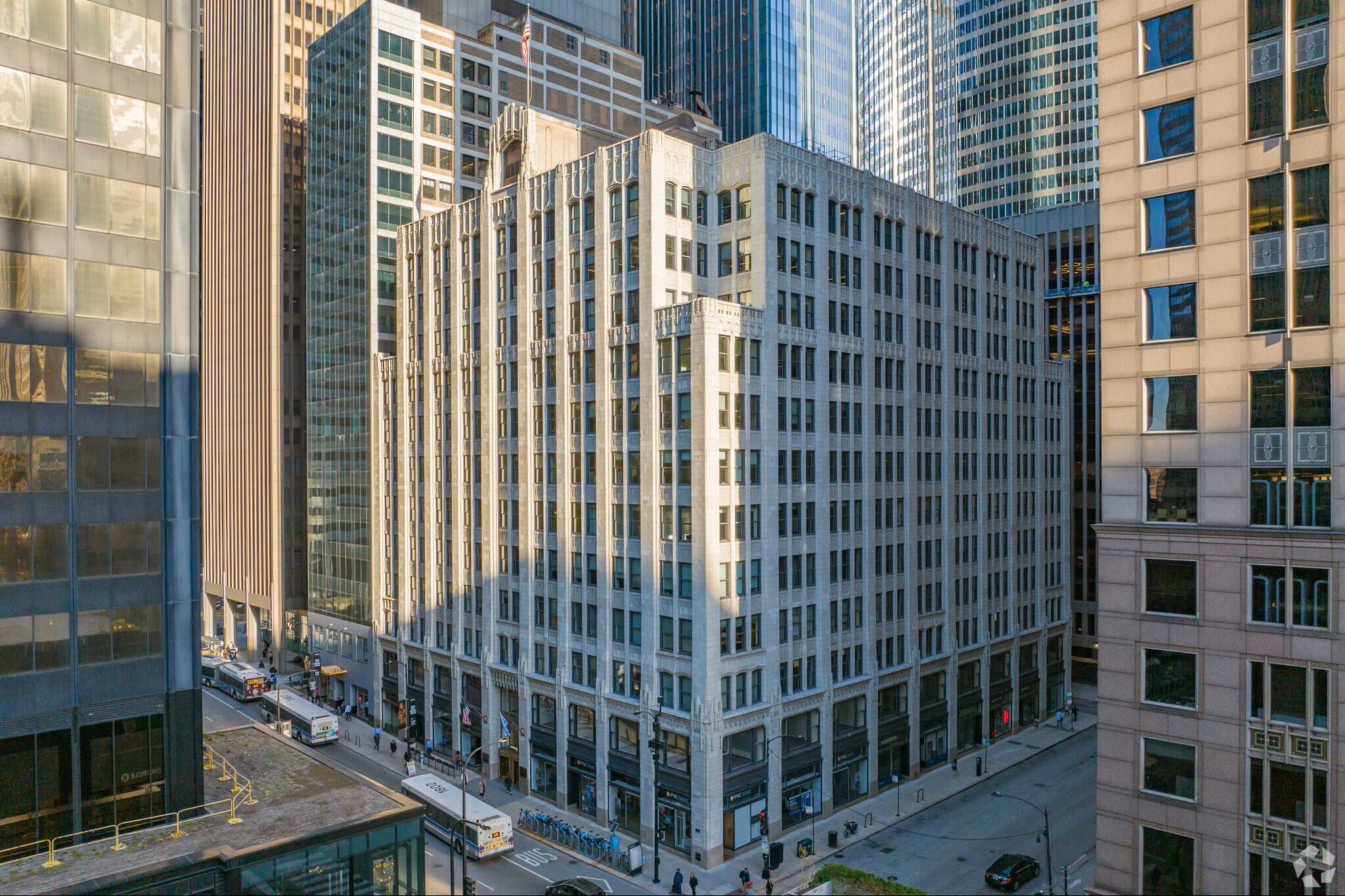

“The Permit Review Committee, a subcommittee of the Commission on Chicago Landmarks, has approved the adaptive reuse of a historic office building at 300 W. Adams into a data center. Planned by Chilled AI, the project would convert about half of the historic structure built in 1920 by architect Jens Jensen that stands at the northwestern corner of W. Adams St and S. Franklin St.
“Designed by C+K Architecture and ZPD+A, the proposed adaptive reuse would convert office space on floors two through six into a data center while floors seven and above would remain as office space. As part of the project, backup generators would be added onto the roof.
“On the ground floor, the building’s ground floor will remain largely the same, but three retail storefront bays will be eliminated to create a ComEd vault along S. Franklin St.
“The existing building has a center light court starting at level two and extending up to the sky. As part of the project, the light court will be filled in on floors three through five for the data center and a new cargo elevator will be added inside the light court up the entire height of the building.
“On the rooftop, a large new dunnage steel platform will allow for the installation of 10 backup generators. As part of exterior work for the project, terracotta repairs will be performed on the building facades as necessary.
“With Permit Review Committee approval secured, the project can proceed with the permitting process. The developer has already received a permit for interior demolition and is awaiting the issuance of renovation permits for the project. A timeline for the project has not been announced.” (Kugler, Urbanize Chicago, 8/26/26)
“Preservation Chicago was supportive of the building’s landmarking in 2009, which recognized the site as a symbol of the Loop’s transformation from industrial to office use.
“But allowing the data center conversion could set a ‘dangerous precedent’ that leads to other landmarked buildings being converted to industrial use, Ward Miller, executive director of Preservation Chicago, said in the meeting.
“He called for more creativity in how the office building finds its second life during a time when Chicago desperately needs more housing — especially affordable units.
“‘Preservation Chicago feels that a historic and Chicago landmark building should be adaptively used in other ways, specifically for residential reuse, and not for a conversion of a Loop office building across the street from the Sears Tower, in the heart of the financial district,’ Miller said.” (Miller, Chicago Sun-Times, 8/13/26)
“‘A historic and Chicago landmark building should be adaptively reused in other ways,’ Miller said during the meeting. ‘Specifically residential re-use and not for conversion of a Loop office building for an industrial use. We feel that’s really a dangerous precedent for (Chicago’s) other world-renowned buildings in the future. That really concerns us.’
“Gabal’s purchase price for the building in 2023 was a staggering 89% less than the property’s appraised value when it previously changed hands in 2012.
“The Gabal-led entity sold the property last month for $12.5 million to a new joint venture he formed with Greenwich, Conn.-based Strategic Value Partners, according to Illinois property records.” (Ecker, Crain’s Chicago Business, 8/7/26)
Preservation Chicago opposes the conversion of the lower floors of 300 W. Adams Street to a data center. The 300 West Adams Street Office Building was designed by architect Jens J. Jensen, completed in 1927, and designated a Chicago Landmark on May 13, 2009. A landmark office building in the heart of the Loop should be adaptively reused as residential, hotel, or another use that brings people downtown, not converted to an industrial use that brings servers.
The precedent is the concern. Chicago’s Loop holds one of the most significant concentrations of historic commercial architecture anywhere, and a great many of those buildings are underleased and searching for a next use. If the conversion at 300 W. Adams is approved, the same argument will be made for the next landmark, and the one after that. Downtown Chicago is at a decisive moment in determining what it becomes over the next generation, and the answer should be a downtown of residents, workers, students, and visitors.
The economics deserve a closer look. The ownership acquired this building for $4 million in December 2023 — roughly a tenth of what it last traded for — and sold it last month for $12.5 million. A building bought at ten cents on the dollar carries a very low basis, which is precisely the condition that makes an ambitious adaptive reuse affordable. Dozens of downtown office buildings are being converted to housing right now by owners who paid considerably more. It is difficult to accept that residential conversion cannot be made to work here when it is working across the Loop at higher acquisition costs.
Preservation Chicago supported the Chicago Landmark designation of 300 W. Adams Street in 2009, which recognized the building as a symbol of the Loop’s transformation from a clothes manufacturing wholesale district to office use”. It would be a poor outcome if that designation became the instrument by which the building returns to industrial use. We urge the full Commission on Chicago Landmarks to reject the data center conversion, and we encourage the ownership to revisit residential reuse.
Read the full story at Urbanize Chicago, the Chicago Sun-Times and Crain’s Chicago Business
- Landmarks approves data center redevelopment at 300 W. Adams; The historic office building would be partially converted into a data center, Lukas Kugler, Urbanize Chicago, 8/26/26
- Loop data center pitched for landmarked office building; A Chicago investor wants to add a data center to the lower floors of the building at 300 W. Adams St. — a move Preservation Chicago calls a “dangerous precedent” for landmarked buildings Downtown, Abby Miller, Chicago Sun-Times, 8/13/26
- Landmark Loop office building takes step toward data center conversion, Danny Ecker, Crain’s Chicago Business, 8/7/26
- Committee approves plan to convert part of landmark Loop office building into data center, ABC7 Chicago Digital Team, ABC7 Chicago, 8/7/26
- Landmark Loop office building takes step toward data center conversion, Danny Ecker, Crain’s Chicago Business, 8/7/26
- Editorial: Data centers occupying Loop landmark buildings is a bad idea; Whirring servers would mean a dystopian future for the Loop’s historic buildings, The Editorial Board, Chicago Tribune, 8/10/26
- Committee approves plan to convert part of landmark Loop office building into data center, ABC7 Chicago Digital Team, ABC7 Chicago, 8/7/26
- Chicago Office Tower Sells at Massive Discount, Spotlighting National Plunge in Prices; Investor Igor Gabal Pays $4 Million for Half-Vacant, 12-Story Building in Loop Business District, Ryan Ori, CoStar News, 1/5/24
- Distressed Chicago Office Tower Sells to Investor at Huge Discount, Connect CRE, 2023