



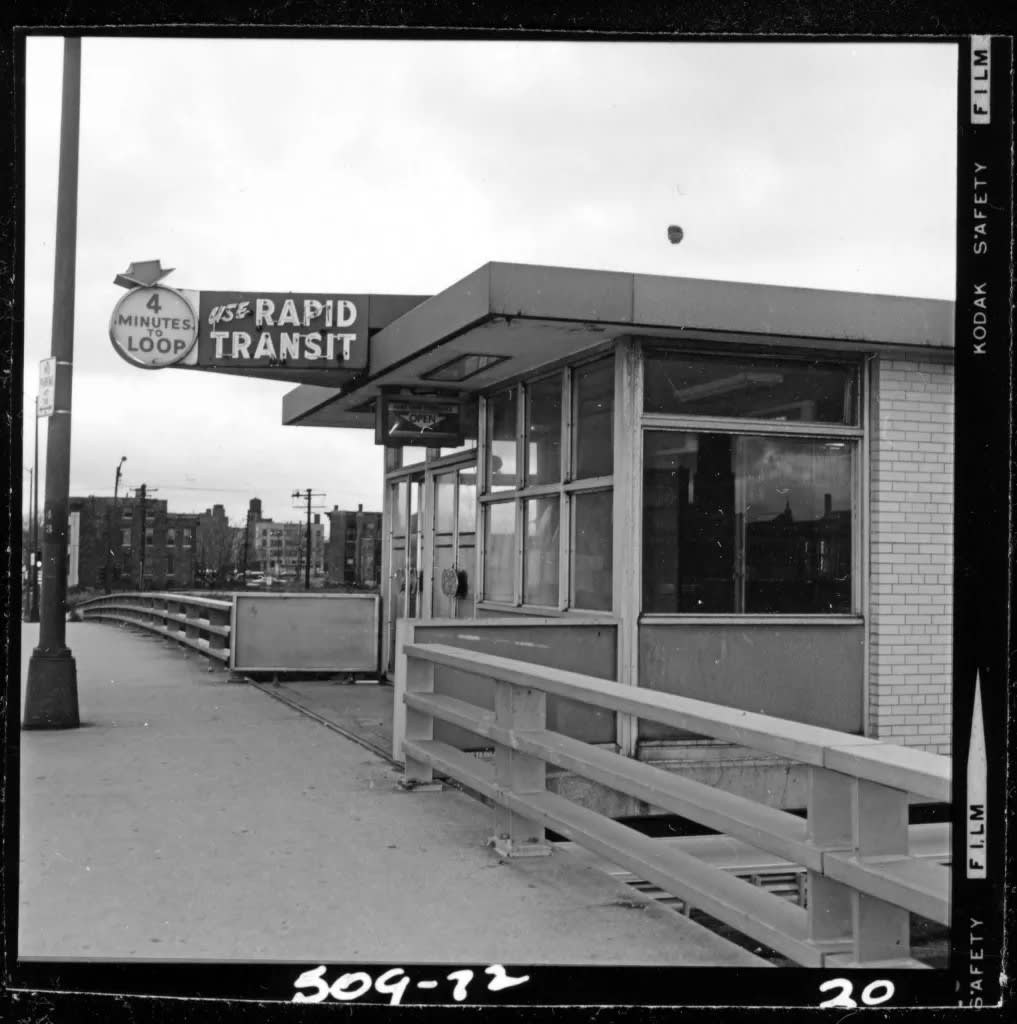
The CTA’s Racine stop in 1958 including neon sign. Photo credit: CTA
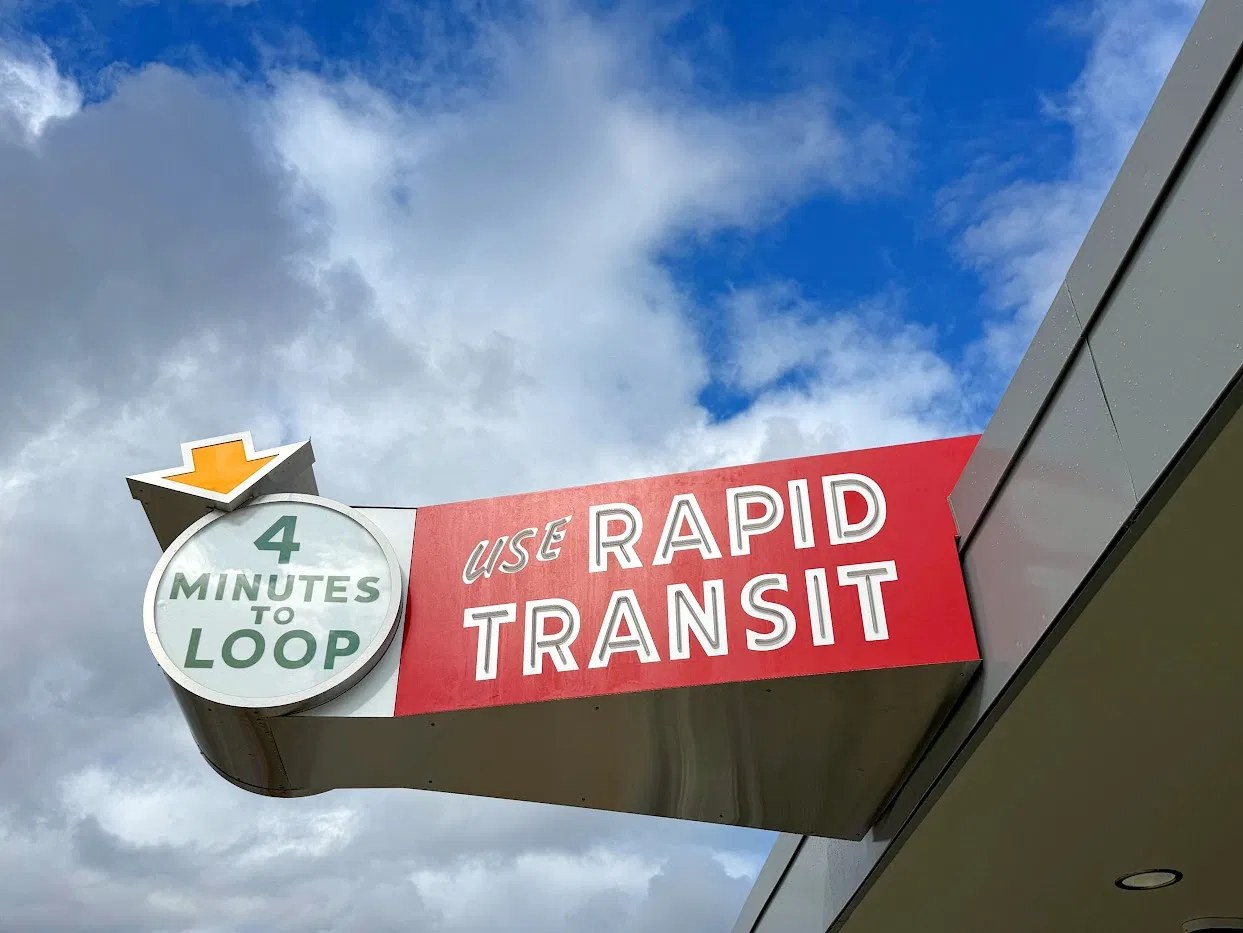
The new neon-style “Use Rapid Transit / 4 Minutes to Loop” marquee at the Loomis Street entrance of the CTA Racine Blue Line station, recalling the signage of the 1958 Congress Line. Photo credit: Cristen Brown
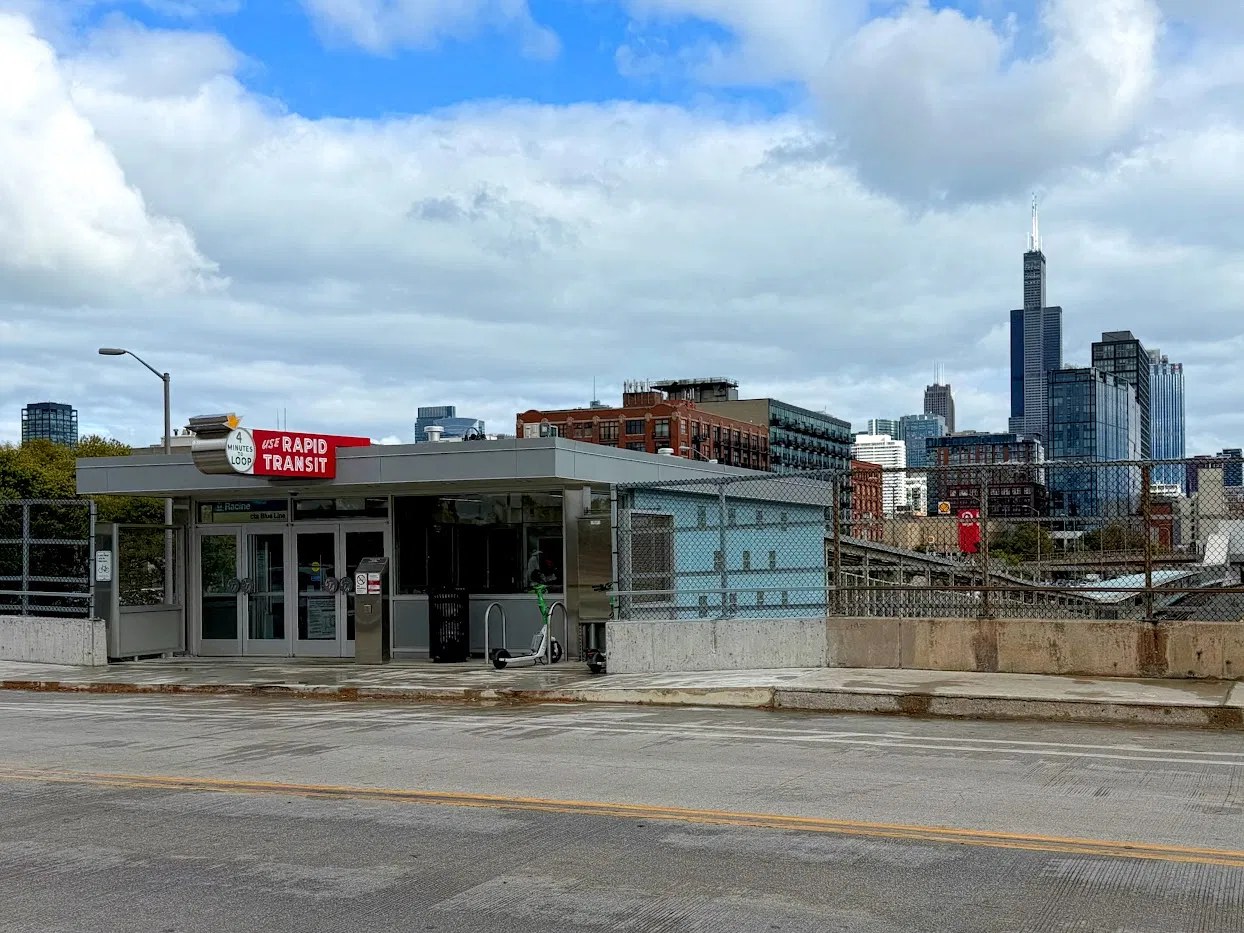
The Loomis Street entrance of the CTA Racine Blue Line station, with its new “Use Rapid Transit” marquee and the Loop skyline beyond. Photo credit: Cristen Brown
“The Racine Blue Line station’s Loomis Street entrance is glowing over the Eisenhower Expressway again, thanks to a new neon-style sign inspired by the station’s original mid-century modern aesthetic.
“After about a year of construction to modernize accessibility at the Near West Side stop’s auxiliary entrance, the Loomis access looks more retro than ever. The Racine station’s new marquee recreates the signage of the original Blue Line Forest Park Branch, then called the ‘Congress Line,’ which first moved Chicagoans in 1958. It uses LED tubing designed to look like neon to display messages like ‘4 Minutes To Loop’ and ‘Use Rapid Transit’ outside the entrance.
“‘This is the first time we’ve replicated a backlit, more elaborate sign like this,’ Chicago Transit Authority General Manager Graham Garfield said. ‘It gives the station a unique look and feel that people will recognize and take ownership of — “I use the 1950s station.”’
“In bringing the historic station to modern day, the CTA worked with the Illinois State Historic Preservation Office to assess any adverse effects to the landmark structure, in accordance with Section 106 of the National Historic Preservation Act. The state agency asked that the CTA reserve the Loomis Street entrance as an example of the ‘L’ system’s 1950s architectural and transit design, Garfield said.
“‘We’re proud of the whole Racine project,’ Garfield said. ‘We’re proud to continue making our system accessible and bring it up to modern, state-of-the-art standards while, in this case, we could add a little historic flourish to it. You kind of get the best of both worlds.’
“Garfield, who’s worked at the CTA for 26 years and also operates as its in-house historian, said the same ‘unfortunately’ happened with the original 1950s neon marquees at Blue Line stations. The CTA removed each of the signs by the 1980s as they began to fall into disrepair.
“But he said the CTA was committed to making the new sign at Loomis Street a near-exact replica of its original, with small allowances for modern technology and maintenance needs.
“The CTA worked with architectural and infrastructure design firm HNTB and provided the company’s engineers and architects with the construction plans for the station’s initial build in the 1950s. The CTA added to HNTB’s designs by finding matching colors and materials, and Garfield said he used extensive photo references to copy the playful, hand-painted-looking font.
“‘We wanted to give it the utmost attention to do it just right and to do it justice,’ Garfield said.
“The reopened station entrance features other nods to the 1958 station’s look. The authority recreated CTA-logo door handles at the entrance and restored the station house’s glass and aluminum front, which was typical of those built for the 1958 Congress Line. Garfield said the CTA maintained the entrance’s original brick exterior.
“The entryway also includes interpretive panels explaining the history of the Congress Line, the station’s design and the particular features the CTA preserved or recreated.
“It was also the golden age of American roadside architecture. Along highways such as Route 66, businesses competed for motorists’ attention with bold colors, distinctive shapes and glowing neon signs.
“The Congress Line used similar tactics. Its bright red signs and neon lettering gave the stations a distinctive presence along the expressway and made their entrances easier to identify from a distance.” (Quealy, Block Club Chicago, 10/5/26)
Preservation Chicago congratulates the Chicago Transit Authority, General Manager and CTA historian Graham Garfield, and HNTB on the restoration of the Loomis Street entrance. Working from the station’s original 1950s construction plans – then matching the colors and materials and copying the hand-painted lettering from photographs – is the right way to do this work, and the result shows it.
Credit is also due to the Illinois State Historic Preservation Office, whose Section 106 review asked the CTA to retain the Loomis Street entrance as an example of the “L” system’s 1950s architectural and transit design. When SHPO’s review makes a project better, that deserves recognition.
Preservation Chicago named the city’s historic neon and vintage signs to our 2015 Chicago 7 Most Endangered list, calling attention to the rapid loss of hand-crafted signage from commercial corridors across the city. We also supported the 2023 City Council ordinance protecting historic signs. Chicago has lost most of its great vintage signage, and the CTA removed the original Congress Line marquees by the 1980s. A sign brought back is rarer than a sign saved.
This project also answers a question that comes up whenever an accessibility upgrade meets a historic building. The CTA added an elevator, ramp and stairs, brought the station into compliance with the Americans with Disabilities Act, and recreated a 1958 marquee at the same time. Preservation Chicago encourages the CTA to extend this approach to the remaining Congress Line stations as the Forest Park Branch Rebuild continues.
Read the full story at Block Club Chicago
Neon Signs; a Preservation Chicago 2015 Chicago 7 Most Endangered, 3/4/15
Section 106 of the National Historic Preservation Act; U.S. General Services Administration
This Win Was Powered by Supporters Like You!
Spectacular wins like this are the result of years of dedicated advocacy. Your gift will fund the next one.
Preservation Chicago is a 501(c)(3) nonprofit. All donations are fully tax-deductible as permitted by law.
Get monthly updates on advocacy efforts in neighborhoods all across Chicago.
Preservation Chicago: From Impossible to Inevitable!