


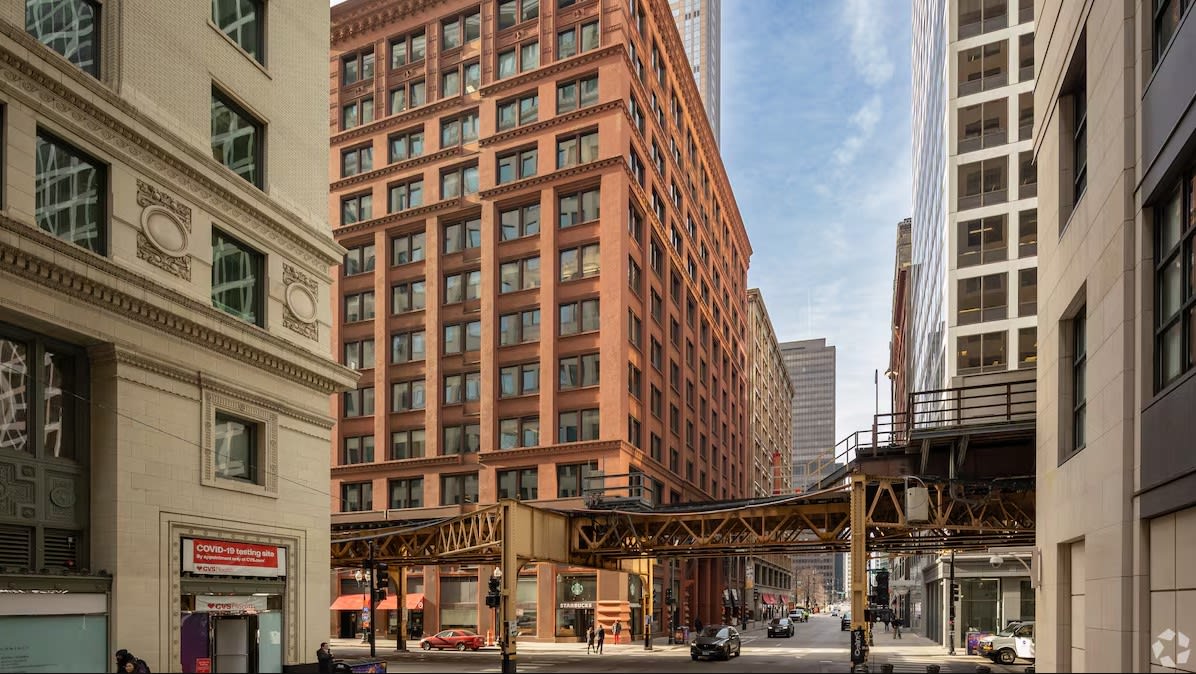

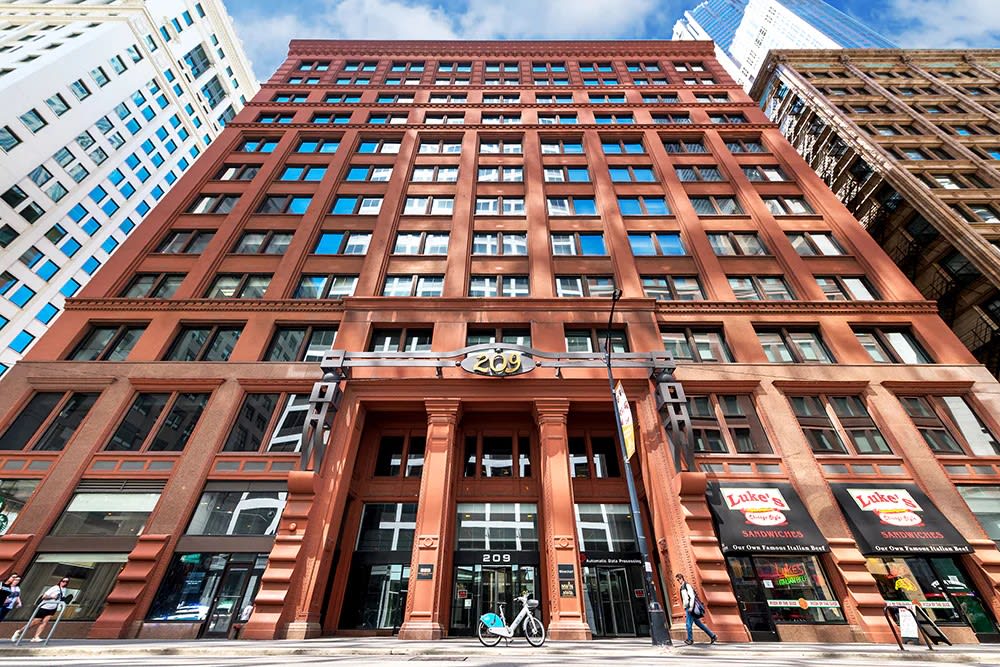
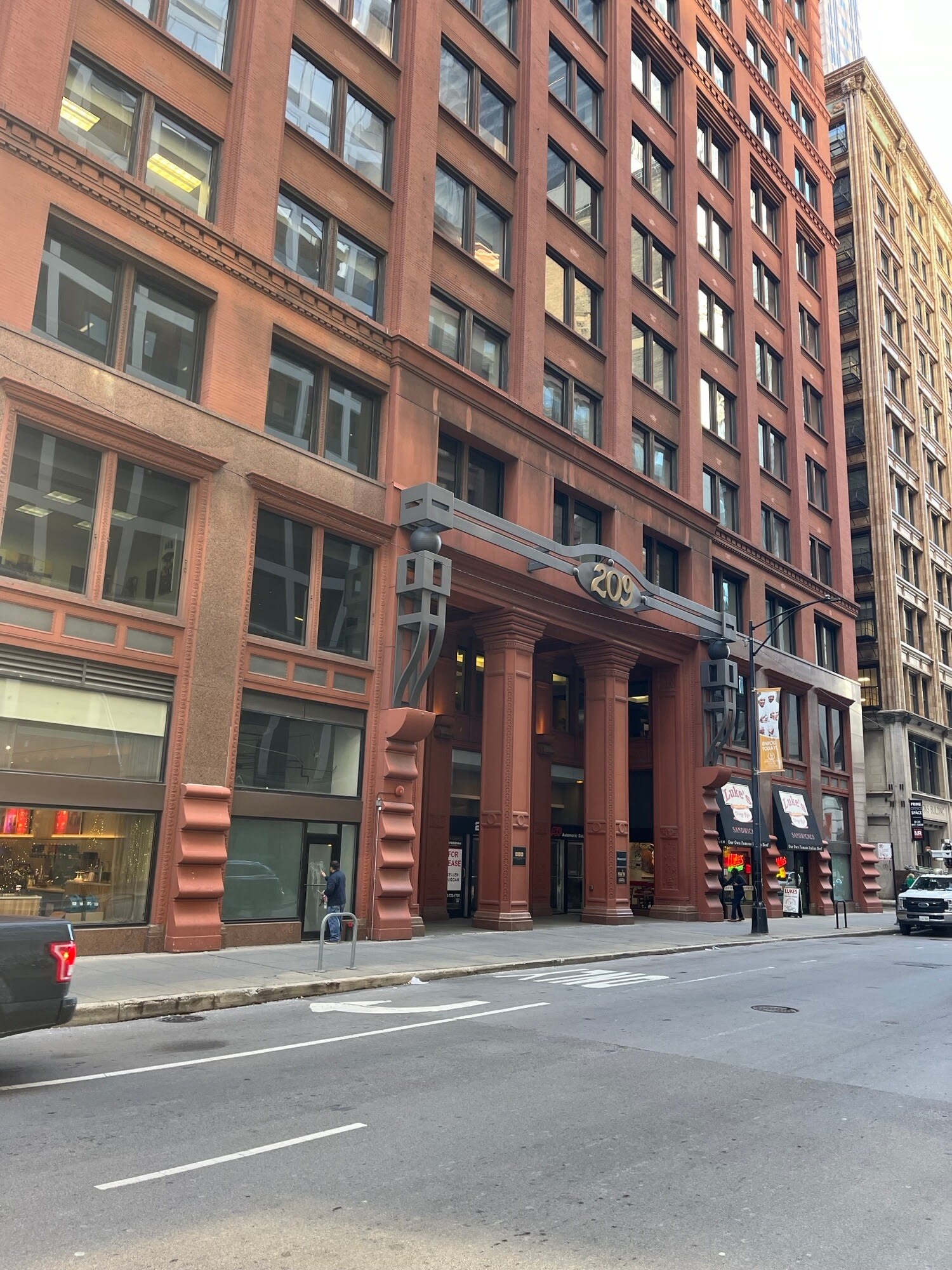
“Initial details have been revealed for the upcoming residential conversion of the existing office building at 209 West Jackson Boulevard in The Loop. Also known as the McKinlock Building, the structure sits on the corner with South Wells Street and has suffered a similar fate as many surrounding buildings, with low office occupancy rates post-pandemic.
“Built in 1898, the 12-story building has maintained its original office use since opening and has undergone a few renovations since its completion, most recently in 2019. Reaching 185 feet in height, the structure contains 143,000 square feet of office space, including ground-floor commercial space. However, these days it is roughly 30 percent leased.” (Achong, Chicago YIMBY, 6/11/26)
“A development team plans to turn a mostly vacant vintage Loop office building into about 180 apartments, adding a large-scale project to the wave of conversion proposals set to reshape downtown Chicago.
“Chicago-based Mavrek Development is poised to enter into a joint venture with Acres Capital for a project that would turn the 12-story property at 209 W. Jackson Blvd. into residences, Acres CEO Mark Fogel said.
“The plans add to the growing number of office-to-residential conversions in the pipeline in downtown Chicago amid the waning demand for workspace. Meanwhile, apartment rents are rising as challenges in the debt and equity markets over the past few years have made it harder to get shovels in the ground for bigger projects.
“‘We felt like it was a good opportunity in the Chicago market to create some value. The Chicago market has not seen a lot of multifamily deliveries in the past few years, so it’s a tight market, and we saw that the rental rates continue to increase dramatically every year,’ Fogel said.
“The project, which has estimated total development costs of about $90 million, is targeted for completion in early 2029. The financing structure will likely include federal historic preservation tax credits, similar to another Acres-Mavrek collaboration underway in the Loop at 65 E. Wacker Place. That 252-unit project is expected to welcome its first residents in August.
“While a slate of city-backed projects around the LaSalle Street corridor will bring hundreds of apartments to the financial district in the coming years, the conversions at 65 E. Wacker Place and 209 W. Jackson Blvd. are among the first privately-funded, large-scale conversions to emerge, along with the conversion of Salesforce’s former office at 111 W. Illinois St. Smaller conversion proposals have also popped up around downtown, including plans to turn the Pontiac Building in Printer’s Row into 74 apartments.” (Herzog, Crain’s Chicago Business, 6/1/26)
The building at 209 West Jackson Boulevard was initially constructed in 1893-1894 by W. W. Cole (William Washington Cole), the “circus man” and founder of W. W. Cole’s New Colossal Shows circus in 1884 (the company that later became Cole Bros. Circus after ownership changed hands around 1900). The architect was H. B. Seely, who also designed the F. P. Owings Building (demolished in 1940). Cole leased the building to Wilson Brothers, a shirt company founded in Chicago in 1864.
The construction of the building used the up-to-date skeleton frame typical of the period and was of steel, terra cotta, glass and fire proof materials, after the model made familiar to Chicagoans by successful examples such as the Home Insurance Building and the Monadnock Building.
The building was occupied for mercantile purposes until George A. McKinlock purchased it in the 1910s and converted it to offices. Charles Sumner Frost (1856-1931) was the architect. Two stories were added on top during the modification, circa 1917-1918.
George A. McKinlock Sr. (1857-1936) was a prominent businessman who ran the Central Electric Company. He was born in Oswego, NY, the son of John and Margaret McCormick McKinlock, received his education in the public schools there and then entered business. In 1877 he became business manager of the American District Telegraph company in Detroit. He moved to Chicago in 1887, organizing the Central Electric company and becoming its head.
McKinlock was also the holder of considerable loop real estate, including the McKinlock Building at 209 West Jackson Boulevard. In 1890, three years after coming to Chicago, Mr. McKinlock married Marion Wallace Rappelye. They had one son, George Alexander McKinlock Jr. (1893-1918). Alexander attended Harvard and graduated in 1916. Upon the United States’ entry into WWI, Alexander enlisted and was assigned to duty as a brigade intelligence officer in the First Division of the U.S. Army. He was a 1st Lieutenant and awarded the Distinguished Service Cross for extraordinary bravery in operations before he was killed in action by a German sniper in France in July 1918, just as he was making a reconnaissance in the Soissons sector.
Mr. and Mrs. McKinlock were determined to erect a memorial to their son. In 1921, they pledged $250,000 to purchase nine acres of land at Chicago Avenue and Lake Shore Drive, donating it to Northwestern University for its downtown campus, which was named the “Alexander McKinlock Memorial Campus.” Mr. McKinlock later added to his gifts, pledging $500,000 to Northwestern and giving $500,000 to Harvard University for a dormitory in honor of his son, the McKinlock Hall.
After McKinlock Sr.’s death in 1937, his wife, Marion W. McKinlock, modernized the McKinlock Building again, including an entirely new entrance on Jackson Boulevard, extensive use of glass brick and aluminum, and new show windows, as well as some interior improvements. The architect was Melville Clarke Chatten (1873-1957). In 1936, the New England Mutual Life Insurance company foreclosed a $650,000 mortgage and Carroll Sudler was appointed receiver. Title went to the insurance company in 1939.
Read the full story at Crain’s Chicago Business and Chicago YIMBY
Details Revealed For 209 West Jackson Street In The Loop, Ian Achong, Chicago YIMBY, 6/11/26