


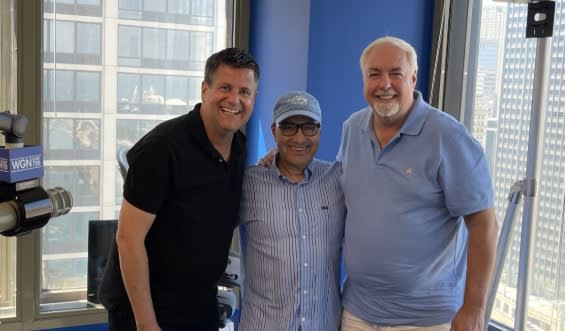

“Preservation Chicago is an advocacy organization. It’s a nonprofit that encourages the preservation of historic buildings, and we’re not looking at every historic building. We’re looking at the ones that are most important, that tell a story, that are cornerstones of our community, buildings that are well-published, well-known throughout the world, as Chicago is America’s city of architecture. We work with 77 communities around the city just inside the city limits, and oftentimes we work with Warren and Friedman Properties, and we have a good time doing it.” (Ward Miller)
“Ward’s really out there on the front lines giving these buildings a voice that don’t have a voice, and there’s so many beautiful endangered buildings in our city. You look out the windows even of this studio and you see the mix of architecture. There’s many great things that make Chicago a wonderful place to live, but no doubt architecture plays a critical role in that.” (Warren Strovel)
Asked how many buildings Preservation Chicago has saved:
“Thousands. Thousands between landmark districts and individual landmarks across the city. When you see a landmark district that’s got 300 buildings in it, plus — you get a couple of those, and you’re easily in your thousand mark.” (Ward Miller)
On the Chicago Loop Synagogue and Chicago’s closing houses of worship:
“We see a lot of these houses of worship closing, unfortunately, or consolidating, and that leaves a lot of buildings available. So we’re out there trying to get them landmarked, find other uses for them, something that gives back to the community. But with the Loop Synagogue specifically, you’re looking at a building from the 1950s in the heart of the Loop which is having some struggles. I think they’re committed now to staying downtown because of LaSalle Street and the central Loop being transformed from office to residential or from office to hotels, re-visioning these historic buildings. And in the process we’re getting many of them landmarked. But Loop Synagogue we hope will be with us for a long time to come.” (Ward Miller)
“This is why we’re out there and we reach out to everybody and talk to everybody we can, from aldermen all the way down to community spark plugs, as we like to call them. People that are really interested and have time to work with us, and then we try to work this through the city. And ideally, a Chicago landmark designation is a way of preserving buildings in perpetuity, and we like to go towards that direction, because there’s been a few times where we’ve had to save buildings several times.” (Ward Miller)
On the Church of the Epiphany at Ashland and Adams, now Epiphany Center for the Arts:
“We were trying to save it and landmark it as an Episcopal church, which is what we did, just recognizing its architecture and history. Now it’s Epiphany Center for the Arts, which is an amazing venue. And it still gives back to the community, so that’s really important too. These buildings, we want them to be the hardest working buildings in our city. Our landmarks have to be something for everybody. We really push that.” (Ward Miller)
On Friedman Properties:
“We’ve been around for 55 years. The majority of our portfolio of almost 60 properties are historic properties, many of which were endangered, and that’s how we’ve gotten to know Ward and work together on many different projects over the years.” (Warren Strovel)
“The visions actually occur very quickly, and you have a lot of great ideas. It’s really getting them to pencil out — that’s always really the challenge, finding out how you can make them economically viable. I think that’s always a challenge and why some of them sit and deteriorate around the city and become endangered, because people struggle with that. We consider ourselves stewards of these buildings. We look at it as preserving for future generations of Chicago.” (Warren Strovel)
On Medinah Temple and Tree Studios:
“I’m not originally from Chicago. I came here 15 years ago. I fell in love with the city, and I remember on that first visit to the city seeing Tree Studios and Medinah Temple, the block right there, home of the Bally’s temporary casino. I knew nothing about Friedman Properties. I didn’t have an interest in moving to Chicago. But I just remember how captivated I was with the architecture and the history of that block. The Moorish architecture of Medinah Temple — that building was originally developed by the Shriners as an auditorium. It’s just so uniquely different, and so special in that neighborhood. And to see a relic like that preserved in the heart of our urban environment, I just remember it always sticking with me.” (Warren Strovel)
On the Chicago Daily News Building mural:
“There was this great Art Deco, Art Moderne building on the river, connects the river with Ogilvie Station, formerly Northwestern Station, and it had this beautiful 1930 mural on the ceiling by John Warner Norton. It was 180 feet long, and it was gathering, printing, and distributing the news. And it had airplanes and typewriters and people and reporters and all sorts of things on the ceiling, and it was removed by the former owner 33 years ago and disappeared.” (Ward Miller)
“We knew the building was transferring ownership, and we knew this mural was in storage somewhere. And all these sort of art places and storage places sort of trade spots, if you will, and one of them was folding, and the building was also transferring ownership, and we wanted to make sure that mural transferred with the ownership. We didn’t want an issue like the Calder at the Sears Tower — a piece of public art that, by the way, should be back on display. That was another one of our Chicago 7 Most Endangered a number of years ago and still remains so.
“So we found this mural, which has been moved five times. It’s at Mana Contemporary Chicago. It’s in 19 big panels. It was taken off the ceiling in a kind of not-so-conservation-friendly way, shall we say. And it’s about a $3.5 million project to put it up. Now, we’ve got the whole building landmarked, including the riverfront space, all elevations, all these interior spaces, and if we can get the mural back in, we can add it as an addendum to the landmark designation. We need to do this.” (Ward Miller)
On buildings coming down that should have been landmarked:
“None of us are out to save every old building in Chicago. We’re looking for the ones that have an interesting story, architectural history, so many qualities that could maybe be landmarked. But we are seeing a lot of buildings that are coming down that should have been landmarked or should have been considered, and really, the city needs to put more dollars towards more landmark researchers at City Hall. They do a fabulous job. They are the best team out there, no doubt. But we need more of them. There’s only a handful of them that do all these landmark reports, and we often try to help wherever we can.” (Ward Miller)
“Chicago’s skyline is an incredible canvas. A lot of architects from around the world want to leave their mark, and it’s important that we preserve the buildings that made Chicago, while you still see these modern masterpieces rising from the city.” (Warren Strovel) (Lyle, WGN Radio, 7/12/26)