


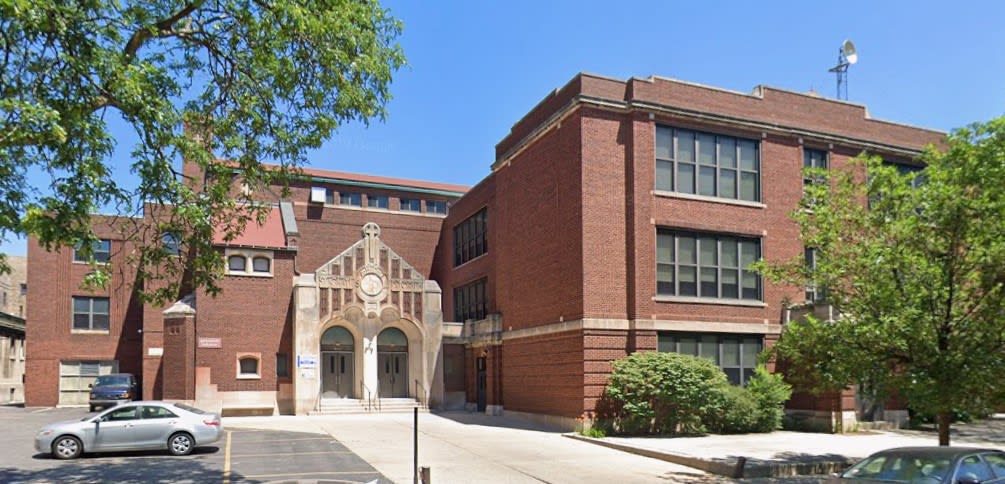

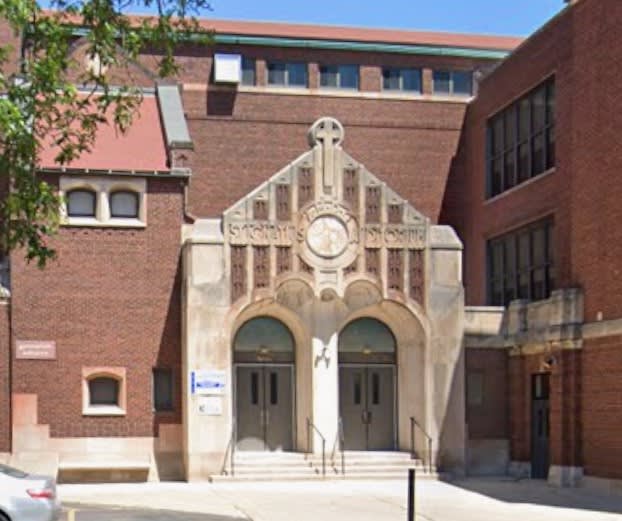
“Loyola University Chicago and the Ignatian Mission Center are proposing a redevelopment of the St. Ignatius campus that would include housing for over 200 students and a social services center. The campus includes a church and rectory that have been empty since 2021, after the Archdiocese of Chicago announced it would merge with nearby parishes, and a school building that has been vacant for nearly 10 years.
“The Ignatian Mission Center, a layperson-led Catholic nonprofit, is proposing to turn the church and rectory part of the campus into a center with a shelter for Spanish-speaking women facing domestic violence, a day care for the children of the women at the shelter and potentially neighborhood kids, a space for religious gatherings and the group’s food pantry.
“Loyola is proposing to demolish the adjacent school and construct a 64-unit building that would house upperclassmen and graduate students who typically live off campus, which could free up more of the neighborhood’s privately owned apartments that are rented by students, university officials have said.
“Loyola explored the possibility of reusing the school buildings rather than demolishing them, but the university couldn’t make converting existing buildings into housing economically feasible, said Kana Henning, Loyola’s vice president for facilities and campus management.
“Loyola would need a zoning change and a special use permit to build its five-story student housing building, while the Ignatian Mission Center would also need a special use permit to operate the women’s shelter and other social services on the campus.
“Ald. Maria Hadden (49th), whose ward includes the shuttered St. Ignatius campus site, will be accepting feedback from neighbors on the proposal for about two weeks, she said Monday.
“Hadden said Monday she shares some neighbors’ frustrations over how Loyola has handled recent acquisition of properties in the direct vicinity — specifically its purchase and demolition of 1226-1234 W. Loyola Ave., which housed small businesses and affordable apartments — but this is the only solid plan for the empty campus that has been brought to her office.
“‘As your alderperson, I want to save this church, and I think this is a proposal worth hearing,’ she said to the large crowd of neighbors Monday night.
“‘I don’t see a way forward for us without this Loyola plan,’ [Ignatian Mission Center executive director Liam] Ford said. ‘This would be a great way for the parish’s legacy to live on in a new organization.’
“St. Ignatius was formed by the local Jesuit order, which bought the lakeshore land bounded by Devon Avenue, Sheridan Road and Pratt Boulevard in 1906. That same year, Jesuits began work on the first St. Ignatius Church, which opened in 1907 at 6435 N. Sheridan Road, according to the Rogers Park West Ridge Historical Society.
“To make way for the university, St. Ignatius Church moved from its lakeshore space to Glenwood Avenue in 1917, inhabiting a classical Roman church that has protections against demolition or significant alterations under the city’s historical survey.
“In 1993, St. Ignatius grammar school closed and merged with Northside Catholic Academy. The school building was then used by Waldorf School, which moved to Andersonville in 2018.” (Savedra, Block Club Chicago, 7/21/26)
Preservation Chicago welcomes the proposed reuse of St. Ignatius Church and rectory by the Ignatian Mission Center. Finding a new steward for a closed Catholic church is difficult, and a shelter for Spanish-speaking women facing domestic violence, a day care, and a food pantry represent exactly the kind of continued community service that keeps a religious building meaningful after the parish has closed. The church is included in the Chicago Historic Resources Survey, and its retention is a good outcome.
We have serious concerns about the proposed demolition of the school buildings. The original school was completed in 1915, and incredibly, the gymnasium and auditorium, built in 1931, were designed by Andrew Rebori.
Andrew Rebori (1886–1966) is among the most accomplished and distinctive Chicago architects of the twentieth century. His work includes the Fisher Studio Houses on State Parkway, a Chicago Landmark; the Racquet Club of Chicago on Dearborn Parkway; the Roanoke Building at LaSalle and Madison; the LaSalle-Wacker Building; the Elizabeth Arden Building at 70 E. Walton; the Fine Arts Building Annex; the 1325 N. Astor cooperative; and the Florsheim House. He was also among the architects who shaped the West Burton Place Chicago Landmark District, working alongside Sol Kogen and Edgar Miller. Rebori moved fluidly between Beaux-Arts classicism, Art Deco, and streamlined modernism, and he brought an artist’s sensibility to every commission.
Two of Rebori’s finest buildings stand on Loyola University’s own Lake Shore Campus: the Madonna della Strada Chapel, a designated Chicago Landmark and the signature building of the university’s lakefront, and the Cudahy Memorial Library. Loyola is the steward of two significant Rebori works, yet the same institution plans to demolish a extraordinary Andrew Rebori designed auditorium.
The former St. Ignatius school is also a strong candidate for residential reuse. There are many examples in Chicago of school buildings converted successfully to housing, and student housing is among the easiest uses to accommodate in a former school: the floor plates, corridor plans, window rhythms, and generous ceiling heights translate readily to apartments. An auditorium and gymnasium of this quality offer exactly the kind of amenity space a residence hall needs.
The auditorium in particular would be a perfect venue for academic lectures and performing arts such as live music or dance — an amenity for Loyola students and for the Rogers Park community alike.
Loyola states that reuse is not economically feasible. That conclusion deserves scrutiny. It is almost always simpler to clear a site and start over, and simpler is not the same as infeasible. The feasibility analysis behind this claim should be shared publicly so that it can be evaluated by neighbors, the alderman, and the City.
This is a familiar pattern among universities: buy adjacent property, demolish it, let the vacant lot sit for years, and then propose a large new development — arguing at that point that anything is better than a vacant lot. Loyola recently demolished the building at 1226-1234 W. Loyola Avenue, displacing long-term residents and local retailers, and that site will likely remain vacant for years until the university is ready to build.
Universities can choose to embrace the existing architecture and character of the neighborhoods they occupy, and we encourage Loyola to do so here. Adaptive reuse projects are almost always more interesting than new construction. People love unique character, and a converted school offers something a new five-story building cannot. Loyola would end up with a more distinctive residence hall and a stronger relationship with Rogers Park.
Preservation Chicago urges Loyola University to commission and publish an independent adaptive reuse study for the St. Ignatius school buildings, and to explore whether a combination of rehabilitation and new construction on the site could deliver the student housing the university needs while retaining the Rebori gymnasium and auditorium. We urge Ald. Maria Hadden, the Committee on Zoning, and the City Council to require that analysis before approving the zoning change and special use permit this project requires.
The campus as a whole — church, rectory, and school — tells the story of the Jesuit presence that brought Loyola University to Rogers Park in the first place. We would like to see that story preserved intact.
Read the full story at Block Club Chicago
FEEDBACK FORM: St. Ignatius Campus Development