



“What strikes me most about the first generation of Jewish architects in Chicago is how seamlessly they moved between the commercial skyline and the communal institutions of their own community — not two separate careers, but one.
“The same thread runs through the Chicago Loop Synagogue at 16 South Clark, designed in 1957 by the firm of Loebl, Schlossman and Bennett — with Richard Bennett as lead architect — for a congregation founded in 1929 to serve Jewish professionals working in the Loop. Jerrold Loebl and Norman Schlossman were both Armour graduates, sons of Hungarian and German Jewish immigrants respectively, and the commission reflects the pattern the tour traces throughout: the same architects building the commercial skyline and the communal institutions of Jewish life, often in the same career.
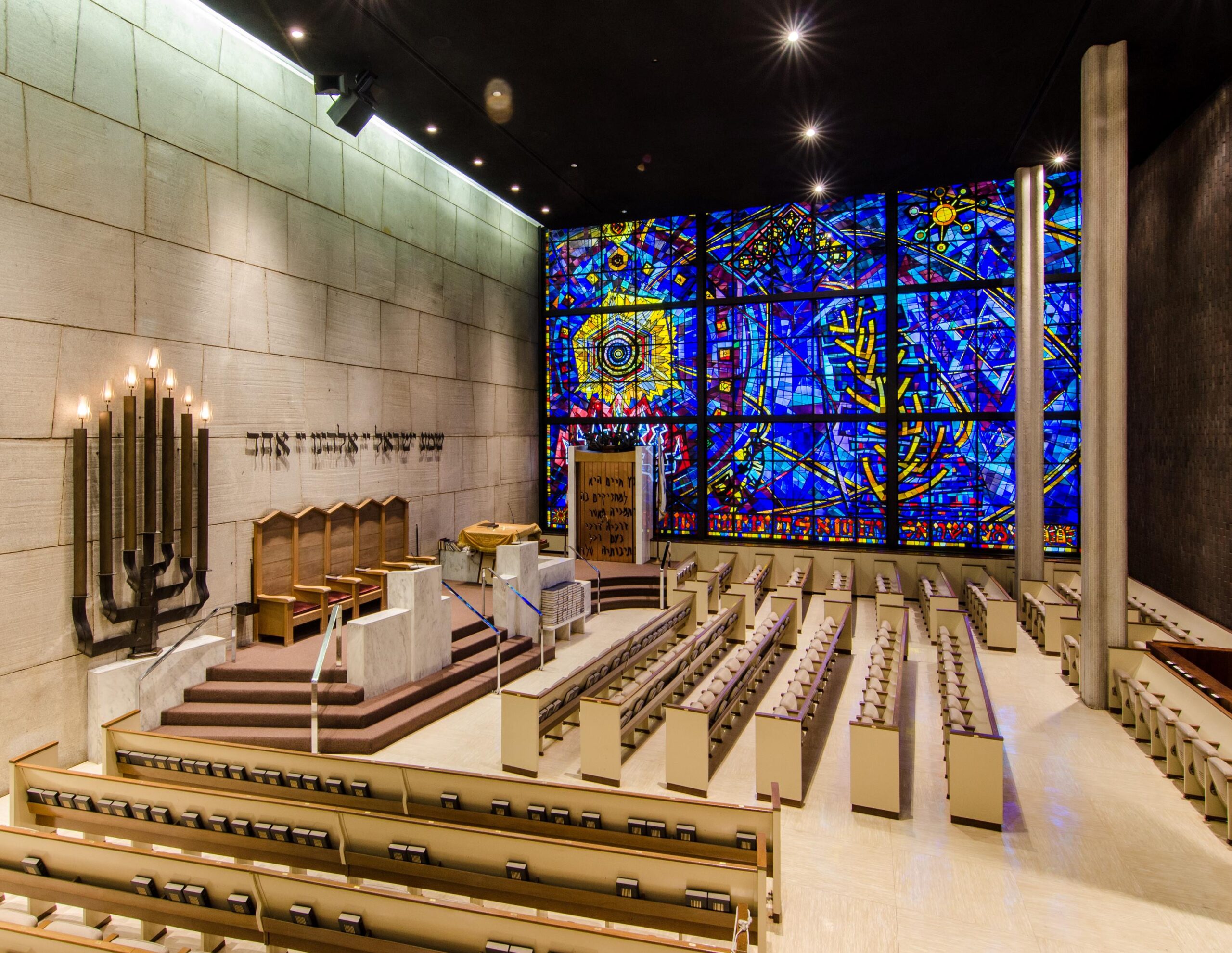
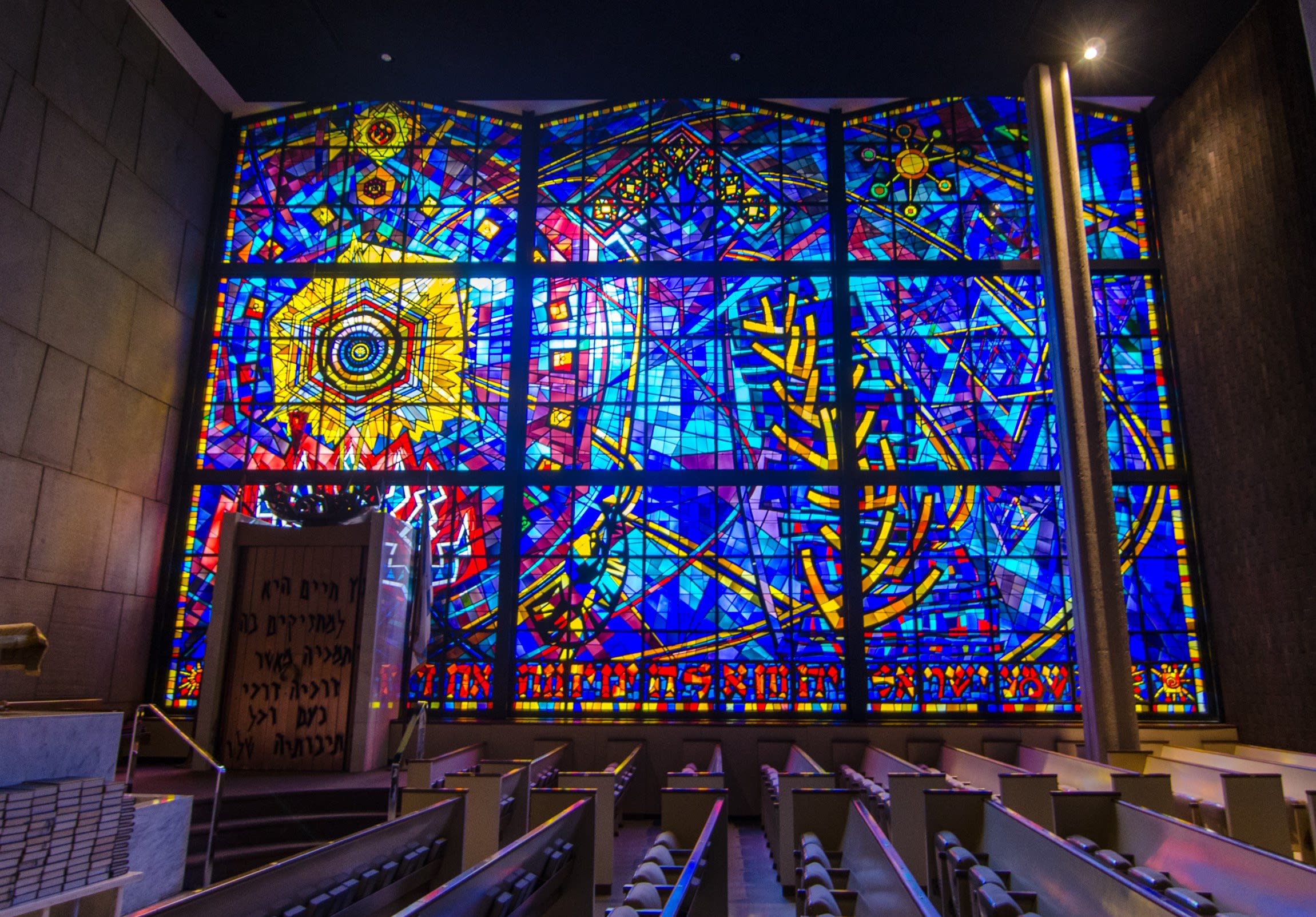
“Inside the main sanctuary, the east wall holds Let There Be Light, a stained glass composition by American artist Abraham Rattner — three years in the making in a Paris studio, its ancient Hebraic symbols, Tree of Life, Menorah, and Star of David, rendered in luminous color and installed personally by the artist before the High Holy Days of 1960. In 2026, Preservation Chicago named the Loop Synagogue one of the city’s most endangered buildings. The same people who built Chicago’s commercial skyline built this. It deserves to survive.”
A skyline is not just a collection of buildings. It is a collection of stories — the people who imagined them, engineered them, and built them, each one a chapter in the larger story of a city and a community. Chicago’s skyline is one of the most celebrated in the world. Look closely and you will find Jewish stories hiding in plain sight, in the facades and foundations of buildings you may have passed a hundred times without knowing what was there.” (Spiegel, The Times of Israel, 7/20/26)
The Chicago Loop Synagogue holds a special place in the Jewish community. For almost 100 years, it’s where the faithful went to worship downtown, but now the temple is navigating its way through a difficult time, with declining attendance and a broken boiler. Nonetheless, the synagogue’s top official is optimistic about its future.
“The synagogue at 16 S. Clark St. has an enormous 30-foot by 40-foot stained-glass window that was manufactured in Paris.
“‘It’s considered just a magnificent work of art. It’s one of the largest pieces of religious stained glass in the country, if not the world, and the reason is because it’s a single image,’ said Chicago Loop Synagogue president Lee Zoldan.
“‘We were founded in 1929,’ Zoldan said. ‘It says in our charter to be a place for people to say kaddish — which is prayers for their departed relatives — when they were downtown working.’
“Earlier this year, Preservation Chicago included the synagogue on its annual ‘Most Endangered Buildings’ list, citing its declining attendance and broken boiler. But Zoldan is glad to be on the most endangered list.
“‘We got the attention of people who care about preserving architecture in Chicago, and preserving buildings that are worth our history,’ she said. Despite the challenges facing the synagogue, Zoldan is hopeful, pointing to more residential housing coming to the downtown area, which could help the synagogue’s membership. ‘I believe that our best days are still ahead of us,’ she said.” (Kozlov and Spector, CBS Chicago, 5/11/26)
The Chicago Loop Synagogue is a Preservation Chicago 2026 Chicago 7 Most Endangered. We’re amplifying the uncertain future of this significant midcentury religious building to mobilize the stakeholder support necessary to revitalize and reactivate it.
Organized in 1929 by attorney Maurice J. Nathanson, the Chicago Loop Synagogue was the first businessmen’s synagogue in the world, established to serve commuters seeking kosher food and a place to pray during the workday. It remains the only Loop venue offering both. The congregation grew from roughly 1,000 members in the 1930s to some 8,000 in the 1950s. After a fire destroyed the earlier building on the site in 1953, the congregation commissioned Loebl, Schlossman & Bennett — the leading Chicago Jewish architects of Modernism — to design the current three-story building, completed in 1957. It is among the last buildings constructed in the Loop as a dedicated house of worship, and it appears in Chicago’s Famous Buildings as one of the city’s architectural gems.
Two works of art make the building extraordinary. Abraham Rattner’s Let There Be Light, the colossal stained-glass window on the sanctuary’s east wall, took three years to complete. Rattner studied the Old Testament, Jewish symbolism, and theosophy before arriving at the composition, fabricated it at Atelier Barillet in Paris, and personally supervised its installation daily to ensure completion before the High Holy Days of 1960. One critic called the result perhaps the most beautiful synagogue interior in the United States.
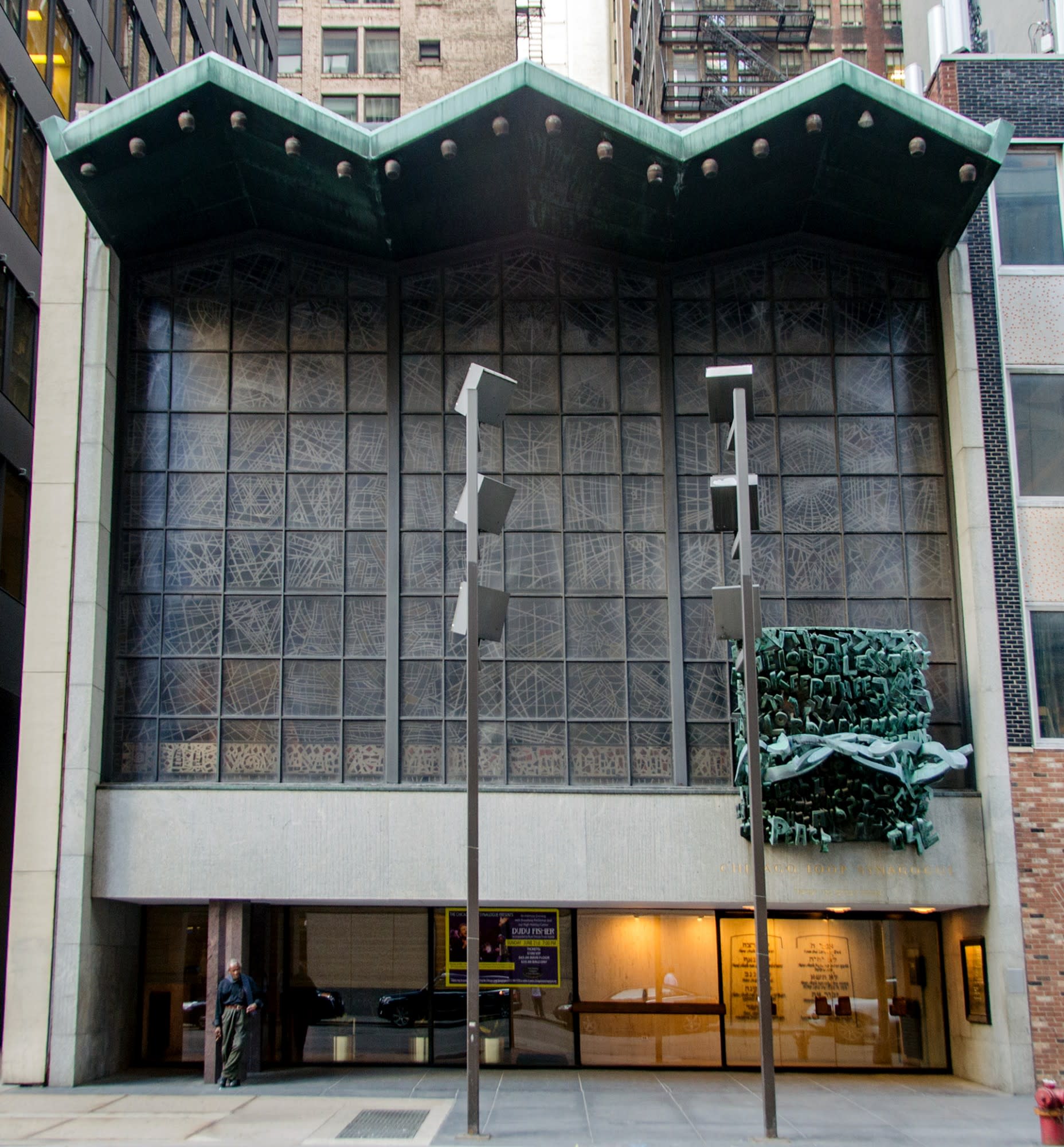
Above the Clark Street entrance is Hands of Peace, a 1963 bronze by the Israeli sculptor Nehemia Henri Azaz, a gift of the family of Chicago philanthropist Henry Crown, depicting the outstretched hands of the priestly benediction against scripture rendered in English and Hebrew. Azaz also designed the Ark within the sanctuary.
The challenges facing the congregation are familiar. A shrinking congregation is trying to support a midcentury building with deferred maintenance. The boiler needs replacement and membership has fallen from roughly 1,500 in the early 1990s to about 400 following the pandemic.
Preservation Chicago urges the philanthropic community, the Jewish community, and preservation funders to support the Chicago Loop Synagogue with the capital needed to reactivate its building systems. We encourage the congregation to pursue Chicago Landmark designation, which could open access to restoration funding and permanently protect this significant midcentury building. And we encourage Chicagoans to visit — the Rattner window is a world-class work of art in a building most people walk past without realizing the beauty within.
Read the full story at CBS Chicago and The Times of Israel
Chicago’s Jewish History Is Hiding in Plain Sight, Dan Spiegel, The Times of Israel, 7/20/26
Chicago Loop Synagogue; a Preservation Chicago 2026 Chicago 7 Most Endangered