
PDF Download: Preservation Chicago’s 2021 Chicago 7 Most Endangered Booklet
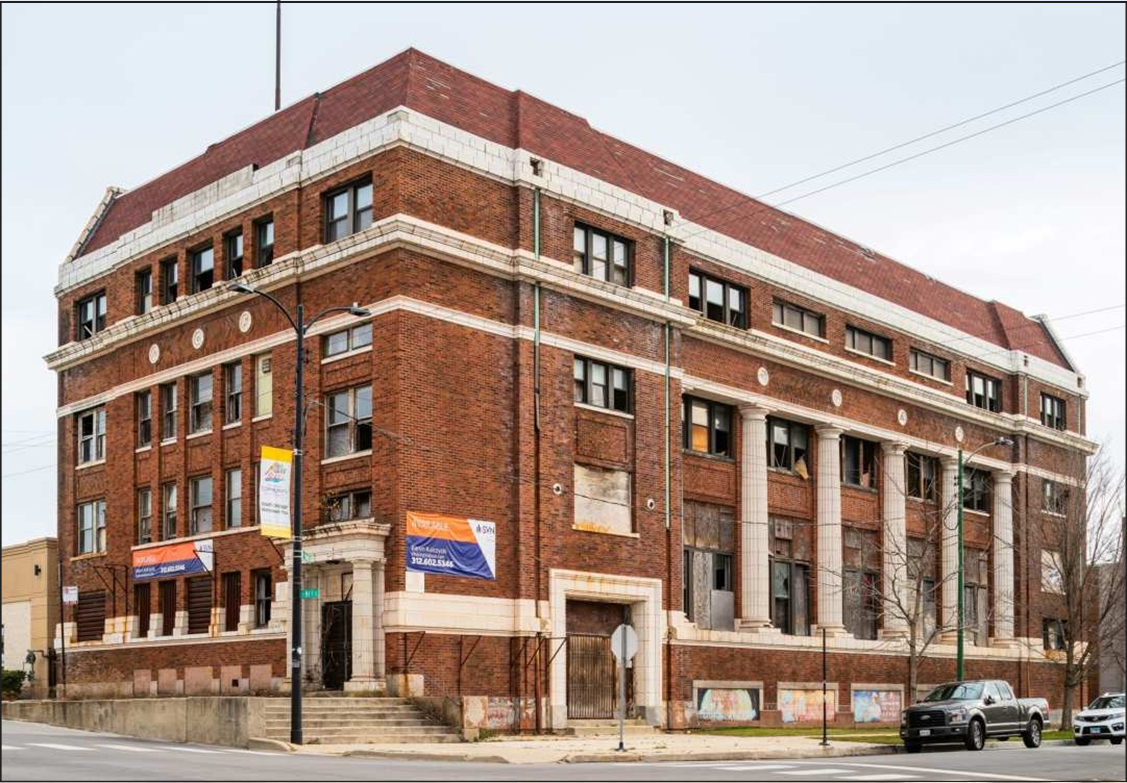
South Chicago Masonic Temple
Address: 2939 E. 91st Street
Architect: Clarence Hatzfeld
Date: 1916
Style: Classical Revival
Neighborhood: South Chicago
OVERVIEW
A grand Masonic Temple designed by Clarence Hatzfeld is at risk for emergency demolition. In 2018, the South Side Masonic Temple at 6400 S. Green Street in Englewood designed by Hatzfeld was demolished.
Despite decades of vacancy, the building on the southeast corner of 91st and Exchange remains extraordinary and worth exploration for adaptive reuse potential. With $26 million being invested in the former South Chicago YMCA just two blocks east, this is a great opportunity to further spur redevelopment with a plan to restore the South Chicago Masonic Temple.
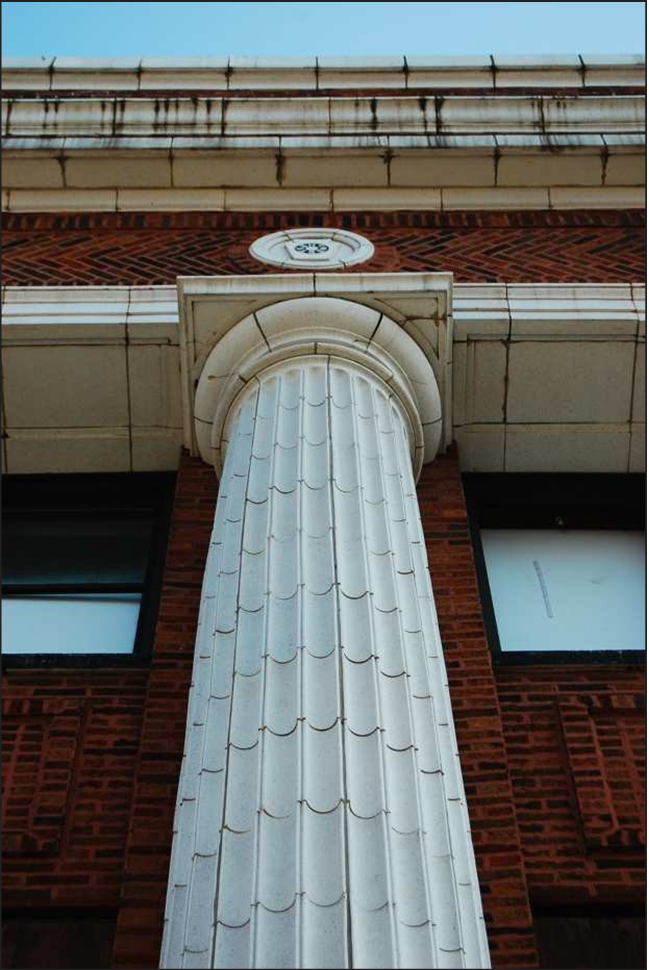
The Classical Revival building was designed in 1916 by noted Chicago architect Clarence Hatzfeld. A prolific
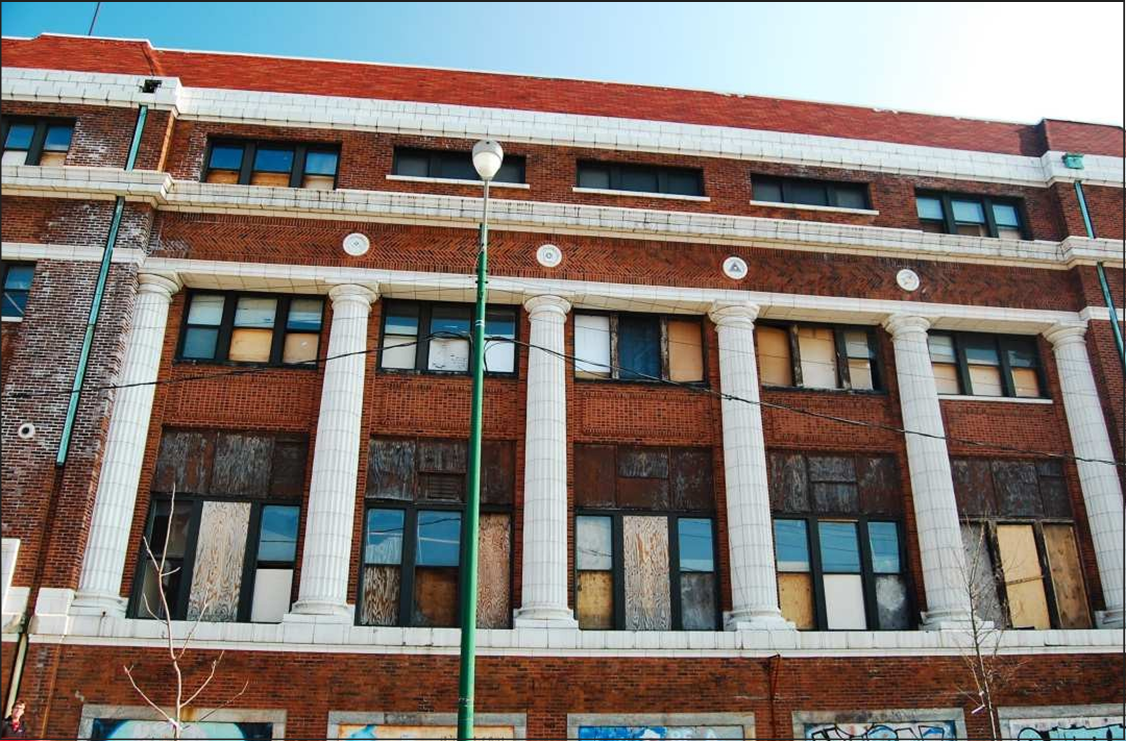
architect, he designed several Chicago Park District fieldhouses and has 30 properties listed in the Chicago Historic Resources Survey either attributed to him individually or to his firm, Hatzfeld & Knox.
HISTORY
South Chicago was once a bustling community with steel mills and other businesses operating along the southern basin of Lake Michigan and Calumet River. This Southeast Side neighborhood long served as a destination for new immigrants including Polish, Irish, Mexican, Swedes, Croatians, Slovaks, Serbians, Italians, and many other ethnic groups.
When the steel mills closed in the late 1970s, the community struggled to compensate for the loss of thousands of jobs. Ancillary businesses closed their doors as well, which contributed to population decline and disinvestment. Despite the challenges, the people of South Chicago are a testament to the strength and bonds of communities in the City of Chicago. While they work together and united to resolve the issues that challenge the neighborhood, they are also working to inspire art and artists. The residents of South Chicago support their local businesses and are unified in opposition to environmental polluters who want to relocate their heavy industry to the South Chicago community.
The South Chicago Masonic Association was established in 1906, and acquired the land on the southeast corner of 91st Street and Exchange in the South Chicago neighborhood. The land was purchased from local real estate developer Niel Lykke, having acquired the parcel from the First Swedish Methodist Episcopal Church of South Chicago.
The Freemasons are the oldest fraternal organization in the world. Founded in the Middle Ages, they began as skilled builders. The Freemasons symbol, including the square and compasses, adorns the buildings they built and occupied. The Freemasons symbol is also found on the headstones of notable Freemasons. The “G” in the logo stands for God, or geometry, depending on an individual’s preference.
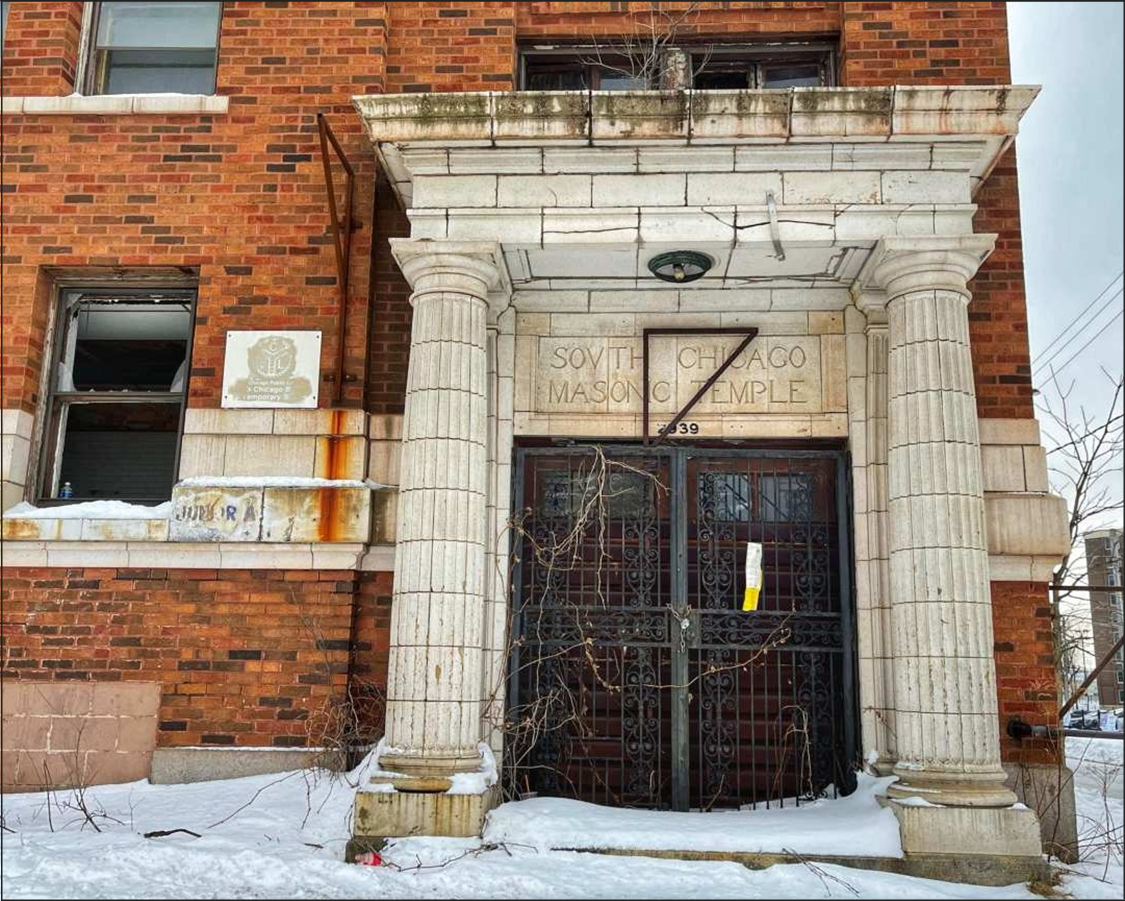
Notable Freemasons include George Washington, Benjamin Franklin, Franklin Delano Roosevelt, Winston Churchill, Buzz Aldrin, John Wayne, and former Chicago Mayor Harold Washington. The Freemasons are not a religious order, but members believe in a Supreme Being, and in morality, charity, and obedience to the laws of the land. As recently as the 1990s, the Roman Catholic Church discouraged its members to be Freemasons, yet had their own affiliated order known as the Knights of Columbus, or K of C. The Shriners, originally known as The Imperial Council of Ancient Arabic Order of the Nobles of the Mystic Shrine, were founded in 1870 and are an offshoot of the Freemasons. The Freemasons were a men’s-only club with a separate order composed of mostly women called the Order of the Eastern Star.
The South Chicago Masonic Association commissioned architect Clarence Hatzfeld to design the three-story brick Classical Revival building, and construction began in 1916. Ruffner-Bloss Co. was listed as the mason on the project. The total construction budget was $100,000.
Hatzfeld designed fieldhouse buildings for the Chicago Park District including Indian Boundary Park, Athletic Field, Independence Park, and Portage Park. He was also the architect of the South Side Masonic Temple which was built in 1921 in the Englewood Community. The South Side Masonic Temple was part of several long-term preservation advocacy campaigns and a “Chicago 7 Most Endangered” building in 2004 and 2015. Despite these efforts, including a plan to reuse the building as part of the new Kennedy-King College Campus in 2007, the South Side Masonic Temple continued to remain vacant and deteriorating until it was demolished in 2018.
Clarence Hatzfeld is the architect of record of five historic homes in the Villa Chicago Landmark District and is believed to have designed as many as 20 more. Listed individually and with his firm Hatzfeld & Knox, he has 30 buildings listed in the Chicago Historic Resource Survey. His partner, Arthur Knox, worked with Dwight Perkins during the design of Carl Schurz High School, which is now a designated Chicago Landmark.
The last Masonic Lodge to operate in the South Chicago Masonic Temple was Triluminar Lodge #767. In 1975, they moved to Lansing, Illinois where they remain in operation today. In 1978, the South Chicago Masonic Association sold the building to Mary Ann Grochal.
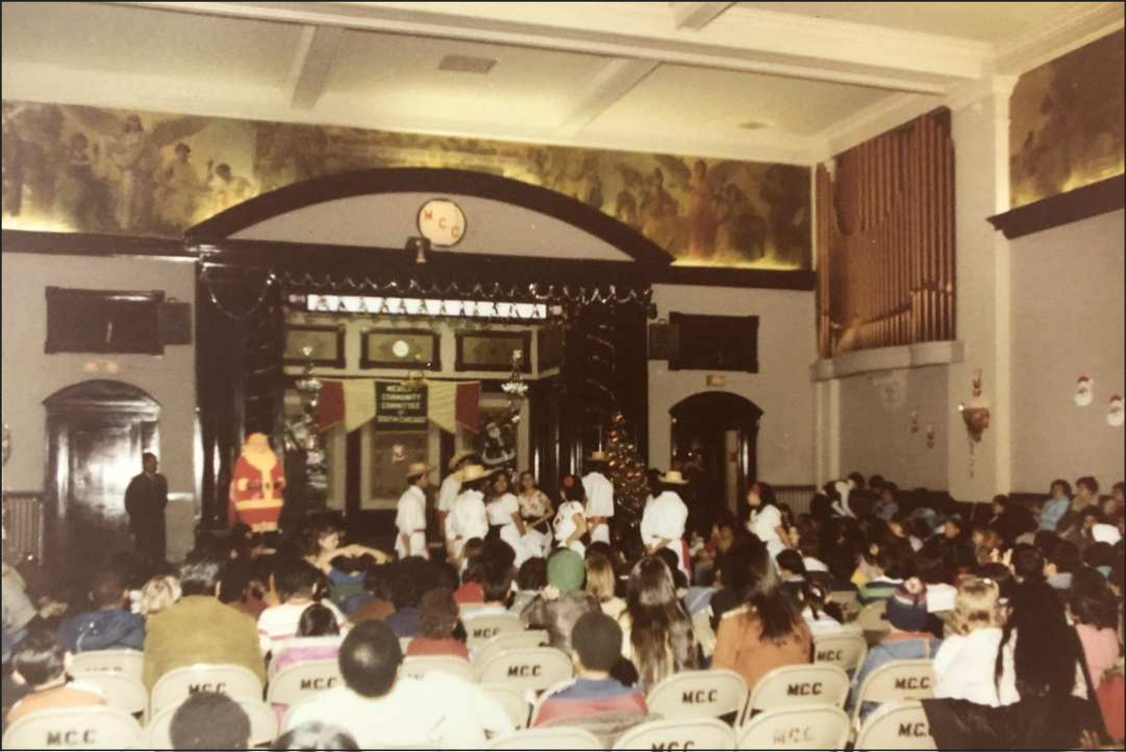
The Mexican Community Committee owned the building from the mid-1980s until 2006 when it was lost to foreclosure. While the Mexican Community Committee operated their Service Center at the South Chicago Masonic Temple building, they organized after-school programs, cultural events, job development, literacy programs, and health advocacy for South Chicago’s large Mexican- American community.
The South Chicago Branch of the Chicago Public Library operated from the building for three years in the early 1990s while its permanent location at 9033 S. Houston was being renovated. Also, at some point during this period, the Welded Tube Company of America was located at the building.
The current owners purchased the property in 2008 and are listed as “91st and Exchange LLC” and Mark R. Reynolds. The building has continued to deteriorate during a lengthy period of vacancy.
Like most Masonic temples, this building had a grand assembly hall and reception areas on an upper floor for ceremonies and large events. Preservation Chicago has been unable to tour the building’s interior to assess its current condition.
THREAT
Years of vacancy have left the South Chicago Masonic Temple in a significantly deteriorated state. Even while in use, maintenance appears to have been minimal on the building. The annual property tax burden on the property is over $100,000 and the property taxes have not been paid since Tax Year 2010. Tax bills and notices sent to the owner of record have been returned to the County, giving the impression that the current ownership has abandoned the building.
The property was listed for sale, but the $750,000+ price tag and extensive back taxes would appear to exceed the value of the building, noting the extensive work required to stabilize and restore it. When contacted, the most recent listing agent indicated that she is no longer representing the South Chicago Masonic Temple building.
Despite the disinvestment which overwhelmed the South Chicago community after the closing of the steel mills and related industries, there are positive indicators that confirm the neighborhood has tremendous redevelopment potential. South Chicago was selected as one of the City of Chicago’s INVEST South/West communities. The redevelopment of the former YMCA building at 3039 E. 91st Street into affordable housing represents a $26 million investment in the immediate area. Claretian Associates, in partnership with Interfaith Housing Development Corporation, is also planning a 78-unit affordable housing development at 3211-3229 E. 92nd Street. The $30 million development is expected to be complete in 2023.
RECOMMENDATIONS
Redeveloping the South Chicago Masonic Temple would have a tremendous impact on the immediate commercial area of 91st Street. The building is adjacent to the Chicago Family Health Center, a thriving health facility.
The Cook County Land Bank could work to eliminate the extensive burden of back taxes and clear title. The City of Chicago could target INVEST South/West incentives and resources towards the South Chicago Masonic Temple. This would create a dynamic development which would serve as the cornerstone of the 91st Street Arts Corridor in South Chicago and catalyze wider reinvestment throughout the neighborhood. Placing this property back into a vibrant use would further advance historic preservation as an economic development engine in the community. South Chicago has its share of vacant land, and an abundance of suburban-style strip center infill. Keeping this history and character alive will contribute to a revitalized South Chicago – one that values its history as it grows stronger.
In the immediate area of the South Chicago Masonic Temple are at least two other vacant buildings, facing an uncertain future, that could be grouped together in a larger redevelopment plan.
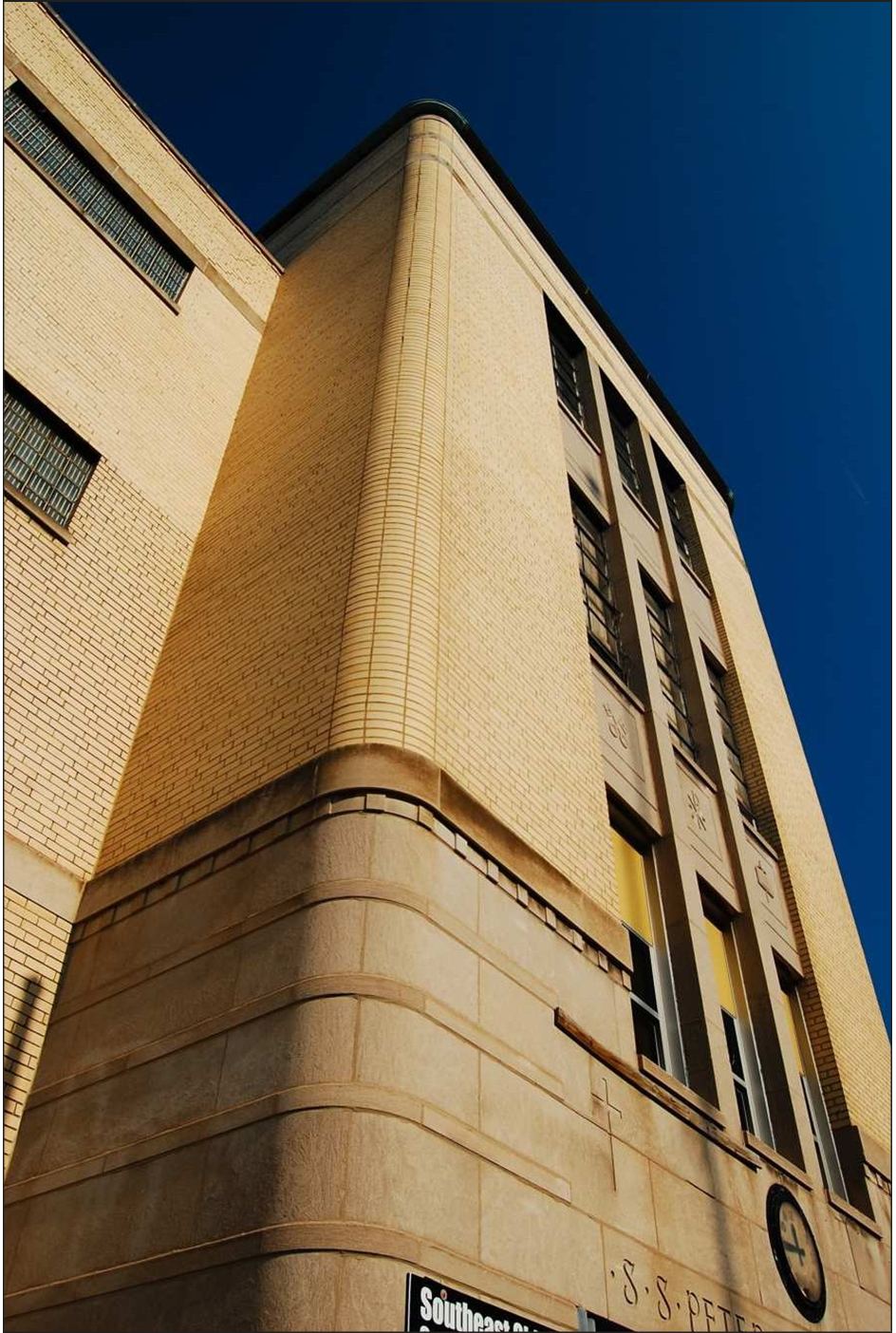
Saints Peter and Paul Catholic Church
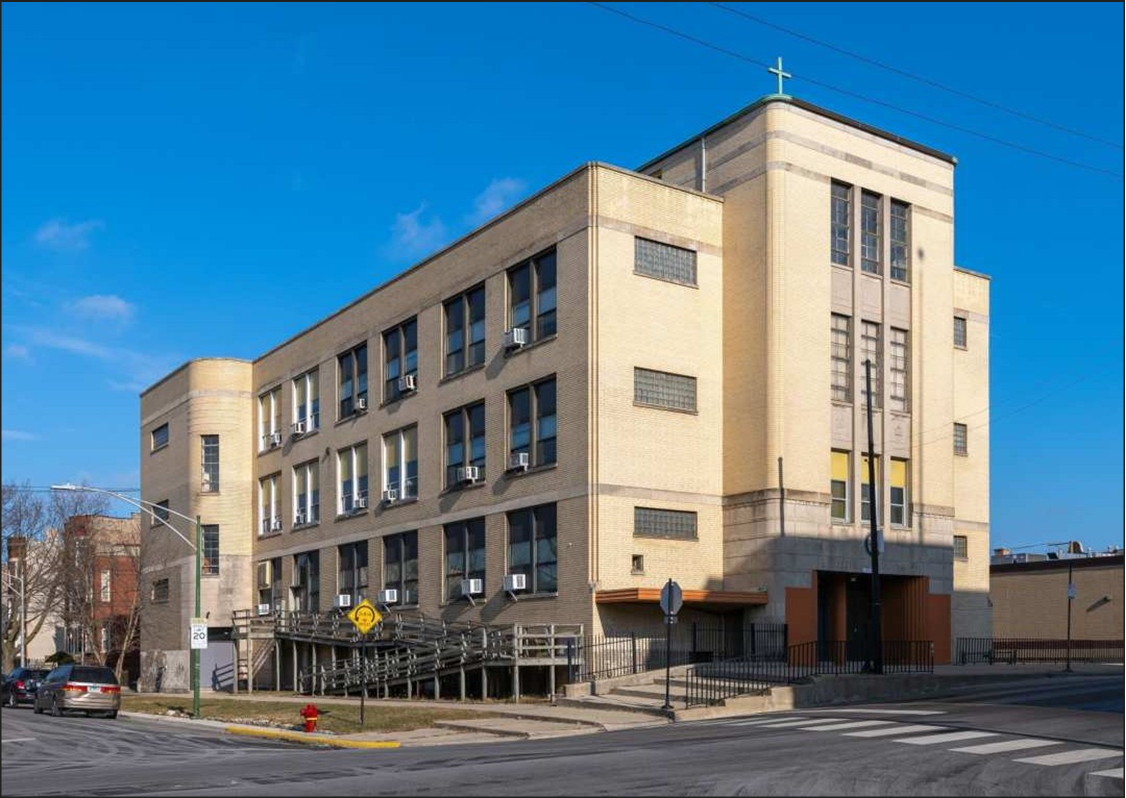
Saints Peter and Paul Catholic Church at 2938 E. 91st Street is a remarkable Art Moderne church and school that was constructed in 1941.
Founded in 1882 as a Roman Catholic Church that served German families, the church conducted its first Mass on April 2, 1882 in the original church building and the school opened on November 25, 1882. The original church campus included a rectory, church hall, and convent building. The church property was originally located in the Village of Hyde Park and later annexed into the City of Chicago on June 29, 1889.
The church had originally planned to build a new facility in 1932, but the Depression interfered those plans. The grade school continued to grow its membership in these years, and they opened the high school in 1939.
Construction began on the new combination church and school building in July 1941, with an estimated construction budget of $140,000. Architect G. S. Smith designed an Art-Moderne building with yellow brick, limestone base with horizontal banding, gentle rounded corners, and symmetrical massing. In 1948, the high school became a girls’ school and operated until 1969 when the high school operations ceased. The school and church finally closed their doors in 1987 when the parish was consolidated with others nearby in South Chicago.
In 1997, the building was transferred from the Catholic Bishop of Chicago to a charitable title holding corporation for the Chicago Legal Clinic, Inc called CLCET, Inc. It held title to the property until 2017 when it was sold in to the Chicago Family Health Center, which operates a nearby facility on the 9100 block of South Exchange Avenue
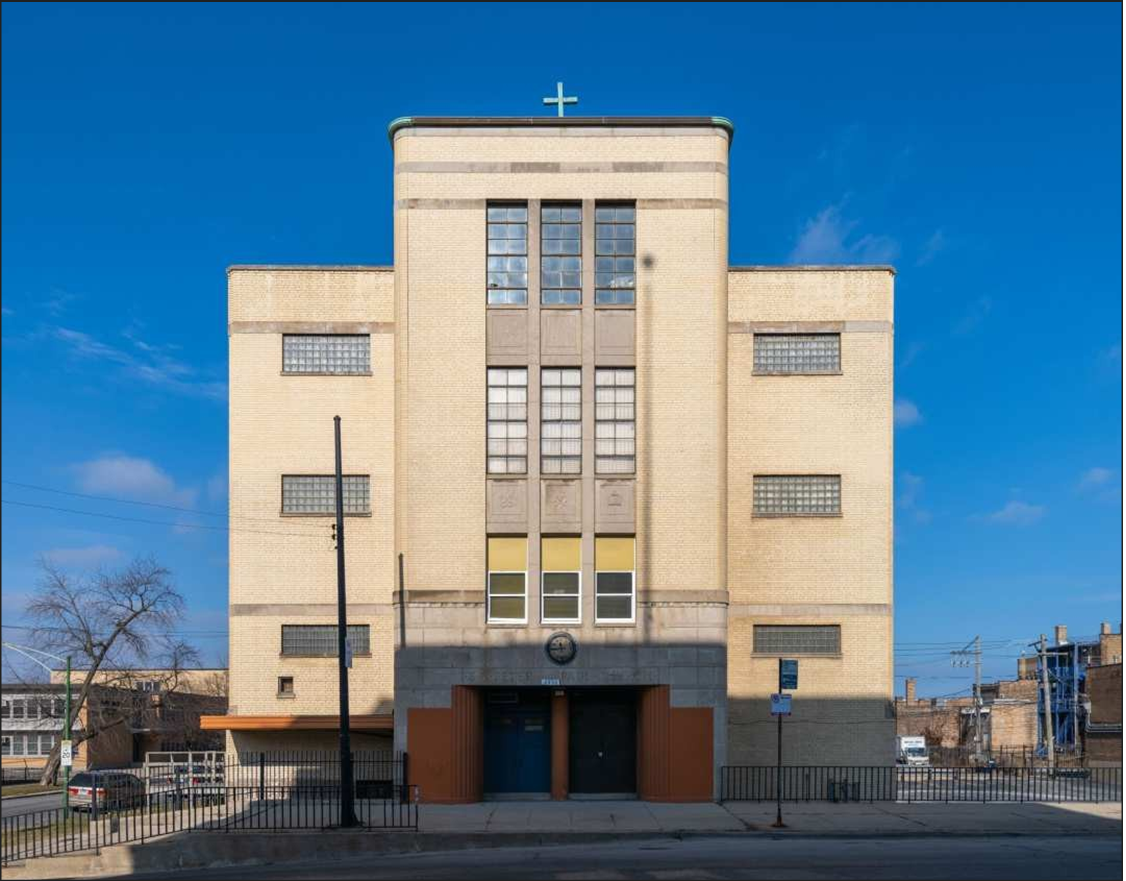
The church and school building are currently vacant. The Saints Peter and Paul Church and School building likely has some deferred maintenance issues, but the building generally appears to be in good and stable condition.
The Saints Peter & Paul Church and School building has an estimated 35,000 square feet which includes the basement which housed the auditorium and stage, the church and ancillary rooms on the first floor, and most of the school’s classrooms on the second and third floors. The church and school site includes a substantial parking lot to the east of the building.
The South Chicago Masonic Temple, located just across 91st Street, is estimated to be just over 30,000 square feet. The interior condition is unknown, but based on the roof condition, it can be anticipated to be highly deteriorating, due to water infiltration. There is no off-street parking available at the Masonic Temple site.
Also of note is a two-story Art Deco/Art Moderne store and office building at 9135 S. Exchange, which appears prime for a reuse, along with a restoration of its facade. Built in 1935, the colorful polychromed terra cotta tile remains intact on the building’s facade, and would be even more stunning if it were restored.
South Chicago is a strong community of people who care deeply about their history and future. The South Chicago Masonic Temple and Saints Peter & Paul Church can become a wonderful anchor for a revitalized 91st Street Corridor. We encourage the City of Chicago to prioritize the South Chicago neighborhood and to continue to channel public and private investment to breathe vibrancy into this long overlooked community.