


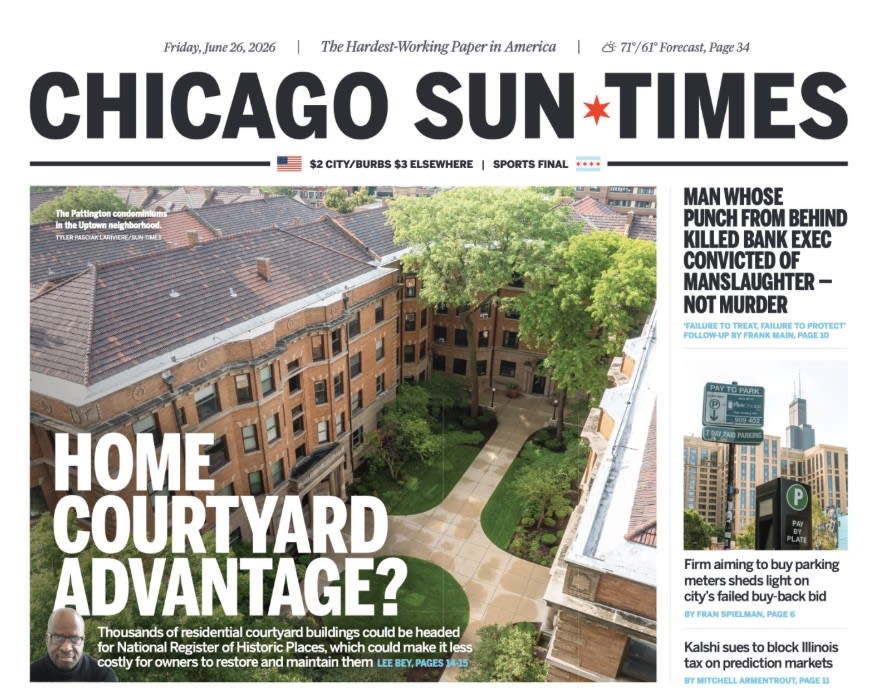

“Chicago’s entire class of vintage residential courtyard buildings — totaling in the thousands — could be headed for the National Register of Historic Places under a measure before a state panel Friday. The nine-member Illinois National Register Advisory Council will decide whether to ask the National Park Service to approve a multiple-property designation encompassing the city’s inventory of courtyard buildings.
“Ramsey Historic Consultants Principal Emily Ramsey, who prepared the nomination report that the state advisory council will consider, said the federal designation would recognize and uplift Chicago’s courtyard buildings as an important class of historic structures. It also would make it easier for owners and developers to later get national register listings for individual courtyard buildings. Individually listed structures can be eligible for state and federal tax breaks that could substantially offset the costs of a historically correct rehab or restoration.
“‘I like to call it an umbrella document,’ Ramsey said of the multiple-property designation. ‘Once you have this umbrella document set up, you can list individual buildings that — without this context — would not be seen as rising to the level of an individual national register listing.’
“If used correctly, the two listings could help take some of the financial sting out of fixing up and preserving a large but high-quality component of the city’s aging inventory of rental and condo buildings.”
“‘They’re important as part of the fabric of the city,’ Ramsey said. ‘A reflection of how the city developed. It takes the ideal of Chicago as a city in a garden and applies that to residential architecture. You have shared open space, and in some of these buildings along parks and boulevards … it kind of blends into the larger parkland. That’s what I think the Chicago courtyard building does so successfully.’
“‘And you could have a range of apartments,’ Chicago author and historian Julia Sniderman Bachrach said. ‘One building could have people on a much tighter budget, and more well-to-do, upper-middle-class people all living in the same complex. Then, there are so many advantages with the courtyard itself — it almost emulated the advantages of having your own single-family home with a yard.’
“Ramsey said she created the nomination report while working with the nonprofit developer Preservation of Affordable Housing. The organization is rehabbing 1920s courtyard buildings in Austin at 5401-15 W. Washington Blvd. and the Washington Manor, 5113-23 W. Washington Blvd. ‘They were getting low-income housing [rehab] tax credits, and they wanted to also layer in historic tax credits,’ she said. ‘We took a look at these two buildings and said, “We don’t think an individual listing is likely, but there is this thing we can do for the multiple properties.” And, to their credit, they jumped at the opportunity.’
“National register multiple-property listings ‘are a bit of an unsung hero,’ Ramsey said. ‘When we did the residential hotels, it was kind of a similar situation. It worked so well for opening the door to [individual] national register listings and to the incentives.'” (Bey, Chicago Sun-Times, 6/26/26)
Preservation Chicago strongly supports the Illinois National Register Advisory Council’s recommendation and urges the National Park Service to approve both the multiple-property designation for Chicago’s courtyard buildings and the individual listing for the Casa Bonita Apartments at 7340-50 N. Ridge Boulevard in Rogers Park.
This designation is an important step toward recognizing, celebrating and protecting Chicago’s courtyard apartment buildings. Constructed between the 1880s and the late 1960s in seven distinct building types, from L-shaped walkups to massive M-shaped complexes enclosing multiple landscaped courts, Chicago’s courtyard apartment buildings are among the most human-scaled residential building types in American urban history. They solved the problem of density without sacrificing light, air, or green space. They appear in virtually every Chicago neighborhood, in every architectural style from Romanesque Revival to Art Moderne to mid-century Modern. They are part of the core residential fabric of the city, and they have been largely taken for granted while doing outstanding work to support Chicago’s vibrancy for generations without much attention or recognition.
The multiple-property designation functions as what Emily Ramsey aptly calls an “umbrella document” — establishing the historical and architectural significance of the courtyard building type so that individual buildings can be listed on the National Register without having to independently justify their significance from scratch. That matters enormously for preservation finance. National Register listing opens the door to federal Historic Tax Credits (26% of qualified rehabilitation expenditures) and Illinois Historic Preservation Tax Credits, which can be layered with Low-Income Housing Tax Credits to make the rehabilitation of affordable courtyard buildings financially viable. The Austin projects being rehabbed by Preservation of Affordable Housing — layering LIHTC and historic tax credits to restore 1920s courtyard buildings on the West Side — are a model for exactly what this designation can unlock citywide.
Among the buildings given special attention in Ramsey’s detailed nomination report: the Victorian-era Pelham Apartments at 334 W. Dickens Ave. (1889); the mammoth Marshall Field Garden Apartments at 1336-1452 N. Sedgwick St.; and the overlooked Merrion Square in South Shore, six Art Moderne buildings each wrapping around a grassy courtyard. These are not obscure architectural curiosities. They are the places where generations of Chicagoans have lived — and where the next generation could live, if the financing tools exist to keep them in good repair.
Read the full story at the Chicago Sun-Times
- Could Chicago’s stock of courtyard buildings wind up on the National Register of Historic Places?; Lee Bey, Chicago Sun-Times, 6/26/26
- Chicago Courtyard Apartments Multiple Property Document Form; Emily Ramsey, Ramsey Historic Consultants / Illinois Department of Natural Resources Historic Preservation Division