
Clarence Darrow Memorial Bridge / Columbia Basin Bridge / East Bridge
Address: within Jackson Park, formally 6401 S. Stony Island Avenue
Architects: Daniel H. Burnham & John W. Root, Burnham & Root
Date: 1880
Style: Naturalistic / Romanesque
Neighborhood: Hyde Park/Woodlawn
OVERVIEW
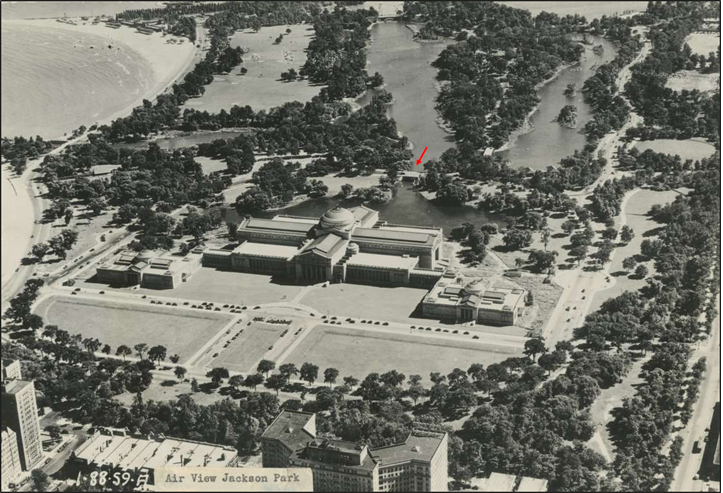
The Clarence Darrow Memorial Bridge, originally known as the East Bridge and later, the Columbia Basin Bridge, has provided passage over Jackson Park’s lagoon for nearly 150 years. Designed by the famed Chicago architectural firm Burnham and Root (1873-1891) and constructed in 1880, the South Park Commissioners described the bridge as the “most important work” within the park. The bridge is one of the few surviving architectural elements of the original Jackson Park, designed by Frederick Law Olmsted (1822-1903), and is likewise a rare remaining feature that predates the 1893 World’s Columbian Exposition. Since Jackson Park’s opening, millions of visitors have traversed the bridge, traveling east-west across
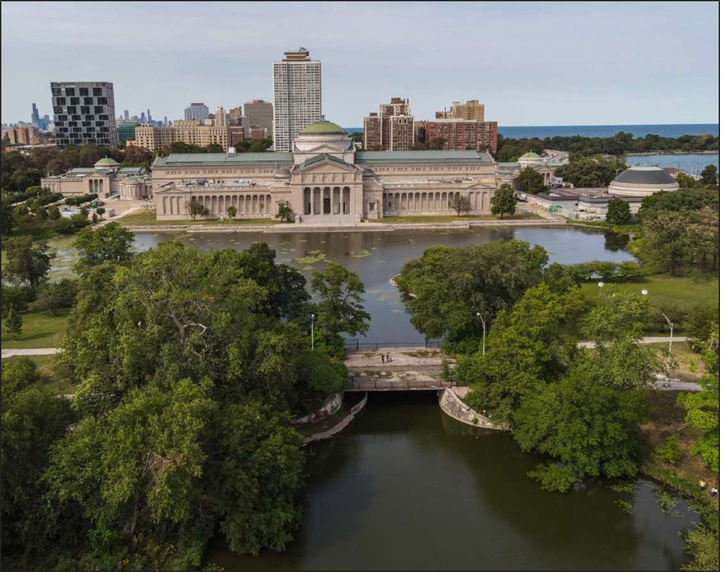
the park, and enjoyed picturesque views across Columbia Basin towards the Griffin Museum of Science and Industry. One of the many people who enjoyed the bridge was Clarence Darrow (1857-1938), famed Hyde Park resident, attorney, and activist, to whom the bridge was rededicated by Mayor Richard J. Daley in 1957.
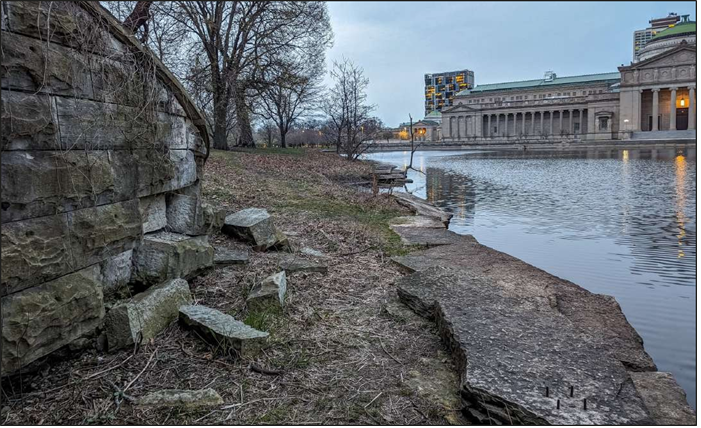
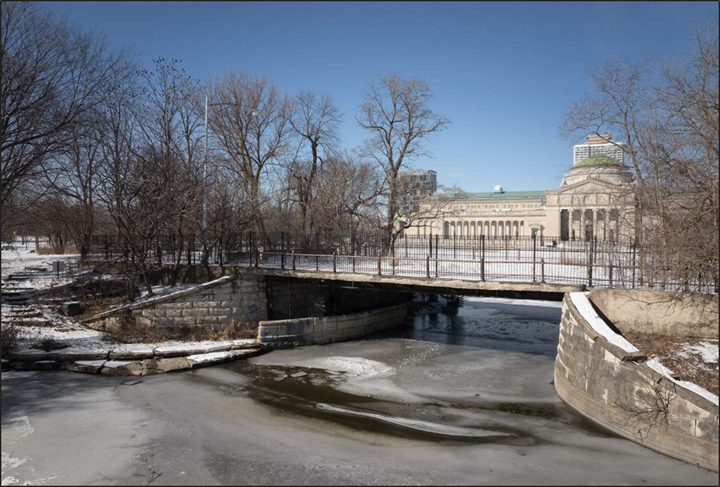
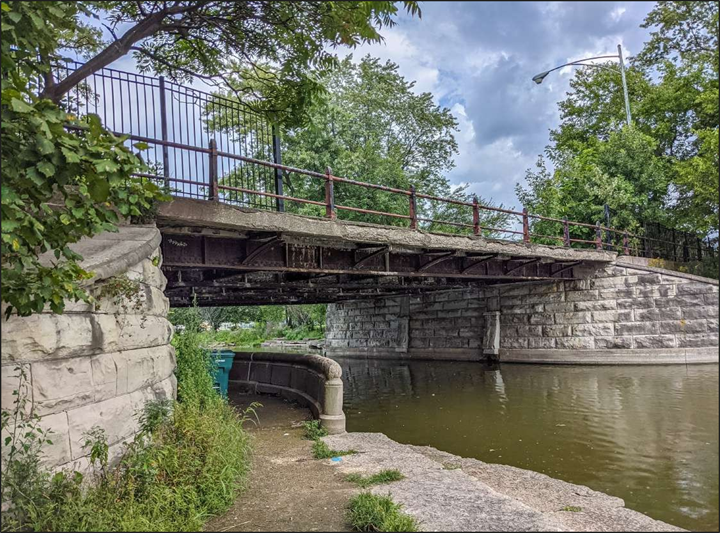
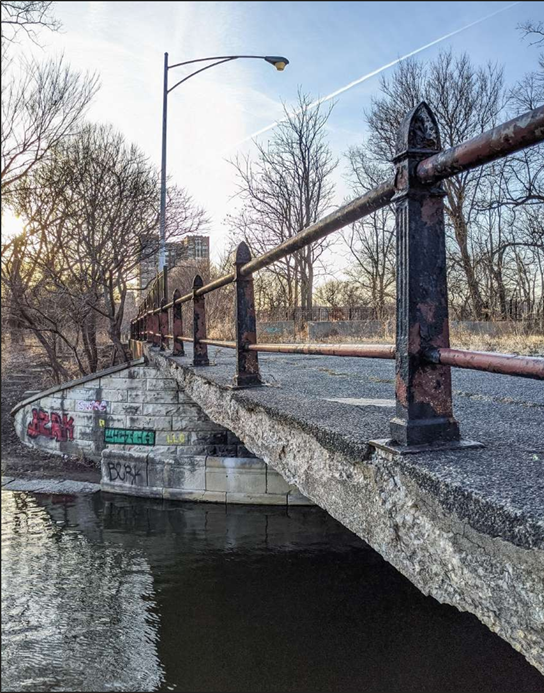
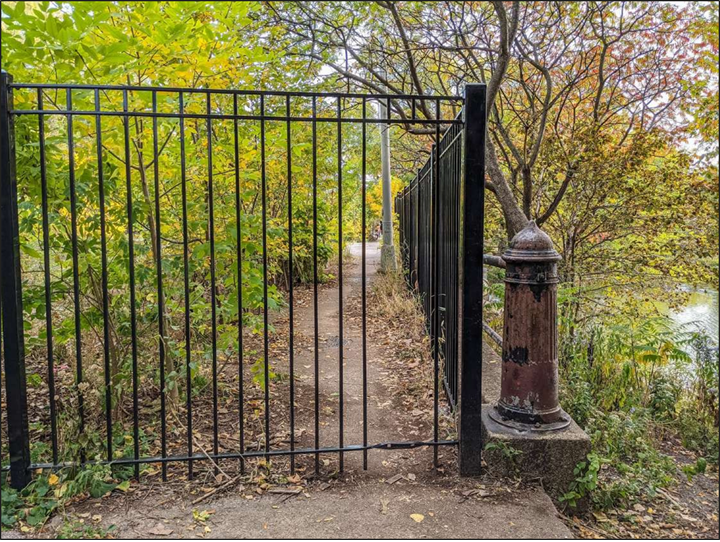
Unfortunately, the Darrow Bridge has been closed to pedestrians since 2013, when the Chicago Department of Transportation (CDOT) erected a permanent fence to block access. The banks of the bridge are overgrown with saplings and weeds, the pavement is cracked, and the Burnham and Root-designed railing is increasingly oxidized. The historic structure is badly in need of repair, despite the continuous and admirable efforts by local advocates who have been calling for restoration for over twenty years. Preservation Chicago calls for the City of Chicago and CDOT to complete all necessary repairs and historic rehabilitation of the Darrow Bridge, restoring access to this significant piece of Chicago’s history and its legacy city parks.
HISTORY: THE DESIGN OF JACKSON PARK AND THE COLUMBIAN EXPOSITION
Jackson Park has long served as a vital green space on Chicago’s South Side and as a planned natural area along Lake Michigan. Extending between Hyde Park, Woodlawn and South Shore Communities, the park speaks to the legacy of early beautification campaigns and open space formation in Chicago.
In 1837, when Chicago officially became a “city”, the city government adopted the motto “Urbs in Horto,” a Latin phrase meaning “City in a Garden.” This slogan, which proved to be prophetic, helped to establish and protect the first Lakefront park, and later the same theories were applied by Frederick Law Olmsted and his designs for Jackson Park, beginning in 1871 and continuing following the World’s Fair of 1893. These design principals from
the city’s founding in 1837, were established more than 60 years before Sir Ebenezer Howard (1850-1928), an English urban planner, introduced his “Garden City movement” model in 1898. His writings and theories reflected a civic ideal that would later find concrete expression through the development of extensive park systems, lakefront preservation, and the City Beautiful movement in Chicago and in cities across the world.
By the early 1850s, a grassroots park reform movement had emerged, led by citizens who called for the creation of what would become the nation’s first comprehensive system of parks and boulevards planned for a major city in the United States. These efforts gained momentum in the late 1860s, prompting the Illinois State Legislature to establish three separate park commissions, the South, West, and Lincoln Park Commissions. The goal of these three commissions was to form a “unified park and boulevard system that would encircle Chicago,” an idea first proposed by real-estate speculator John S. Wright (1815-1874) two decades earlier, and one that the city still boasts today. Each commission was responsible for improving one section of this envisioned system.
The South Parks Commission, founded by a group of civic leaders including Paul Cornell (1822-1904), the “Father of Hyde Park”, was established by the State legislature in 1869. The Commission was given the task of developing the parks and boulevards to the “South of the City.” In 1871, their first act was to hire the leading landscape architects of the time, Frederick Law Olmsted (1822-1903) and Calvert Vaux (1828-1895), who had already gained national prominence for designing New York City’s Central Park in 1858, to design what was then called South Park. Unfortunately, shortly after Olmsted and Vaux began their work, the Great Chicago Fire occurred in October of that
year, and delayed the implementation of their plan. When work resumed, the South Park System took shape with Eastern and Western divisions, now Jackson and Washington Parks, linked by the Midway Plaisance. Jackson Park alone made up 593 of the system’s 1,055 acres. In 1875, the Eastern Division of the South Park System was renamed Lake Park, and in 1881 it was officially named Jackson Park, in honor of Andrew Jackson, the seventh
U.S. President, a decision that sparked some public controversy. Vaux eventually withdrew from the project, but Olmsted returned in the early 1890s to revise and expand the plan, particularly in preparation for the upcoming fair.
HISTORY: Frederick Law Olmsted
Olmsted pioneered the field of landscape architecture in the United States. In addition to Central Park, he designed many prominent urban parks throughout the second half of the 19th century. Born in Hartford, Connecticut in 1822, Olmsted established his firm in Brookline, Massachusetts in 1883. The firm remained active under the leadership of his two sons into the mid-20th century. Besides his landscape work, Olmsted was a social reformer and environmentalist – working on the conservation efforts of both Yosemite and Niagara Falls – an abolitionist, and administrator. Olmsted is among the nation’s, if not the world’s, foremost designers to leave a lasting impact on the American social consciousness and urban form.
Olmsted’s design work was guided by the natural features already present on a site. He focused on creating specific feelings and effects in the landscape and employed pastoral and picturesque styles to produce naturalistic and serene scenery, intended to enhance rather than remake a space. By respecting the “genius of a place,” he sought to use the shaping of terrain to bring out the innate quality of a given landscape.
When Olmsted surveyed the site for Jackson Park, he found marshy conditions, bogs, and vegetated ridges. He cited Lake Michigan as an important natural feature that made up for the flatness of the chosen site. Communicated in a set of drawings delivered to the South Park Commission in 1871, Olmsted and Vaux planned a series of waterways in the form of lagoons to connect Jackson Park to Lake Michigan. Delays caused by the Great Chicago Fire prevented construction and improvements of the park’s land from beginning until 1875. Construction on the park resumed with the excavation of the Twin Lakes and the establishment of an early masonry and iron bridge across them. That original bridge, however, no longer exists today. Further improvements of the park continued. The South Park Commission shifted its focus to the northern section east of the Twin Lakes in 1879, at which time a second and larger artificial lake, initially known as the North Pond and still existing today as Columbia Basin, was created.
HISTORY: Burnham & Root
In April of 1880, the famed Chicago architectural firm of Daniel H. Burnham (1846-1912) and John W. Root (1850- 1891), was awarded the commission for a bridge that would span the southern end of North Pond, connecting the East and West Lagoons. Originally named the Columbia Drive Bridge, Burnham & Root designed the structure with masonry and iron. The bridge was planned so that a carriage drive could continue over the lake. In the South Park Commission’s 1879-1880 Annual Report, they referred to the undertaking as “the most important work in the East Park” aside from the general landscape improvements initiated the previous year. As cultural historian, Tim Samuelson said, it “offers one of the only places in the entire park where visitors can experience a location truly authentic to Olmsted’s original conception of the park.” The bridge was officially opened in 1881 for the “driving season,” when upper-class Chicagoans traditionally toured the park in horse-drawn carriages. That same year the park was renamed to Jackson Park, and boaters, picnickers, and carriages flocked to the still-unfinished park.
Daniel Hudson Burnham was born in Henderson, New York in 1846 and moved to Chicago in 1855 at the age of nine. After graduating from Central High School in Chicago, he was sent by his parents to a college preparatory school in New England. However, he failed entrance exams for both Harvard and Yale. So 21-year-old Burnham returned to Chicago in the fall of 1867, eventually becoming an apprentice at the firm of architect William Le Baron Jenney (1832-1907), after several unsuccessful attempts to establish himself in business, politics, and even the mining industry. He met his creative, long-term partner, John Wellborn Root, in 1872 while working at the firm Carter, Drake and Wight.
The encounter with Root would mark a turning point in Burnham’s professional trajectory. Before the two would go on to form their influential partnership in Chicago, Root had already begun to distinguish himself through his intellect, education and early professional experiences.
Four years younger than Burnham, Root was born in Lumpkin, Georgia in 1850. He was raised in Atlanta, where he was first educated at home. During the American Civil War, Root was sent to Liverpool, England, where he attended school in Claremont. His time in Britain exposed him to European architectural traditions and the Gothic Revival architecture, influences that would later surface in his work. After returning to the United States, Root enrolled at New York University, where he studied engineering and graduated in 1869. He worked for several architects in New York City, including James Renwick Jr. (1818-1895), the architect of St. Patrick’s Cathedral, and Peter Bonnett Wight (1838-1925), who designed the National Academy of Design (demolished) in New York City. In 1871, following Wight, Root moved to Chicago in the wake of the Great Fire, and became head draftsman for Carter, Drake & Wight, where he eventually met Burnham.
In 1873, Burnham and Root began what would become an 18-year partnership with the founding of their architectural firm, Burnham & Root, which quickly rose to prominence during the Chicago post-fire reconstruction period. Among their most notable works were the Rookery Building (1888), which featured a hybrid metal-and- masonry frame and a light-filled central atrium; the Monadnock Building (1891), one of the tallest load-bearing masonry structures ever built; and the Masonic Temple (1892), which, at 21 stories, was briefly the tallest building in the world. Beyond their renowned urban skyscrapers, Burnham & Root also contributed to landscape and
infrastructure projects at an early stage of their practice. Some of the newfound firm’s earliest work was for the South Park Commission in the 1870s and 1880s, including the bridge over the Columbia Basin. They were later named the lead architects of the World’s Columbian Exposition and went on to design those famed residential and commercial buildings, making them one of the most important and well-known architectural firms of the 19th century.
Unfortunately, the partnership between Burnham & Root came to a premature end when Root contracted pneumonia and died in 1892 at his home, located at 1310 N . Astor Street in Chicago, while he working on the plans for several pavilions at the World’s Columbian Exposition.
HISTORY: 1893 World’s Columbian Exposition
Although the city’s original plan to completely encircle Chicago with continuous green parkland was never completely realized at its northmost terminus, it nonetheless resulted in one of the most forward-thinking park and boulevard systems in the United States. This network of parks and boulevards, along with the growth and annexation of Hyde Park, Lake View and Jefferson Townships, bringing Chicago’s population to over one million, contributed to Chicago successfully surpassing New York, St. Louis and Washington, D.C. for the privilege of hosting the 1893 World’s Columbian Exposition. This was a monumental event commemorating the 400th
Department of the Interior
anniversary of Christopher Columbus’s arrival in the Americas, which due to delays, was celebrated one year later than the official anniversary date.
Through this event, Chicago aimed to prove that it was the “City of the Century.” Following the precedent of the Philadelphia Centennial Exposition (1876), which featured many separate buildings set in a large garden-like layout, the World’s Columbian Exposition was planned to spread over 686 acres along the city’s south lakefront area. After 1889, most of the city’s resources and attention were focused on preparing for the fair. Long-term plans for Jackson Park’s permanent development were postponed until a new plan was approved in 1895. Jackson Park was selected as the site in 1890 and its incomplete status was the very reason that Olmsted recommended it for the Exposition.
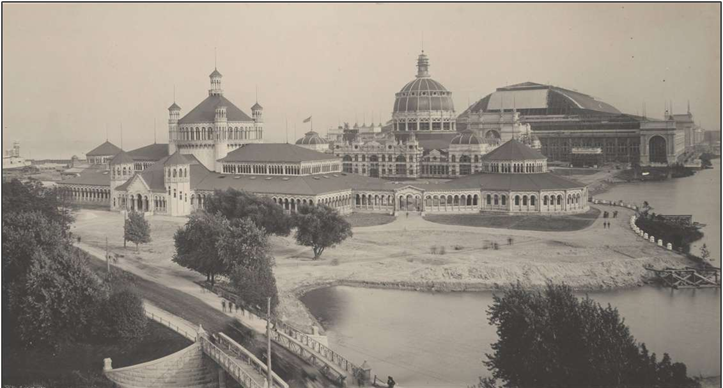
Architects, engineers, and planners worked together to turn the swampy area into the “White City.” Olmsted, Henry Sargent Codman (1863-1893) of Olmsted’s firm, Daniel Burnham of Burnham and Root (later D.H. Burnham & Company), and Charles B. Atwood (1849-1895) of Burnham’s firm, embarked on planning the layout for the Exposition. Rather than design a traditional park landscape, they conceived of a spectacular seascape. Olmsted approached landscape not simply as scenery, but as a system. He used Lake Michigan, along with a series of man- made pools and canals, to form a setting with islands and raised terraces where the buildings would stand. Moreover, he introduced over a million plants to build a diverse and resilient environment. Despite objections from Louis Sullivan and other architects of the “First Chicago School” of architecture, Burnham chose to strongly
encourage the design of buildings primarily in the Beaux-Arts style, featuring contributions by a number of prominent architects, mostly from the East. Exceptions included Burnham’s firm, Henry Ives Cobb (1859-1931) and that of Dankmar Adler (1844-1900) and Louis Sullivan (1856-1924) of the Adler & Sullivan firm, who designed the Transportation Building. These eastern architects included Richard Morris Hunt (1827-1895), Charles McKim (1847-1909), William Mead (1846-1928) and Stanford White (1853-1906) of McKim, Mead & White, and George B. Post (1837-1913), among others. Among these eastern architects, a particularly notable figure was Sophia Hayden (1868-1953), the first woman to graduate from MIT’s four-year architecture program. She designed the Woman’s Building for the Exposition at just 21 years old.
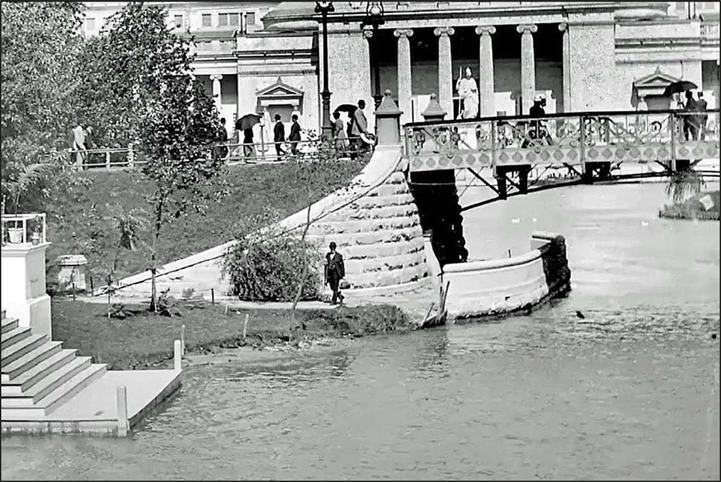
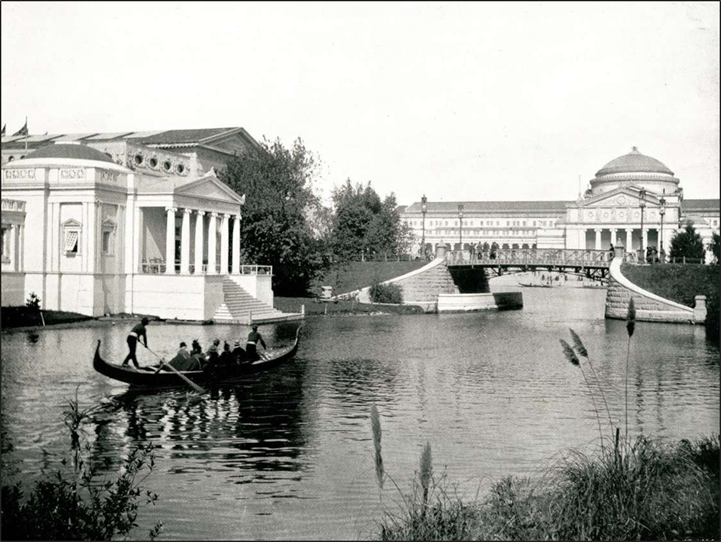
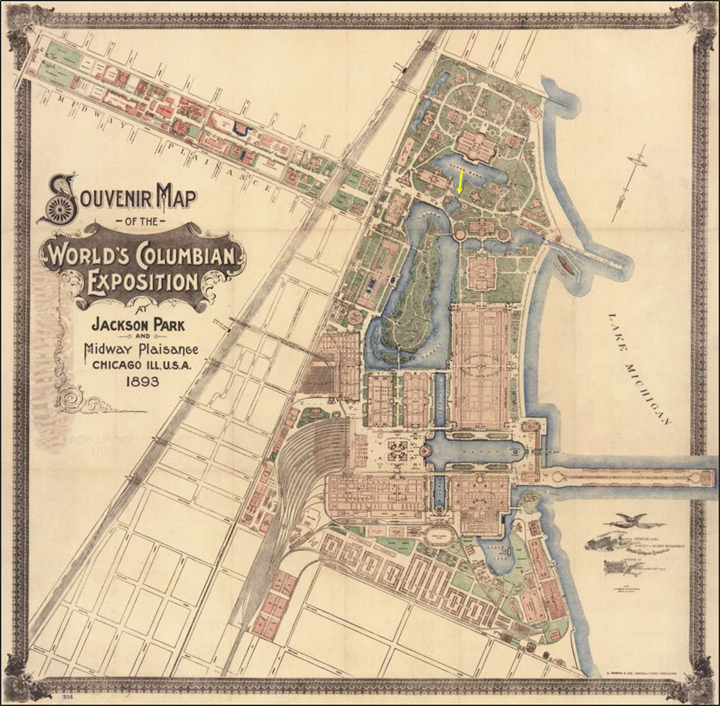
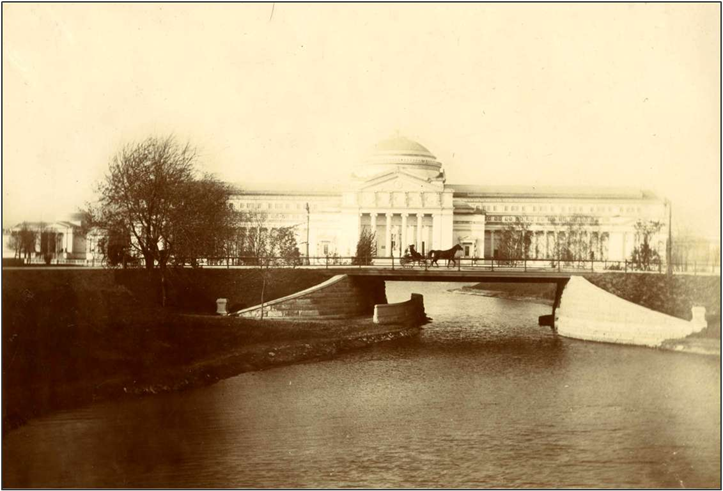
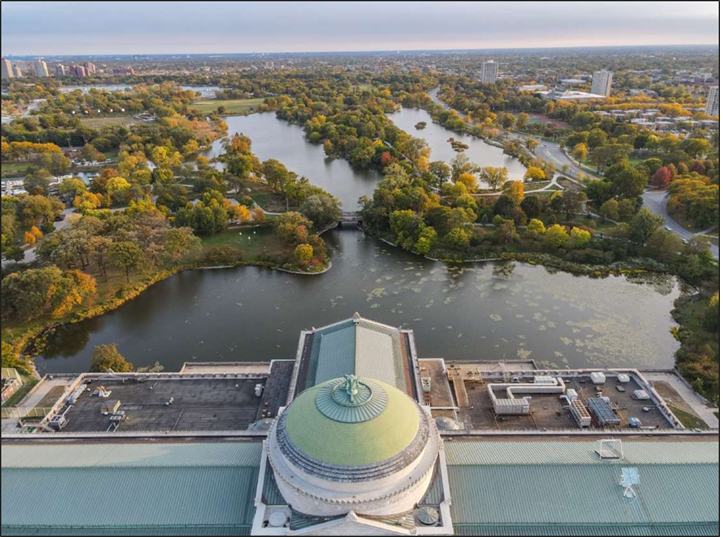
The Columbia Basin was the northernmost part of the Exposition’s lagoon system, and it fronted the monumental Atwood-designed Fine Arts Building, now the Griffin Museum of Science and Industry. While much of Jackson Park was completely redesigned during the fair, the basin’s form remained and became part of the interconnected series of lagoons. The Columbia Drive Bridge also remained one of the only unchanged and extant pieces of the original design for the park, with Burnham & Root adding ornamental railings to improve both its safety and aesthetic appeal. The bridge’s placement was part of Olmsted’s vision to create picturesque views of the Fine Arts Building. Standing on the bridge, a fair-goer would experience a naturalistic vista, where the grand neoclassical building was framed by grassy slopes, clusters of trees and the basin itself. During the fair, tens of millions of visitors crossed the Columbia Drive Bridge, and traveled in boats beneath it.
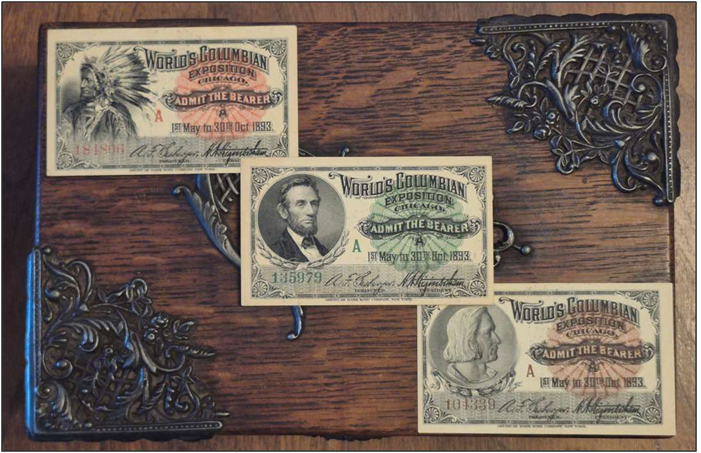
Held from May 1 to October 10, 1893, the World’s Columbian Exposition was an enormous success. Referred to as “the fair that changed America,” it showcased modern innovations to over 27 million visitors, including the Ferris Wheel, Cracker Jacks, early elevators, the zipper, and the earliest voice recording technologies. The fair also acting as a catalyst for Chicago’s intellectual and cultural development, contributing to the founding of conferences, including the Parliament of the World’s Religions, professional associations, and civic organizations. Moreover, it cemented the dominance of classical and Beaux-Arts architectural styles, which Louis Sullivan criticized as a harmful influence. In his words, “The damage wrought by the World’s Fair will last for half a century from its date, if not longer.”
HISTORY: After the Exposition
After the six-month Exposition concluded in late October of 1893, the South Park Commissioners soon began efforts to turn the site back into parkland. Jackson Park was again redesigned by Olmsted’s firm with aims to retain the picturesque qualities of the World’s Fair and serve as a space for passive recreation. The redesign of the park was completed between 1895 and 1906. The Exposition had been conceived as a temporary attraction, so most of its buildings were constructed using a plaster-like material known as “staff,” which was designed to resemble stone. These structures were later either destroyed in the fires of 1894 or demolished. Only a few structures were preserved, most notably the Palace of Fine Arts, which had fireproof masonry vaults. It was repurposed by Burnham to house the Field Columbian Museum, which displayed anthropological and cultural artifacts that had
been exhibited at the fair. After a period of vacancy, following a move of the Field Museum to a site near Grant Park, the building fell into disrepair and was largely reconstructed by philanthropist Julius Rosenwald, president of Sears Roebuck & Company. In 1933, the museum was renamed and transformed into the Rosenwald Museum and later named The Museum of Science and Industry.
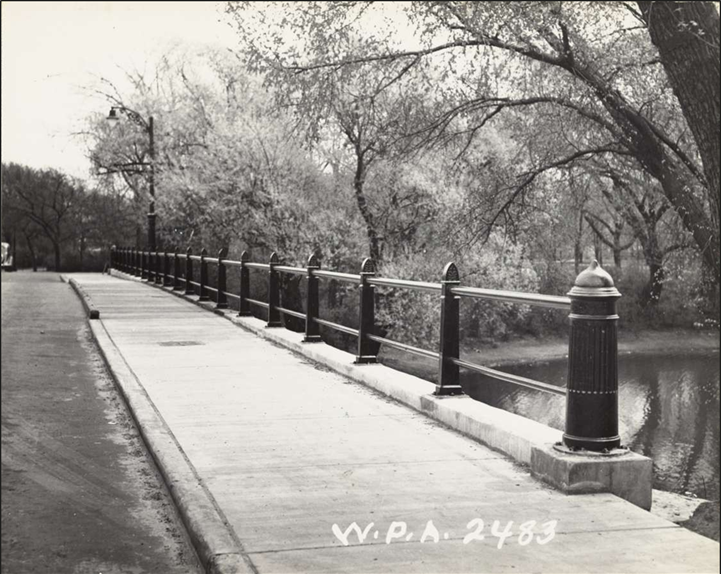
Another structure that was retained from the Exposition, although less prominent, is the Columbia Drive Bridge. After the fair, the bridge was modified under the supervision of Charles B. Atwood. The deck was widened, and the original Burnham & Root-designed iron railings were replaced by simplified ones, in keeping with the Exposition’s style. These railings were reused from another Exposition bridge that had been demolished after the fair. The bridge, in its post-fair state, has remained a constant in the park amidst the city’s many changes. In 1957, the city renamed the structure the Clarence Darrow Memorial Bridge to honor Chicago’s famed lawyer Clarence Seward Darrow (1857-1938).
Both Jackson Park and the Darrow Bridge have been recognized with numerous historic designations. The park was listed on the National Register of Historic Places in 1972 and became part of the Chicago Park Boulevard Historic District in 2018. The bridge itself is documented in the 1990 “Historic Resources of the Chicago Park District” form. It likewise falls within the parcel boundary of the 1995 Museum of Science and Industry Chicago Landmark designation, as a contributing structure.
HISTORY: Physical Description
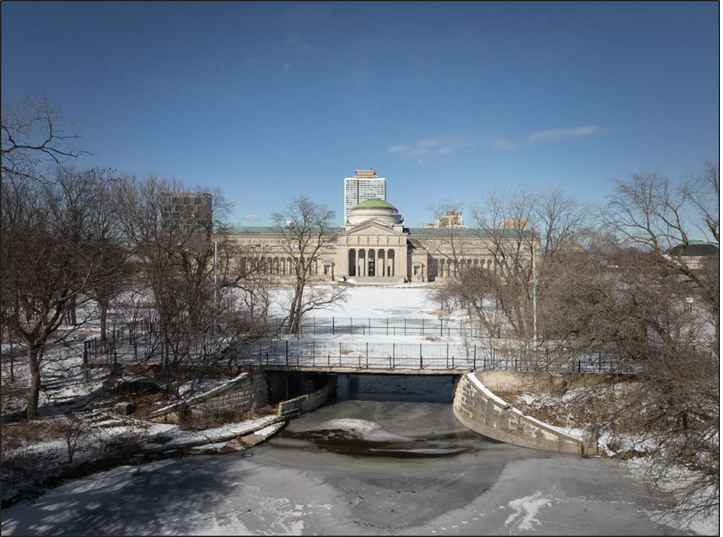
The Darrow Bridge measures 56 feet in length and 56 feet 6 inches in width, including one 40-foot-wide roadway and sidewalks measuring 8 feet 3 inches. It currently stands on the main axis of the Museum of Science and Industry and reflects the symmetry present in the museum’s exterior façade. The Columbia Basin lagoon and its naturalistic banks act as a frame, and the bridge elevates the viewer to provide the viewshed that Olmsted intended. The experience of looking out over the bridge, both to the north and the south, allows visitors in the 21st century to authentically experience Olmsted’s original South Park concept. The location and framing of the Darrow Bridge continue the long tradition of pastoral American landscape design.
The Darrow Bridge additionally acts as an important connector between what is now a parking lot on the eastern bank of the lagoon to the Garden of the Phoenix and Wooded Island, both accessed from the western side of the park. With the bridge blocked and closed to the public, not only is the impressive view of the lagoon and the Museum of Science and Industry lost, but the park cannot be fully experienced or easily traversed. Currently, visitors have limited options for accessing one of the park’s main features, the Wooded Island, and must walk around the museum, along the east bank, or enter from 63rd Street. The loss of this bridge connection has reduced convenient access to the northern section of the park, which for Olmsted and Burnham served as the focal point of Jackson Park.
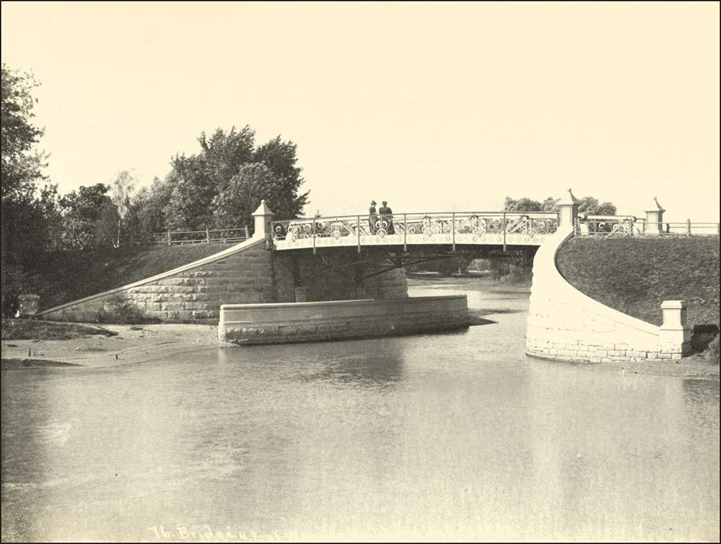
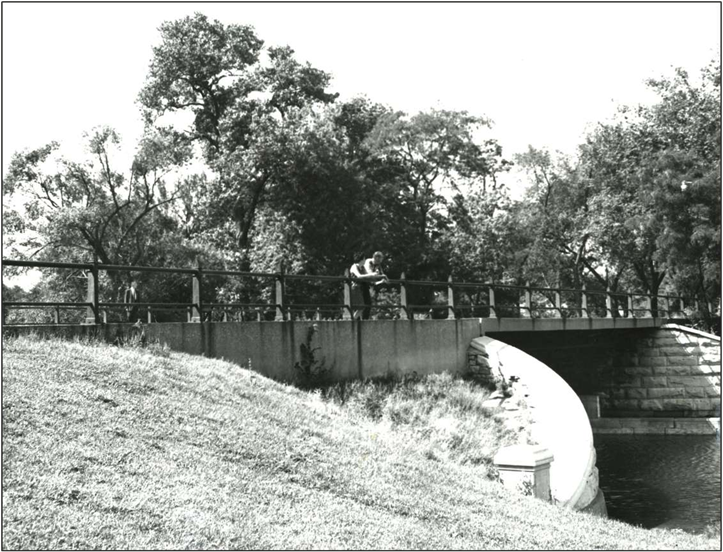
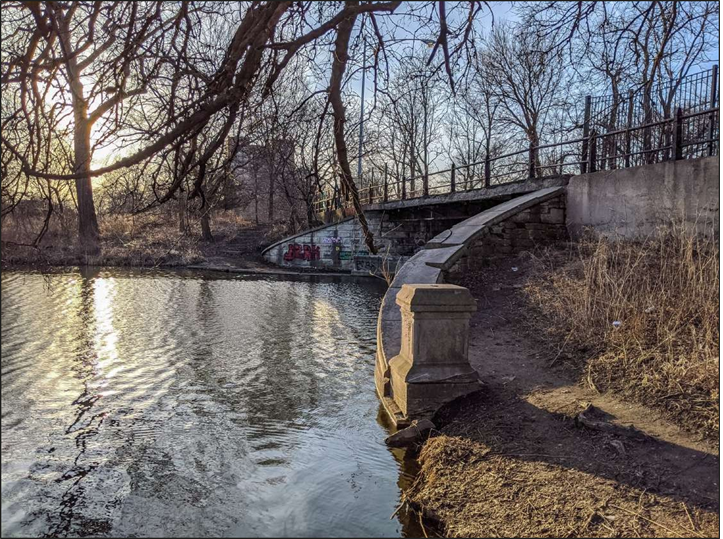
The bridge is an architectural gem in its own right. With its limestone abutments and rough-hewn stone retaining walls, the bridge displays a formal but organic and naturalistic quality. As Tim Samuelson, the Chicago cultural
historian, commented to the Hyde Park Herald, “the dramatic curving swoop of the stone bridge embankment was a remarkable early effort in melding Daniel Burnham’s creative understated modernism with the Frederick Law Olmsted concepts of human discovery and wonder amidst a natural environment.” This simplified form with its minimal ornament reflects Burnham and Root’s later architectural designs for Chicago’s skyscrapers.
Dating back to the earliest phase of Jackson Park’s development and predating the 1893 World’s Columbian Exposition, the bridge’s current structure includes components from different time periods. The stone abutment walls were constructed in 1880, when Burnham & Root designed the original pony-truss bridge to accompany Olmsted & Vaux’s 1871 landscape design for South Park. The iron hand railings were added after the Exposition, and the deck was introduced as early as 1895, following the revisions proposed in Olmsted’s Revised General Plan for Jackson Park. Despite several alterations of the bridge, key historical elements remain. The limestone superstructure and embankments/abutments, along with 1895 railing, and walkway all are original to Burnham and Olmsted’s vision. The abutments are also original, featuring elegant curved wingwalls. The 1895 deck represents an early example of a deck plate girder structure, composed of four shallow girders and floor beams supporting a concrete slab. This structural system, which resembles the jack-arch type, was common during the fair but has largely disappeared. Additionally, as part of Jackson Park, the bridge falls within the park’s overall period of significance of 1875-1953. Despite deferred maintenance, the bridge was evaluated by the National Bridge Inventory and received a rating of five out of ten for historical significance, with a designation of “good historic integrity.”
HISTORY: Clarence Darrow
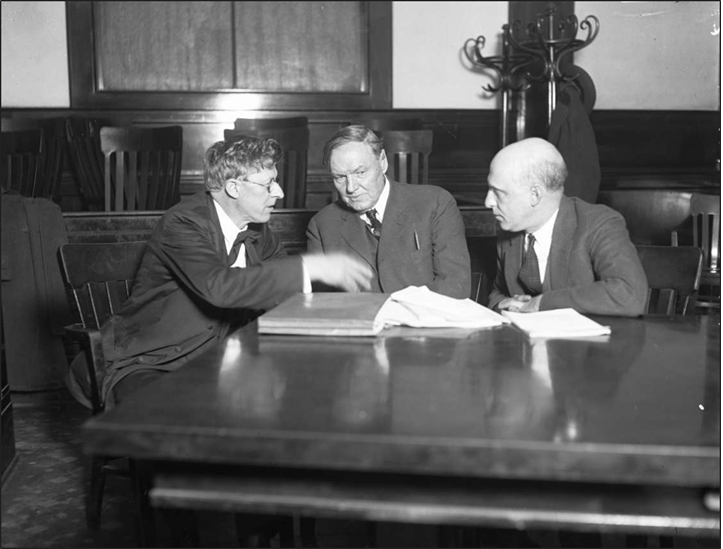
Although many Jackson Park recreationalists have admired and traversed the Darrow Bridge, arguably none have done so more than its namesake, Clarence Darrow. Darrow became one of the 20th century’s most famed lawyers through his many high-profile defense cases. He represented Euguene Debs and other union leaders during the 1894 Pullman Strike, defended Leopold and Loeb, saving them from the death penalty, and is most known for his role as a defense attorney arguing for science education and freedom of speech in the 1925 Scopes Monkey Trial.
Darrow was born on April 18, 1857 in Farmdale, Ohio, and was raised in a household shaped by skepticism, abolitionism, and radical moral thought. His father, Ammirus Darrow, an outspoken freethinker and former seminary student, deeply influenced Clarence Darrow’s ethical worldview. Drawn to its intellectual rigor and persuasive force, Darrow began to study law during his time as a young school teacher. After being admitted to the bar in Ohio in 1879 at age 22, he moved to Chicago in 1887, where he formed crucial political and legal alliances that shaped his career. Influenced by governor John Peter Altgeld’s progressive ideals, Darrow became known for defending labor leaders, political radicals, and socially marginalized individuals. His legal work was driven less by commercial success than by a deep commitment to justice and civil liberties. In 1897 Darrow and his wife, Ruby Hammer storm, moved to an apartment at 1537 E. 60th Street (demolished), where they had a view of the bridge crossing Columbia Basin. Darrow was said to contemplate his cases and the mysteries of life on the bridge, as well as practice his “famous oratory on the fish in the lagoon.” He was an esteemed resident of Hyde Park and stayed
involved in neighborhood institutions and events until his death on March 13, 1938. According to his wishes, Darrow’s ashes were scattered in the Jackson Park lagoon.
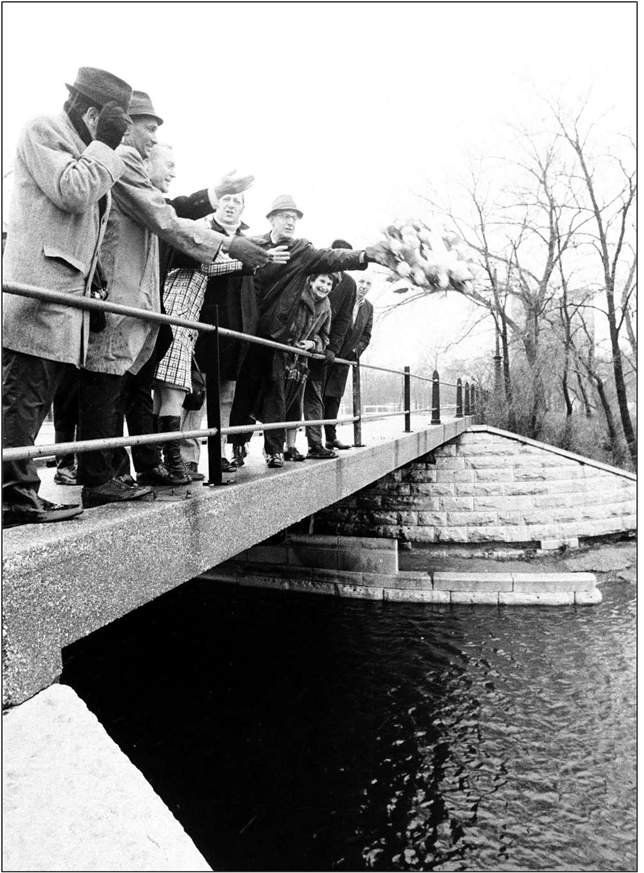
The bridge became both an endpoint of his life and a lasting monument to his values. In 1957, following Ruby’s death, her ashes were also scattered at the same site. That same year, Mayor Richard J. Daley dedicated the bridge to Darrow, and beginning in 1961, those who remember Darrow would gather on the bridge every March 13th and toss a wreath off of its side and into the lagoon.
THREAT
Unfortunately, since 2013, those attempting to celebrate Darrow’s life and memory have been unable to actually set foot on the bridge. The park commissions were merged into the Chicago Park District in 1934, which later proposed modifications to the bridge and its retaining walls after receiving federal funding. In 1962, the bridge was turned over to the Chicago Department of Transportation (CDOT), who still owns and manages it today. At that time, the City planned to build a major expressway through Jackson Park, which would have required the demolition of the bridge. Thankfully, this urban renewal plan never materialized due to strong opposition and massive protests. In
the same year, plans were also drawn up for a dam and drainage improvements at the C o l u m b i a B a s i n , showing that a soil boring was taken at the bridge. Early letters requesting that CDOT make necessary repairs to the bridge were published as early as 1968 in the Hyde Park Herald.
By 2009 the bridge was deemed unsafe for v e h i c l e s a n d a permanent metal fence was built to keep out pedestrians in 2013. In 2017, CDOT presented a plan for the bridge to provide pedestrian and emergency vehicle access to the Obama Presidential Center, cited just southeast of the bridge along Jackson Park’s eastern S. Stony Island Avenue
border. In 2021, CDOT engineers further proposed a timeline for the bridge’s repair with the completion of the project slated for the end of 2024. Unfortunately, neither plan has come to fruition.
With the construction of the Obama Presidential Center taking place just to its south, the bridge project has been postponed, though $2 million in state funding remains earmarked for its repair.
In 2024, the Clarence Darrow Bridge Preservation (CDBP) Coalition was formed in response to the designation of federal funds for the demolition and replacement of the bridge, as well as suggestions that the historic limestone abutments may be replaced with concrete. Because of its location and age, any repair or demolition project is subject to both National Environmental Policy Act (NEPA) and National Historic Preservation Act (NHPA) Section 106 reviews. Formal Section 106 review was initiated in late 2024, but the process has seemingly stalled. Current disruptions and uncertainties around federal offices and regulatory oversight may further delay NEPA and NHPA reviews.
RECOMMENDATIONS
As necessary maintenance continues to be deferred, the bridge is increasingly vulnerable to further disrepair. If conditions worsen, demolition and removal are possible outcomes. In the event that elements of the bridge must be replaced to ensure structural stability and safety, the CDBP Coalition has advocated for the retention of the limestone blocks, retaining wall, iron railings, and other surviving historic elements. Preservation Chicago echoes those recommendations and is confident that the historic integrity and character of the bridge can be maintained.
With ambitious developments underway at both the Obama Presidential Center and the Griffin Museum of Science and Industry, a rehabilitated Darrow Bridge can reconnect not just the two sides of Jackson Park, as originally intended, but further provide a literal and symbolic bridge between these two Chicago institutions. CDOT, community advocates, park visitors, and neighboring partner institutions all stand to benefit from a rehabilitated and reestablished Clarence Darrow Bridge.