



PDF Download: Preservation Chicago’s 2018 Chicago 7 Most Endangered Booklet
Chicago Union Station
Address: 210 – 225 S. Canal Street
Architects:
Graham, Anderson, Probst, and White
Graham, Burnham and Company
D.H. Burnham & Co.
Daniel Burnham
Date: 1909 – 1925
Neighborhood: West Loop
Style: Classical Revival (Exterior)
Beaux Arts (Interior)
OVERVIEW:
Union Station is Chicago’s finest and last connection to an era and an industry that played a major role in Chicago’s growth and history. Celebrated Chicago architect Daniel Burnham envisioned a conceptual de- sign for Union Station in his 1909 Plan of Chicago. After the Great Chicago Fire of 1871, Chicago experienced a building boom and Burnham proposed the consolidation of train stations to increase operating efficiencies and free up acres of land for new development. In 1913, five railroads formed the Chicago Union Station Company (CUSCo) to build a new central rail terminal called Union Station.
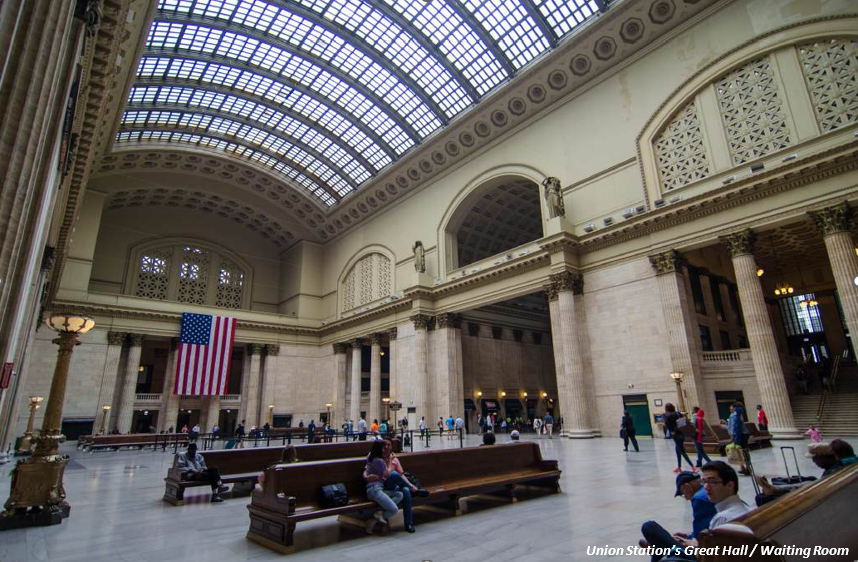
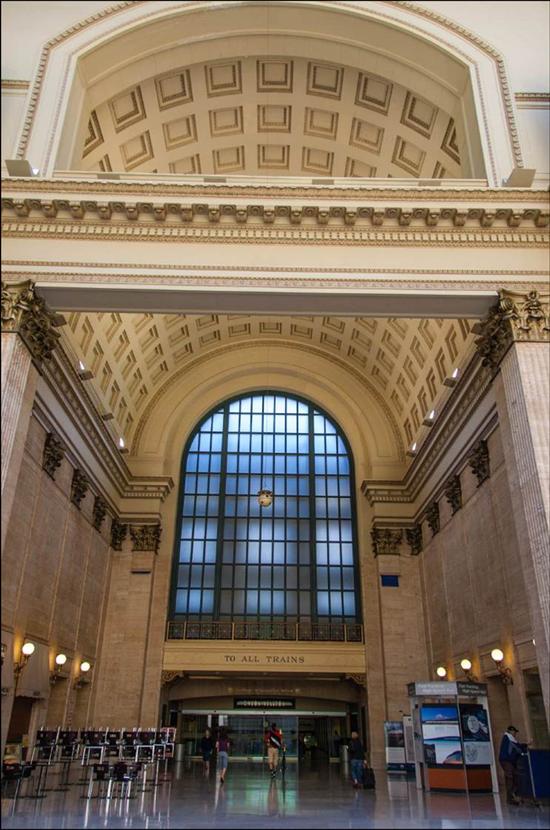
Unfortunately, Burnham died before construction began on the station and Burnham’s successor firm, Graham, Burnham & Company, later known as Graham, Anderson, Probst, and White, took over the design. After twelve years of planning and construction, the Beaux-Arts style Chicago Union Station was widely celebrated when it opened in May of 1925, with its magnificent Great Hall/Waiting Room and massive Corinthian-order travertine columns. The dramatic train station of magnificent pro- portions proved a source of civic pride. It has been featured in many prominent architecture books and scholarly periodicals. In addition, its design became an ideal setting for large functions and the grand staircase was featured prominently in the 1987 film The Untouchables and in other movies.
“Union Station is considered to be one of the most historically significant passenger railroad stations in the nation for its planning and grand architectural design” according to the Commission on Chicago Landmarks in the 2000 Landmark Designation Report.
HISTORY AND IMPACT:
Chicago grew from a small town to a major city in the second half of the 19th century and railroads played an integral role in this rapid growth. In 1890 Chicago’s population was around 500,000. Two decades later, Chicago’s population exploded to over two million in 1910. Chicago became a major transportation hub and the crossroads of the nation. In 1874, five of Chica- go’s railroads agreed to build a “Union Depot” at Adams and Canal Street, immediately north of present-day Union Station. Construction was completed in 1881 and supported increasing levels of ridership. Following the opening of Union Station, the Union Depot was later demolished. Carl Condit, renowned Chicago historian of urban and architectural history, stated that eve- ry day 1,300 trains carrying 175,000 passengers were passing through Chicago’s grand terminals in 1910. The ridership peaked at 270,000 a decade later.
The National Railroad Passenger Corporation was formed by Congress in 1970 and began operations under the name Amtrak. Congress gave Amtrak the responsibility to reroute all passenger trains starting from and terminating at Chicago’s six grand stations, LaSalle, Dearborn/Polk, Grand Central, Chicago & North Western, and Illinois Central into Chicago Union Station. While Amtrak was rerouting all trains into Chicago Union Station, it began cutting its passenger rail network in half. This significant decrease left the remaining Chicago stations with limited train traffic. In May 1984, Amtrak purchased the remaining ownership shares of CUSCo, ending any Chicago ownership stake.


The original Chicago Union Station terminal complex spanned a total of nine city blocks which consisted of a Headhouse building, occupying an entire city block between Canal and Clin- ton Streets; the Concourse building, located to the east of the Headhouse; and numerous glass, concrete, and steel train sheds. Between the 1920s and 1960s, Union Station was truly a city within a city.
In 1929, CUSCo sold the air rights over the tracks and plat- forms for the construction of the Chicago Daily News building, a few blocks to the north of the Concourse building. This was one of the earliest examples of a development which took advantage of air rights, a new type of legal vehicle. Then in 1932, air rights were sold over the southern tracks for the new Chicago Main Post Office. Both of these buildings were located close to the tracks to accommodate easy access to freight trains.

All that remains today is the Headhouse building and one block of the historic train sheds. All of the other buildings and structures have been demolished and redeveloped over time, including the spectacular Concourse building, “Chicago’s Penn Station”, which was the initial gateway to Chicago for millions of visitors with its soaring arched trusses and expansive glass sky- lights.
In 1968, CUSCo demolished the limestone-clad, steel-and-glass, Classical Revival Union Station Concourse building with its lofty grand spaces, arched steel members, and sky lit atrium modeled after New York City’s Penn Station’s Concourse. Air rights above the site were sold and two new office building structures were built. The loss of the Concourse building deprived train travelers of a grand entrance into Union Station and forced them into a subterranean maze of column-filled, utilitarian tunnels.
Union Station’s interior spaces and commuter experience have never recovered from the demolition of the soaring Union Station Concourse building.

In the early 1980s, the Fred Harvey restaurant in Union Station was damaged by a fire. This dramatic two-story space never reopened.
In 1991, the pedestrian flow of train passengers was diverted, thus denying commuters the opportunity to pass through the grand and majestic Great Hall/Waiting Room on their walk to and from work. Ironically, at a time when more passenger train passengers were being routed through Union Station, the opportunity to experience the heroic grandeur of the historic station had been significantly diminished.
LEGAL PRECEDENT:
“Penn Central, the owner of the Grand Central Terminal, leased the building to a company that planned to construct a 50-story office tower on top of it. However, the New York City Landmarks Preservation Commission had designated the terminal as a historic landmark, and the commission refused to allow the building’s exterior to be altered by the planned tower. Penn Central sued the city, and the case went to the U.S. Supreme Court.” (New York Times, 6/27/1978)
In 1978, the United States Supreme Court ruled in a landmark decision that New York City could block the construction of a 53- story office building above Grand Central Terminal as the tower would significantly alter the terminal’s status as a historic land- mark. New York City successfully argued that any additions to a landmark should “protect, enhance and perpetuate the original design, rather than overwhelm it.”

Six years later in 1985, a plan for two towers above Chicago Union Station was proposed but never materialized. This proposal followed the original Graham, Anderson, Probst, and White concept and continued the building’s materials, ornament, window size, window spacing, and cornice treatment. One of the original Graham, Anderson, Probst and White design renderings con- templated a single, limestone-clad, 12-story tower over the Headhouse building. Though the tower was never built, the original building structure was said to be designed to accommodate future tower construction. Unfortunately, the Chicago Landmark Designation of Union Station included a possible provision for the addition of a tower on top of the Headhouse. However, if constructed we fear that the proposed towers will adversely effect the historic building.
PROGRESS:
After decades of demolition and deferred maintenance, significant recent preservation-sensitive restoration work at Union Sta- tion has reversed this trend. Several important interior spaces and features have returned to public use, such as the Women’s Lounge, now known as the Burlington Room, and the Men’s Lounge and Barber Shop, which now form a series of passenger lounges. The restoration of the Great Hall/Waiting Room is underway, along with a comprehensive restoration of the Great Hall Skylight. Preservation Chicago has played an active role as a consulting partner in this process with Amtrak, the City of Chicago, and design teams, and we both recognize the challenges and applaud these amazing accomplishments.


THREATS:
A massive one billion dollar redevelopment proposal was presented by Amtrak for Chicago Union Station in May 2017. Mayor Emanuel and Amtrak CEO Wick Moorman unveiled the Chicago Union Station Master Plan which includes five new high-rises proposed to be built over existing railroad tracks and the Headhouse building. The proposed plans will consist of three phases and are expected to take six years to complete.
Chicago-based Goettsch Partners leads the project design team. The Chicago-based Riverside Investment and Development was selected to lead the project with a joint venture from Convexity Properties. Riverside Investment recently finished the 150
N. Riverside Plaza office tower and Convexity Properties recently completed the Robey Hotel in Wicker Park’s historic North- west Tower. Goettsch Partners was also the design team behind the recently restored Burlington Room and the ongoing renovation of the Great Hall skylight under the direction of its historic preservation design team led by Len Koroski.
Of paramount concern to Preservation Chicago is the proposed addition of a pair of non-conforming contemporary residential towers atop the Chicago Landmark Union Station Headhouse building designed by Daniel Burnham and Graham, Anderson, Probst and White. The new construction will certainly have a profound visual impact on this historic building.
There is serious concern regarding the use of a nearly 100-year old building structure to construct two new high-rise towers.
Another outstanding, yet overlooked feature of Union Station is its train shed design. The train sheds were designed with a “heart-shaped” truss over each column and an approximately 50 foot horizontal span. This innovative design helped to provide structural integrity with lighter gauge girders to support the roof load. The train shed’s height of 28 feet above the platform pro- vided more effective natural lighting and better ventilation, and was a remarkable engineering and design feat for its time.
The Chicago Union Station Master Plan also includes proposals to demolish the last of the remaining historic train sheds and build new wider platforms to accommodate increased traffic during peak hours. Stairs, escalators, and ADA-compliant elevators would add new access to the platforms.

Mayor Rahm Emanuel issued a Request for Qualifications (RFQ) for high-speed rail service between the Loop and O’Hare Air- port. In the RFQ, Union Station is included as a possible terminus. This is still in the conceptual stage but if this option were to be chosen, an extensive construction program would follow which could further threaten the remaining historic train sheds.

RECOMMENDATIONS:
Preservation Chicago is concerned that the proposed two contemporary towers will be an inappropriate addition to a highly significant Chicago Landmark building. If the developer proceeds with the building tower proposal and the City of Chicago permits an addition atop a Designated Chicago Landmark, the design should be highly compatible in form, massing, material, and scale, and follow the original Daniel Burnham and Graham, Anderson, Probst and White conceptual design as precisely and accurately as possible. It should seamlessly continue the historic building’s materials, ornament, window size, window spacing, and cornice treatment.
Chicago bears the unique shame of having an important designated historic building stripped of its National Register status in the case of the Holabird & Roche-designed Sol- dier’s Field. This public embarrassment must be prevented from happening again.
The impact of construction of two new towers above the Great Hall/Waiting Room is unclear. The risks to the nearly 100-year old Union Station building are significant. They could jeopardize the structural integrity of the historic structure which would cause a profoundly negative and adverse effect.

Preservation Chicago supports the criteria for designation by the Commission on Chicago Landmarks and the historical and architectural features identified in the Chicago Union Station Landmark Designation Report. These include “all the exterior elevations and rooflines of the building, including the Jackson Street and Adams Street porticos and the internal vehicular drive/drop- offs, and all interior features of the Great Hall main waiting room, including but not limited to the vaulted skylight and ceilings, columns and walls, floors, and the allegorical statues of ‘Day’ and ‘Night’ and the principal public spaces connecting to and opening onto the Great Hall, including the Canal, Jackson and Adams Street entrances, stairs, lobbies and balconies.”
Preservation Chicago advocates for restoration of the former Fred Harvey restaurant space, a first-class dining room and restaurant, located adjacent to the Great Hall/Waiting Room. Recently other former Fred Harvey restaurant spaces have been fully re- stored in Kansas City and Los Angeles train stations. The restoration of this area of the station with a high quality restaurant would further reinvigorate and reactivate Union Station.

Preservation Chicago advocates for the preservation of the natural light-filled platforms and historic train sheds, an engineering marvel of its day. Any plans to widen platforms to accommodate for increased passenger traffic could include creative solutions that could protect and reuse the existing metal, glass and concrete structures.
Preservation Chicago has advocated for the restoration of Union Station’s grand interior spaces and continues to advocate for the restoration of all remaining historic features. Any significant modifications to what remains of Chicago’s last standing grand train station and a Designated Chicago Landmark must be handled with the utmost sensitivity and caution
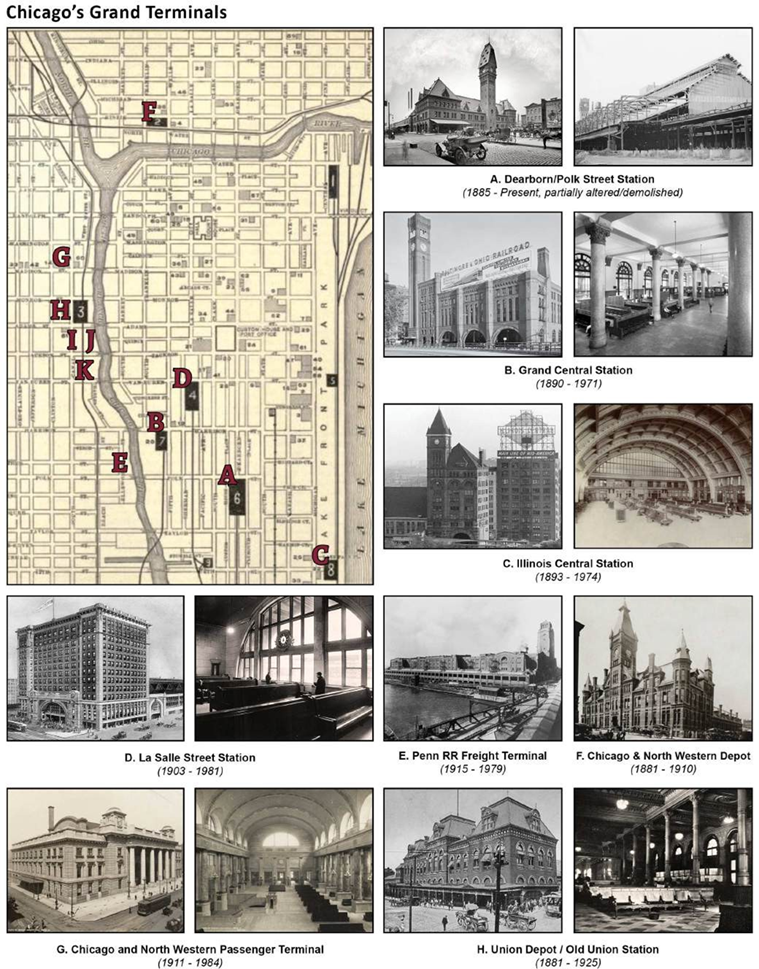


Image Credits:
A. Dearborn/Polk Street Station
Exterior: Chicagology, Terry Gregory
Sheds: Preservation Chicago Archival Image Collection
B. Grand Central Station
Exterior: Library of Congress, Prints & Photographs Division, ILL-1016-1 Interior: Ryerson & Burnham Archives — Archival Image Collection
C. Illinois Central Station
Exterior: http://drloihjournal.blogspot.com/2017/03/central-station-chicago-terminal-also.html Interior: Ryerson & Burnham Archives — Archival Image Collection
D. La Salle Street Station
Exterior: Postcard, Hammon Publishing Co.
Interior: Special Collections, Bradley University Library
E. Penn RR Freight Terminal
Ryerson & Burnham Archives — Archival Image Collection
F. Chicago & North Western Depot
Ryerson & Burnham Archives — Archival Image Collection
G. Chicago and Northwestern Passenger Terminal
Exterior: Ryerson & Burnham Archives — Archival Image Collection Interior: Ryerson & Burnham Archives — Archival Image Collection
H. Union Depot / Old Union Station
Exterior: Postcard, Hammon Publishing Co. Interior: Chicagology, Terry Gregory
I. Chicago Union Station — Headhouse and Waiting Room
Exterior: Ryerson & Burnham Archives — Archival Image Collection Interior: Ryerson & Burnham Archives — Archival Image Collection
J. Chicago Union Station — Concourse Building
Exterior: Ryerson & Burnham Archives — Archival Image Collection Interior: Ryerson & Burnham Archives — Archival Image Collection
K. Chicago Union Station — Train Sheds
Left: Chuckmanchicagonostalgia.wordpress.com Right: Photography by Anthony L. Mourkas