



“In May, Pabst Brewing announced they were discontinuing Schlitz beer after 177 years. Across Chicago, drinkers scrambled for one last sip. Liquor stores quickly sold out. From Electric Funeral in Bridgeport to Schubas and the Long Room in Lakeview, bars gave last rites to the ‘beer that made Milwaukee famous.’
”But over the weekend, Glunz Tavern, 1201 N. Wells St. in Old Town, declared it was tapping what it claimed was the ‘last barrel of Schlitz in Chicago.’
”Few spots in Chicago have a stronger or longer connection to Schlitz than Glunz Tavern. The Glunzes have been in the beer business since 1879, when Louis Glunz emigrated from Germany and began working for Charles Wacker’s brewery.
”In 1888, with savings and a loan from Wacker, Glunz started his own liquor business at Wells and Division streets.
”Right away, he secured a contract to distribute Schlitz. Horse-drawn carriages, with the Glunz and Schlitz names emblazoned across their sides, bolted around the city to meet the demands of thirsty Chicagoans. Business boomed following the Columbian Exposition of 1893, when Schlitz chose Glunz to become Chicago’s first bottler of the beer.
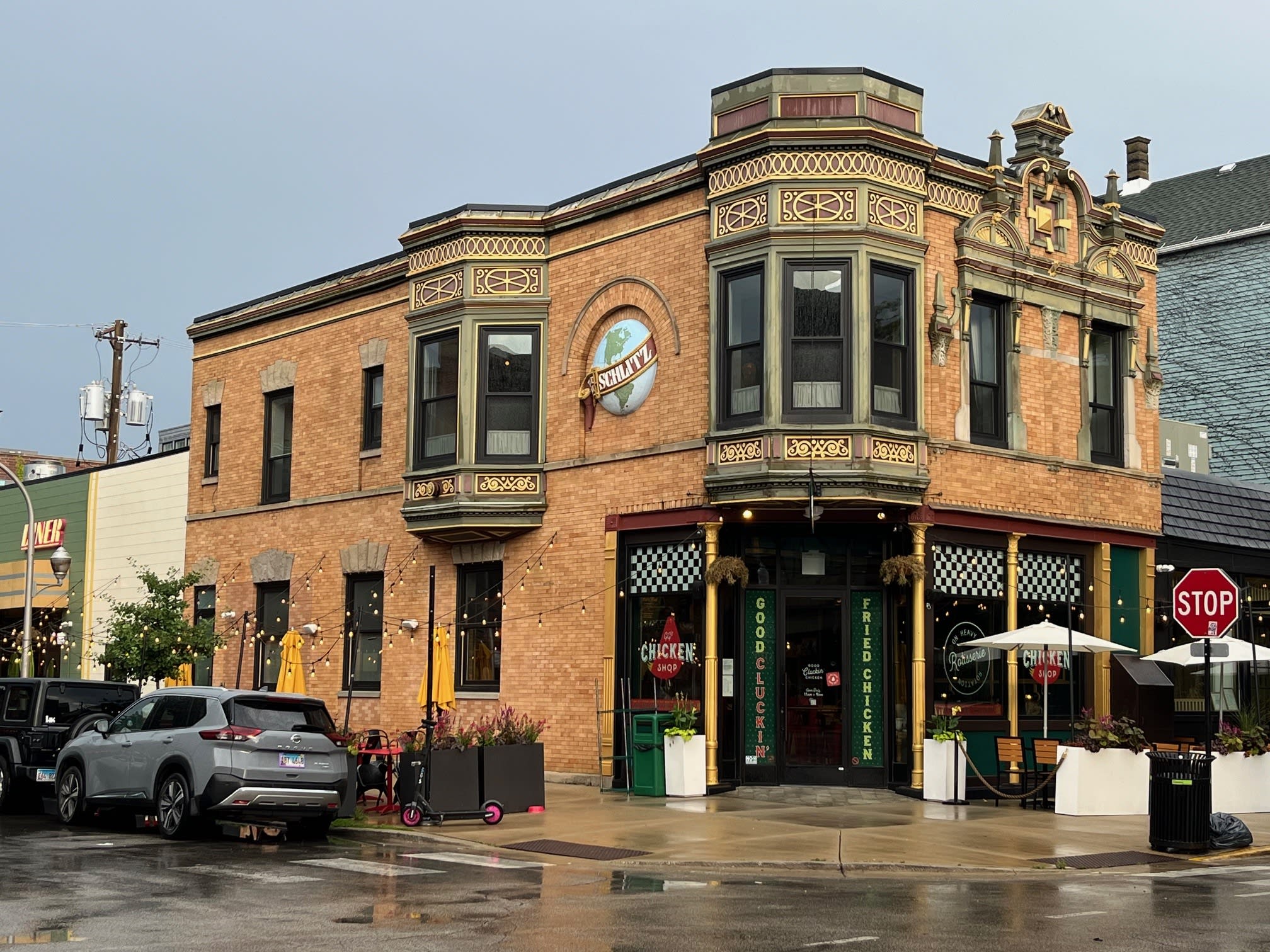
”The Windy City was so obsessed with Schlitz that the brewery built 57 tied houses — bars that exclusively sold Schlitz — to keep up. Forty-one still stand today, displaying the iconic Schlitz globe.
”’Schlitz was integral to our success,’ said [Christopher] Donovan. ‘It became the biggest beer in the world, it was huge. It’s the reason we’re still here today.’
”Schlitz and Glunz continued to prosper into the 20th century. Both survived Prohibition by adapting their businesses. Schlitz pivoted to candy, syrups and ‘near beer,’ while Glunz switched to selling ‘sacramental wines and medicinal products,’ according to its website.
”Glunz, meanwhile, diversified its distribution and continued to grow. In 1999, Schlitz was sold to Pabst. Though Schlitz’s fortunes faded, Glunz stuck by the beer that helped it get its start.
”’Schlitz has always been a part of us,’ Donovan said.
”At 5:28 p.m., that proved true. What appeared to be the final keg of Schlitz anywhere, kicked in a gush of froth and lager. The beer that helped launch Glunz, drunk by generations of Chicagoans, was declared dead.
”Asked what his great-grandfather would think if he saw people drinking the last barrel of Schlitz at Glunz Tavern, Donovan said: ‘He’d be sad to see it go, but he’d be happy to see all these people in the tavern as it always was. It’d be bittersweet.’” (Niendorf, Block Club Chicago, 8/13/26)
”Founded in Milwaukee in 1849 by a German immigrant named August Krug (Joseph Schlitz, who began as Krug’s bookkeeper, took over the company in 1856 and renamed it after himself) the brand’s popularity exploded across the region in the aftermath of tragedy. When the Great Chicago Fire of 1871 destroyed several of the city’s breweries, Schlitz stepped into the void. Some accounts hold that the company sent beer and drinking water to aid residents in the fire’s aftermath; what is certain is that Schlitz’s Chicago sales doubled by 1872.
”This local importance was made clear to international audiences at the 1893 World’s Columbian Exhibition, which for five months turned Chicago into ‘the White City.’ Schlitz spent $20,000 — more than $740,000 in today’s money — on a professionally designed pavilion inside the fair’s massive Agricultural Building, offering patrons pours of Schlitz beers.
”’There was an exhibition piece I needed to do for the Manufacturer’s Building, the Schlitz Brewery trademark of a huge globe with a buckled belt around it,’ wrote Richard W. Bock, the sculptor tasked with the design, in his memoir, according to City of Chicago documents. ‘This globe was supported by four female figures in playful poses representing the four hemispheres. At their feet were gnomes. Flanking this centerpiece were four pedestals constructed of beer kegs, three to a pedestal, and on top of each a herald blowing a trumpet.’
”Art historians have noted that this ornate commission was the genesis for many subsequent high-profile artistic and architectural collaborations around Chicago.
”’It was Bock’s first use of a globe and supporting figures, a motif that he would employ several times in sculpture for Frank Lloyd Wright,’ historian Donald P. Hallmark wrote in a 1971 edition of the Prairie School Review. ‘The ideas used in the exhibit for the Joseph Schlitz Brewing Company remained in Bock’s mind for many years and did not disappear as quickly as the actual sculpture did upon the completion of the fair’s run in late 1893.’
”Many of these symbols, with the Schlitz name prominently displayed, would go on to adorn the facades of Chicago’s neighborhoods. Between 1897 and 1905, the Schlitz company built 57 brewery-tied houses across the city. In establishments like these, beer companies supplied owners with everything they needed to operate a bar, with the caveat that they could only serve that brand’s brews. They ceased operation during Prohibition, and new state laws made tied-houses obsolete. Today, 41 of these former Schlitz tied-houses still stand. Ten of them, as well as one brewery stable, have been designated as Chicago landmarks; some are still even pubs or restaurants.” (Thorsberg, Smithsonian Magazine, 8/14/26)
Preservation Chicago raises a glass to the House of Glunz and Glunz Tavern, a Chicago Legacy Business since 1888. Louis Glunz got his start in Charles Wacker’s brewery and opened his own business with a loan from Wacker, whose family home at 1838 N. Lincoln Park West has been the focus of a preservation advocacy effort.
Schlitz constructed fifty-seven tied houses in Chicago between 1897 and 1905, and forty-one of them are still standing, most still carrying the terra cotta Schlitz globe over the door. They are excellent examples of small commercial buildings in the city, built of brick and stone and terra cotta and many still serve as neighborhood corner anchors.
In 2011, the Commission on Chicago Landmarks designated five Schlitz tied houses and one brewery stable, and additional buildings have followed, including the Lake Street Schlitz Tied House at 1393-1399 W. Lake Street, which Preservation Chicago helped save from demolition in December 2020, and the tied house at 9401 S. Ewing Avenue. Eleven Schlitz buildings now hold Chicago Landmark status.
That leaves roughly thirty surviving Schlitz tied houses without landmark protection at all. Preservation Chicago encourages the Commission on Chicago Landmarks and the Department of Planning and Development to complete a survey of the remaining tied houses and to advance designations for the best of them, and we encourage owners and neighbors to recognize wand celebrate these buildings which are so much a part of Chicago’s histroy.
Read the full story at Block Club Chicago and Smithsonian Magazine
- Glunz Tavern Taps Final Barrel Of Schlitz Beer In Chicago; The Old Town bar was an appropriate final resting place for the iconic beer: It was Chicago’s first bottler of Schlitz in 1893, Matt Niendorf, Block Club Chicago, 8/13/26
- Schlitz Beer, an Iconic Midwestern Pour, Runs Dry in Chicago After 177 Years. Its Legacy, However, Goes Far Beyond the Pint Glass; With significant roles in the Great Chicago Fire, 1893 World’s Fair and modern-day architecture, the beer’s impact on the Windy City is undeniable, Christian Thorsberg, Smithsonian Magazine, 8/14/26
- Chicago Toasts To Schlitz As Bars Serve Up Their Last Kegs Of The Truly Midwestern Beer, Block Club Chicago, 5/26/26
- Five Schlitz Brewery Tied-Houses and One Brewery Stable; Landmark Designation Report, Commission on Chicago Landmarks
- The House of Glunz
- Glunz Tavern
- CBS News Chicago: Chicago’s Former Tied Houses Once Linked with Schlitz and other Breweries Offer a Window to History; Preservation Chicago, 5/2026
- Landmarks: A Schlitz-built tied house being reborn as East Side Tap, saving a structure and over a century of neighborhood stories; Preservation Chicago
- WIN: Schlitz Tied House at 9401 S. Ewing Avenue Granted Landmark Status!; Preservation Chicago
- WIN: Within Hours of Demolition in December 2020, Lake Street Schlitz Tied House Achieves Permanent Protection Through Chicago Landmark Designation; Preservation Chicago
- THREATENED: Owner Neglect Accelerates Deterioration of Lake Street Schlitz Tied House; Preservation Chicago