
The Delaware Building / Bryant Block
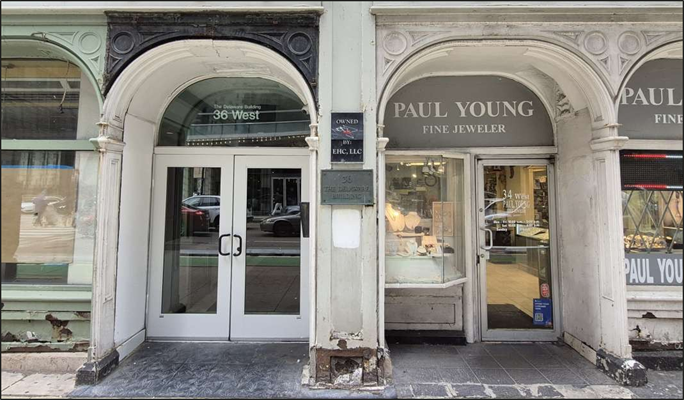
Address: 36 W. Randolph Street / 151 – 155 N. Dearborn Street
Architects: Wheelock & Thomas, Julius Huber
Date: 1872-1874, 1889 addition
Style: Italianate
Neighborhood: Chicago Loop / Downtown
OVERVIEW
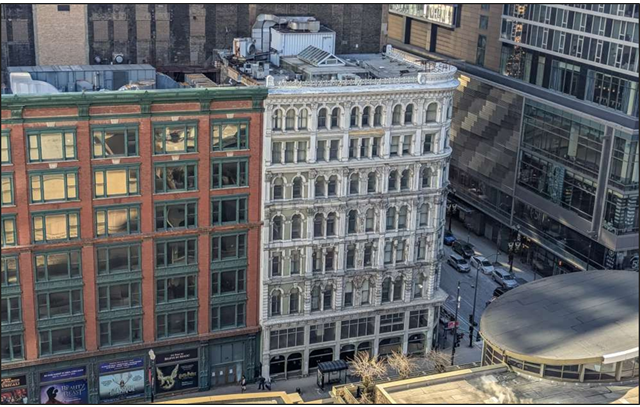
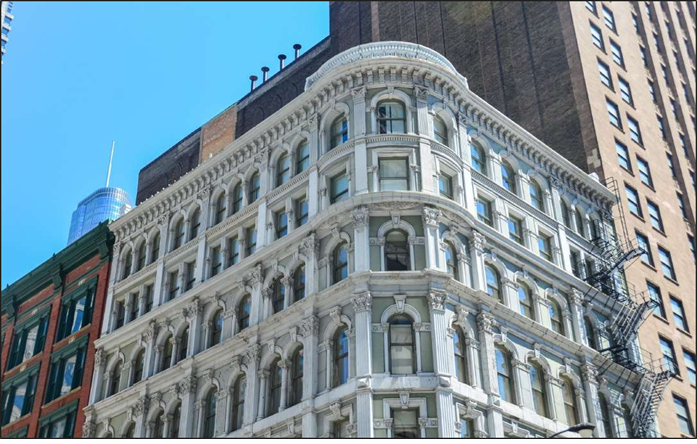
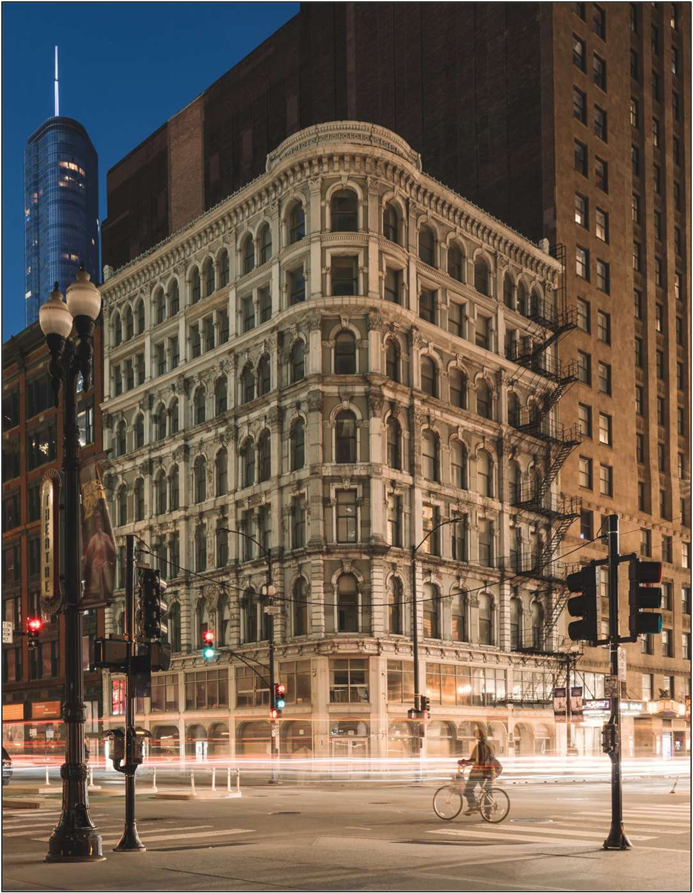
After the devastating Great Chicago Fire of 1871, the city’s Central Business District quickly sought to rebuild. The Delaware Building at 36 W. Randolph Street (also 151-155 N. Dearborn Street) is one of the few remaining buildings from the Loop’s period of early reconstruction and a significant example of Italianate- style architecture. It is further believed to be one of the oldest surviving commercial buildings of its kind within the Loop.
The building was listed on the National Register in 1974 and designated a Chicago Landmark in 1983. That same year, noted preservation architect Wilbert R.
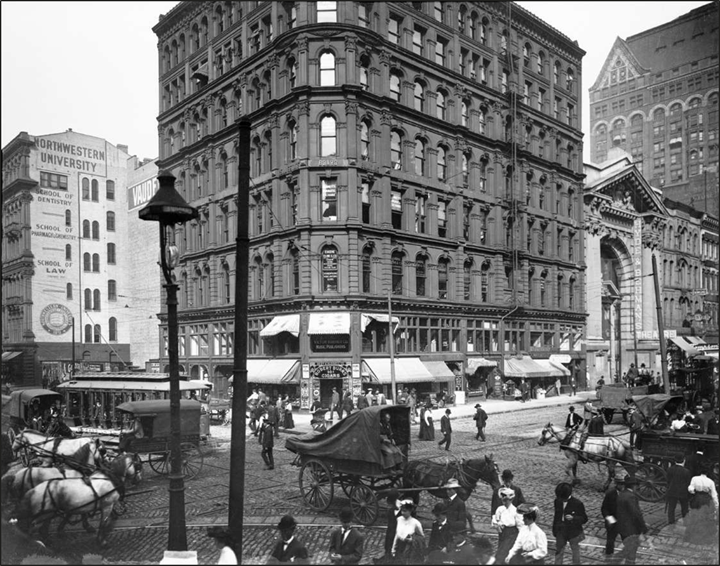
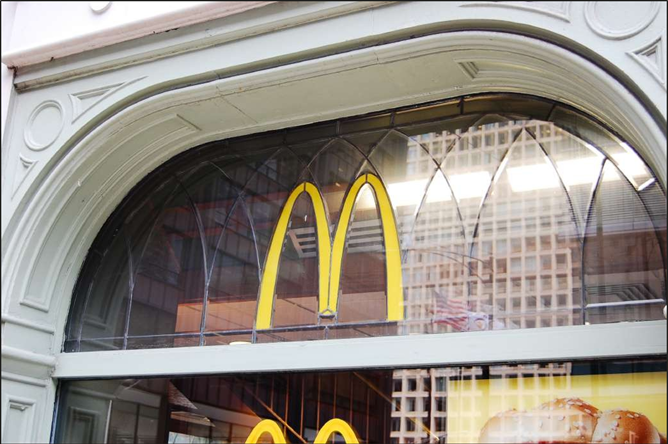
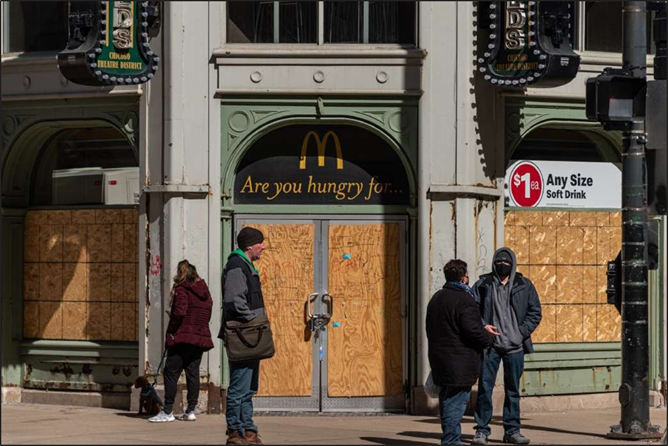
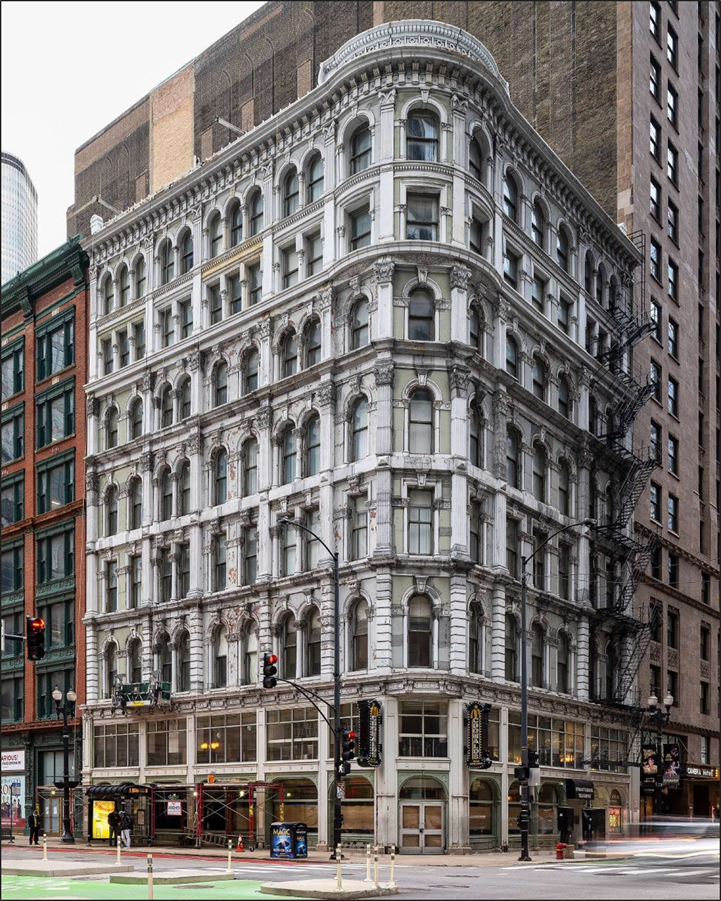
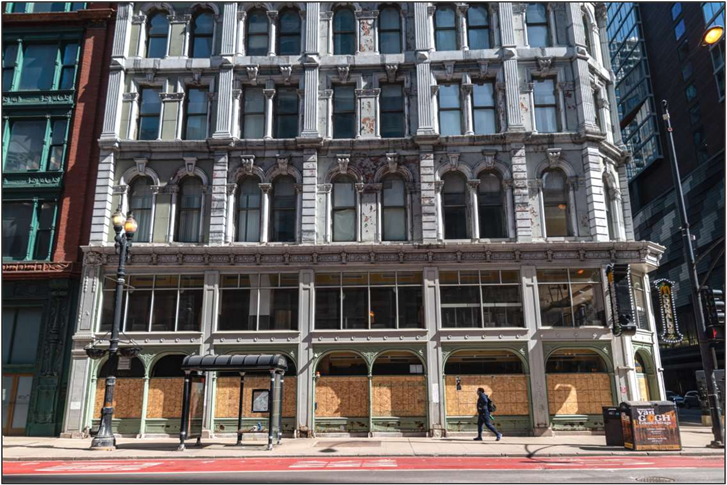
Hasbrouck (1931-2018) of Hasbrouck Hunderman Architects, oversaw a restoration of the building, focusing especially on a recreation of cast iron of the lower floors and historic ground floor entrances. Despite its recognized significance and prime location, plans to reuse the building have long been stalled by long-term leaseholder, the McDonald’s Corporation, which once operated a McDonald’s restaurant on the lower two floors of the Delaware Building. The McDonald’s location closed amid the pandemic with no apparent plans to reopen, but the parent company reportedly refuses to relinquish its lease. A planned residential conversion of the upper floors of the building and replacement tenant for the ground floor commercial space, which would require updated zoning compliance and additional means of egress, is effectively stymied while the lease remains in place.
HISTORY
Buildings constructed in the years immediately following the Great Fire of 1871, closely resembled those lost to the disaster in both use and form. Most were commercial in function, three to six stories in height, and constructed with party walls to form continuous streetscapes with architecturally refined facades, most commonly in the Italianate and Renaissance Revival styles. The Delaware Building was among these early post-Fire buildings and today stands as one of the few last surviving examples of Chicago’s “Great Rebuilding” in the Loop.
Construction of the Delaware Building began in 1872, with an addition to the east added two years later. It was
originally opened in 1874 as the Bryant Block, named after its initial owner James W. Bryant, who invested $165,000 on Dearborn Street during Chicago’s “Great Rebuilding” effort. The structure was designed by the early Chicago architectural firm of Wheelock & Thomas and constructed by George A. Fuller Company.
Architects Otis L. Wheelock (1816-1893) and Cyrus Pole “C.P.” Thomas (1833-1911), Thomas being the son of noted Canadian architect William Thomas (1799-1860), were among the luminaries of Chicago’s early architectural practice. C. P. Thomas, raised and educated in Toronto, was active in both Canadian and American architectural firms during the late 19th century. Between 1870 and 1897, he practiced in Chicago, contributing to nearly 200 projects across commercial, industrial, residential, and institutional sectors, either alone or in partnerships. From 1872 to 1875, Thomas was in partnership with Otis L. Wheelock, an architect originally from New York. During this period, they participated in and designed over 30 projects along major streets such as State Street, Wabash Avenue, Dearborn Street, Randolph Street, Monroe Street, and Washington Street. These projects included the Delaware Building (1872-1874), Merchants Building (1873), the Wheeler & Wilson Building (1873), the Haskell- Barker-Atwater Buildings (1875 and 1877), the Reed Block, also known as the Hibbard, Spencer, Bartlett Company Building (1872), and the McVickers Theater (1872). In addition to his partnership with Thomas, Wheelock went on to work with other noted Chicago-based practitioners, namely, W.W. Boyington (1818-1898), W.W. Clay (1849- 1926), and his own adopted son, Harry Bergen Wheelock (1861-1934). Nevertheless, the Delaware Building remains one of the most notable and celebrated works of both Wheelock and Thomas.
Born in Templeton, Massachusetts, the general contractor George A. Fuller (1851-1900) was among the earliest architects educated at MIT. As a highly talented designer, his proposal for a new clubhouse for the Union League Club of New York, won over prominent architects Richard Morris Hunt, Charles McKim, and William Rutherford Mead. Fuller later moved to Chicago, where he established the George A. Fuller Company in 1882. Often credited as one of the “inventors” of the assembly of the modern skyscraper, Fuller encouraged the use of steel in
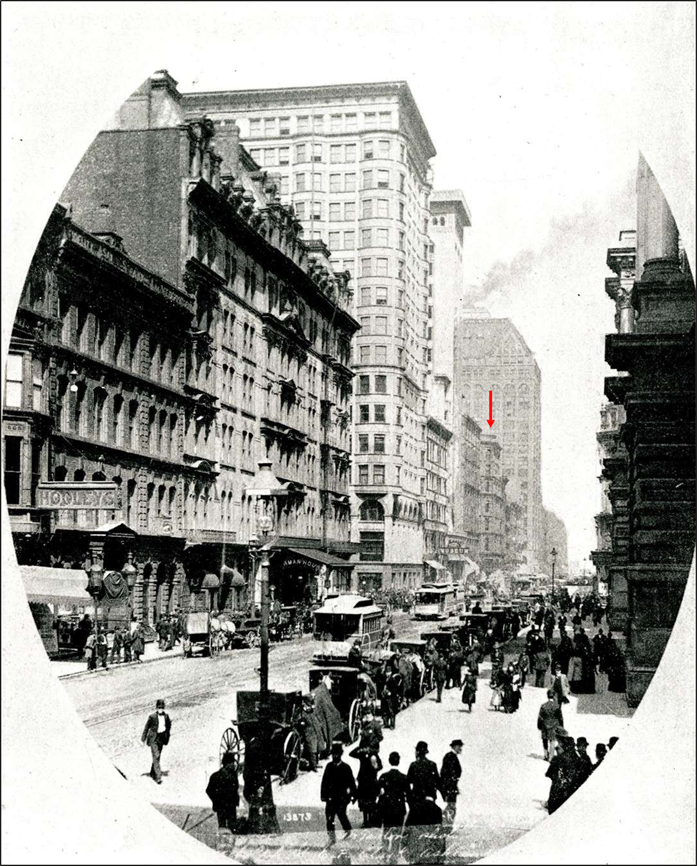
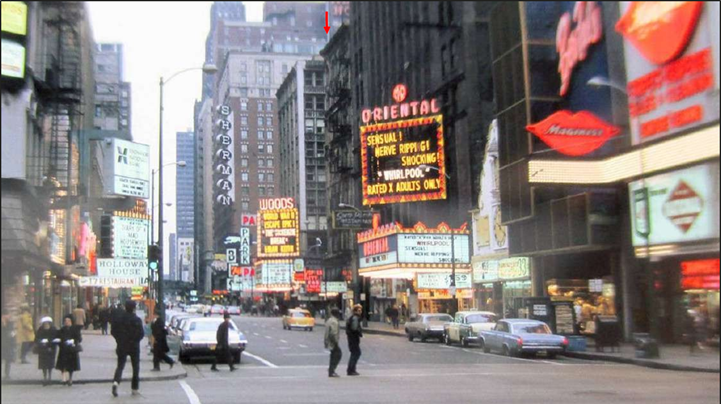
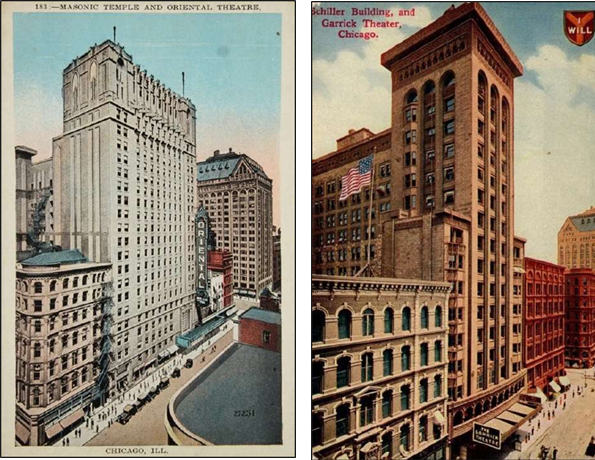
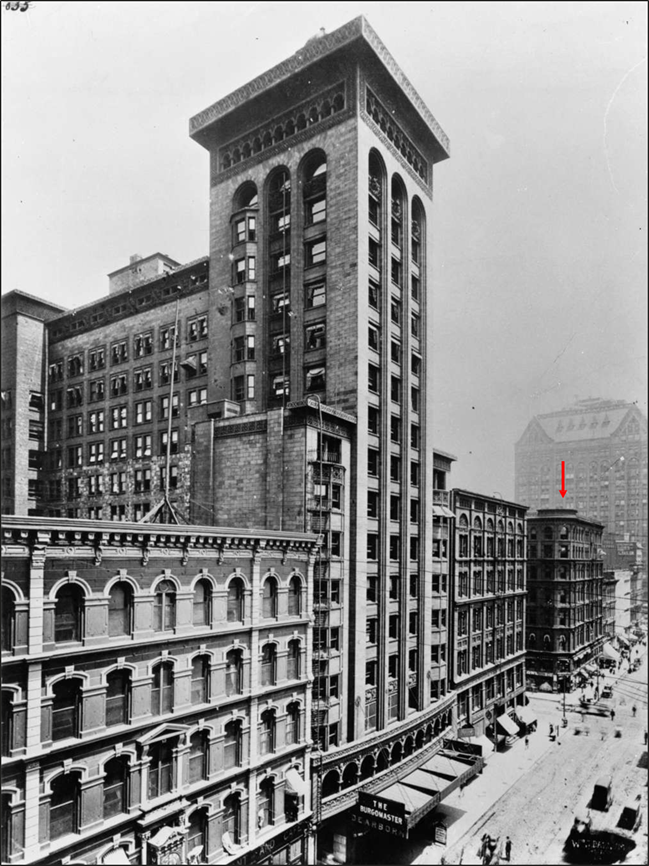
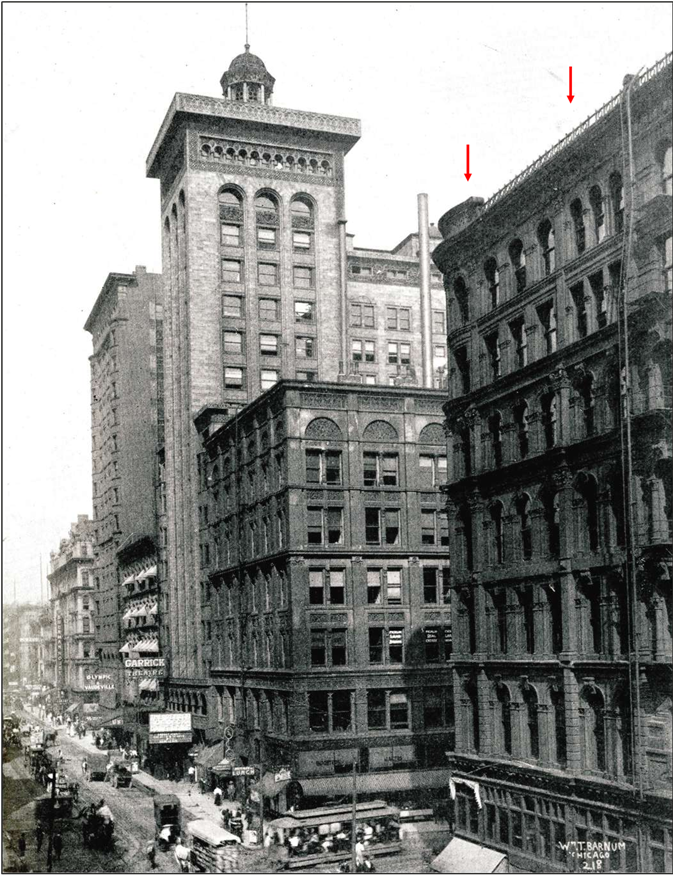
Randolph Street looking east from Hooley’s Theatre, circa 1892, with the Delaware Building in the distance noted with a red arrow. All other buildings in the photograph have been lost to demolition, including the Borden Block and Schiller/Garrick Building by Adler & Sullivan, the Ashland Block by Burnham & Root, the Masonic Temple by Burnham & Root, and the Sherman House Hotel. Photo credit: Chicago and Its Makers, Paul Gilbert and Charles Lee Bryson, 1929, pg. 146 / Preservation Chicago Library Collection
construction of buildings designed b y architectural firms. He also created the new concept of a general contractor, who would handle all of the various trades working in tandem on a building’s construction. In this capacity , Fuller ’ s company could oversee almost every aspect of a project’s development and execution, with the exception of its design, which was left to his many prominent clients. Fuller’s firm contributed to several iconic buildings, including the Rookery Building (1888, Burnham and Root), the Rand McNally Building (1890, Burnham & Root), the Pontiac Building ( 1891 , Holabird & Roche), the Monadnock Building (1891, Burnham & Root; 1893, Holabird & Roche) in Chicago, as well as the New York Times Building (1889, George B. Post) and the Fuller Building, also known as the “Flatiron Building” (Daniel Burnham and Frederick Dinkel berg, 1902) in New York City, among others.
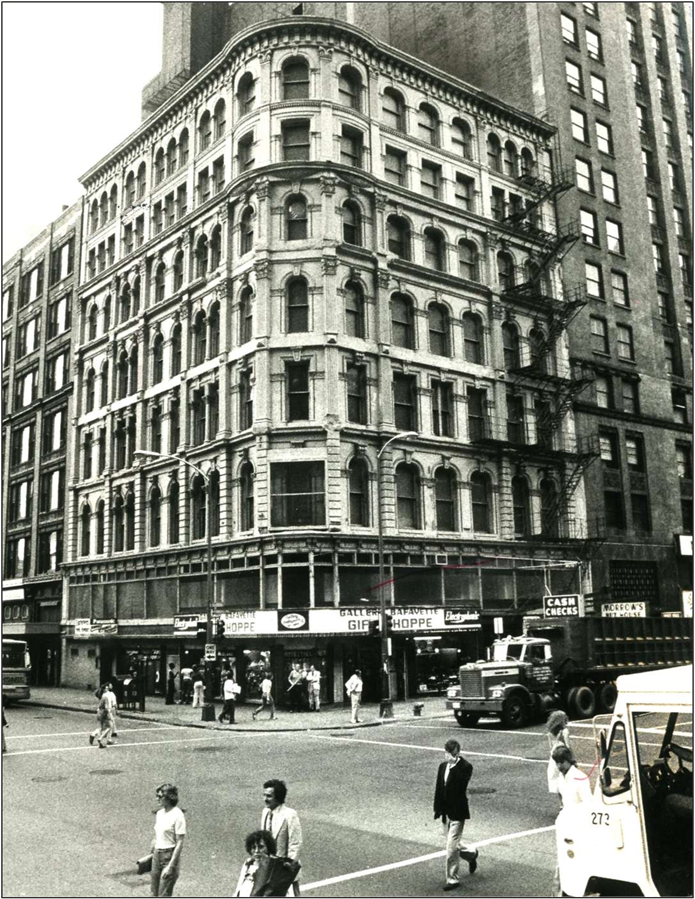
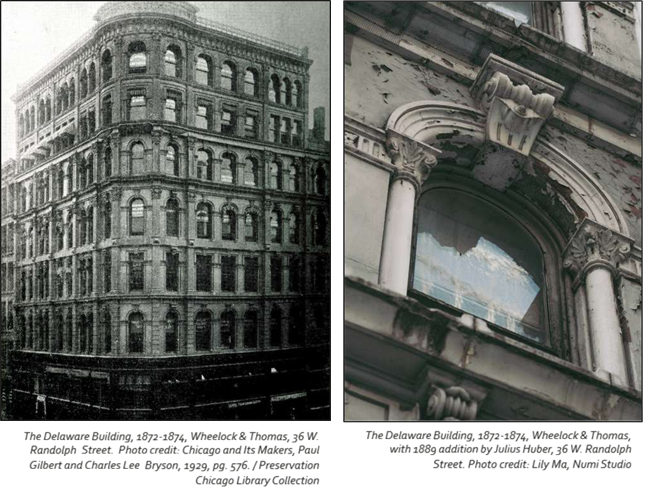
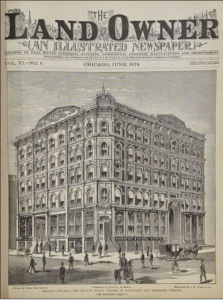
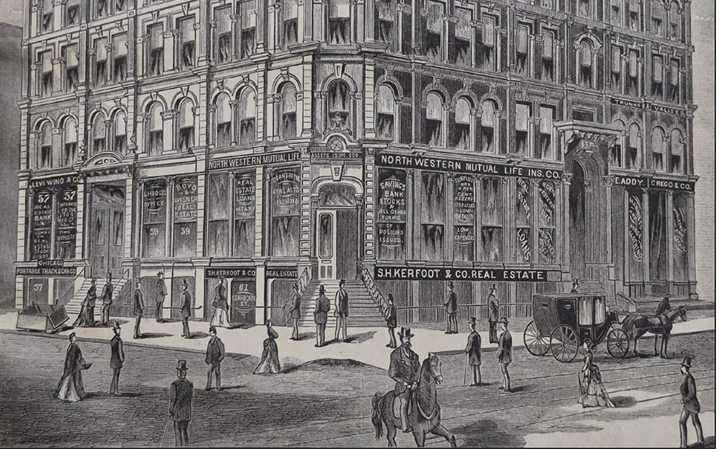
The Bryant Block was originally five stories with street-level and below-grade storefronts. Three separate principal entries with large stairways ( later removed) were located along both Dearborn Street, Randolph Street, with the most prominent at the corner intersection of Randolph and Dearborn Streets. These entries led to the tall upper floor storefronts and offices above, with others more modest in character leading to the lower level, located just above grade. The large one- and-a-half-story arched main entrance (later removed) on the Randolph Street side of the building also led to the many office suites on the upper floors. The two lower floors housed businesses and retail ventures, while the upper floors served as offices. The Bryant Block’s earliest tenants included real estate and insurance companies, including Northwestern Mutual Life Insurance Company, S.H. Kerfoot & Company Real Estate. Levi Wing & Company, Boyd & Wisner and other firms. In the 1880s, as social norms around sexuality were narrowly defined
the Bryant Block also gained a reputation as a brothel on its upper floors, along with the so-called “queer bordellos,” before being revisioned and expanded as the Delaware Building in the 1880s. Despite these perceived early controversies, the building would go on to accommodate a wide variety of tenants over its 150-year history.
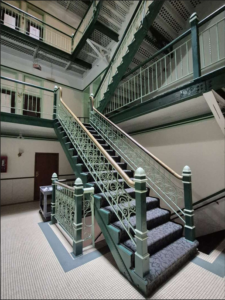
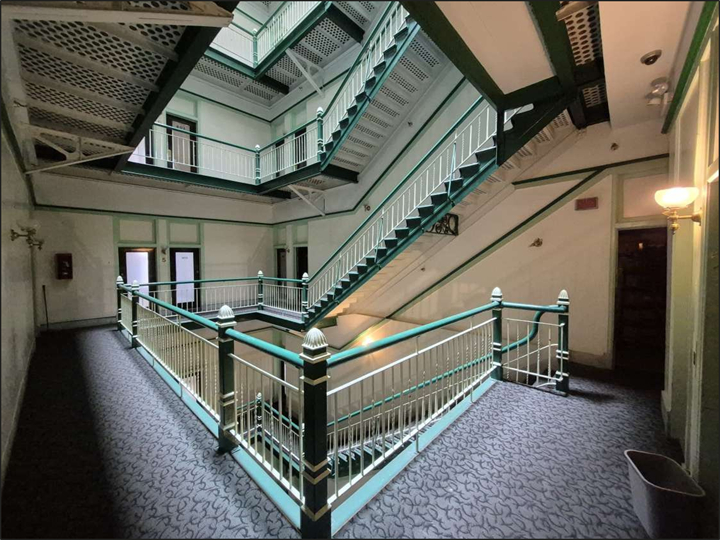
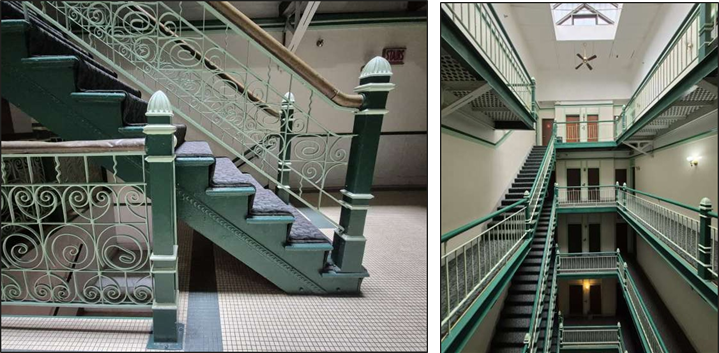
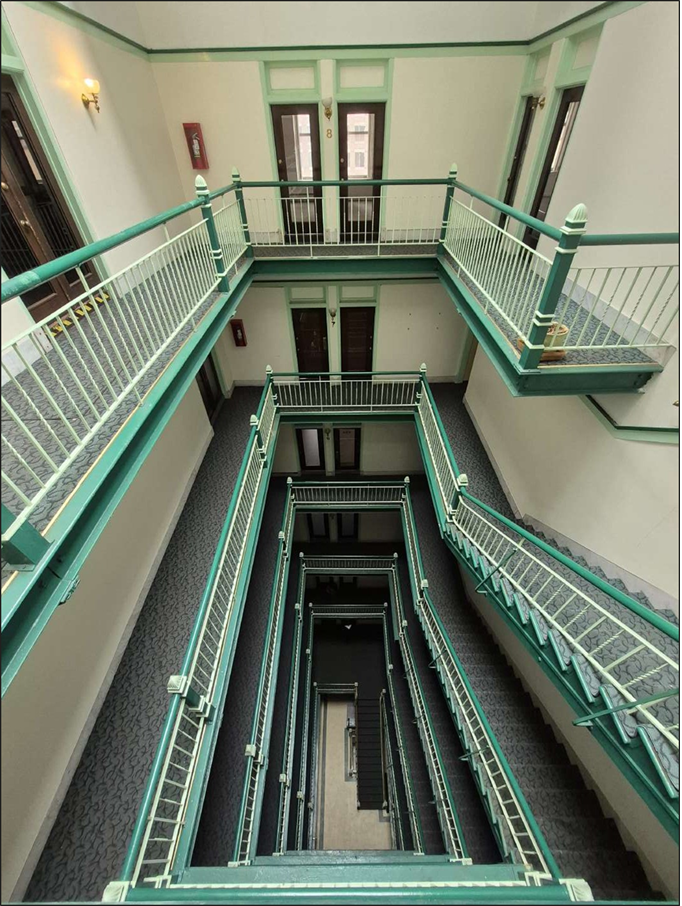
In 1889, the building was remodeled by architect Julius Huber (1852-1939), a prominent Chicago architect active in the late 19th early 20th centuries. Huber’s practice encompassed churches, breweries, including Brand’s Hall (c.1877) at Clark and Erie Streets, as well as residences, apartments, stores, and office buildings. At the same time, it was renamed the Real Estate Board Building in deference to its new tenants, the Chicago Real Estate Board. While the 1889 remodeling included a number of modifications, they remained sympathetic to the building’s original design. Exterior alterations included the addition of the top two stories of the building, which were clad in decorative sheet metal, and the addition of a wrought-iron balustrade and a corner projection at the roofline (no longer extant). The two lower levels were also remodeled at this time with large commercial windows, in addition to a beautiful interior light court and an ornamented open stairwell which was incorporated into the building. The removal of several bays from the eastern end of the Randolph Street facade occurred in 1924, with the construction of the new Masonic Temple/Civic Tower and the Oriental Theatre, now Nedelander Theater complex. These easternmost bays had been added to the building in 1874, on a ground lease which was later sold and that land became part of the Masonic Temple/Civic Tower.
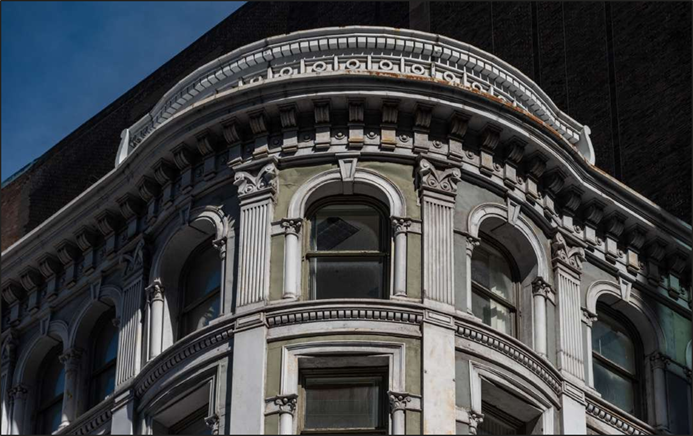
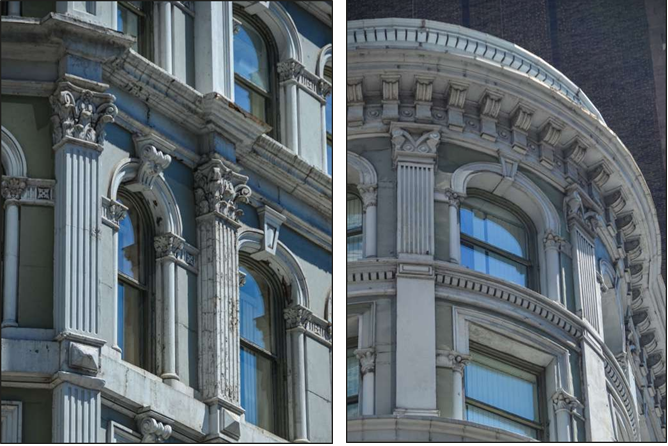
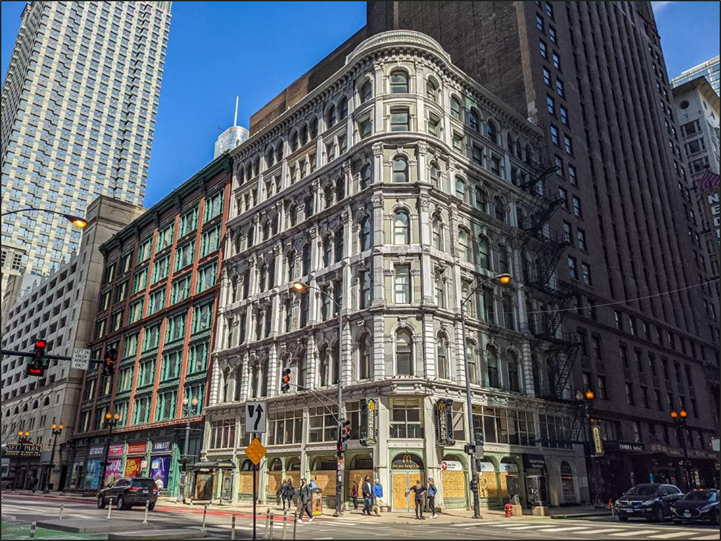
The masonry facade; alternating square- and round-arch lintels featuring inset keystones and Corinthian capitals; and alternating Doric and Ionic pilasters rising to the upper floors are among the building’s character defining features, which are said to be cast-stone. A modest but handsomely bracketed cornice is also highly visible from the street and extends the full width of the building’s facades along Randolph and Dearborn Streets.
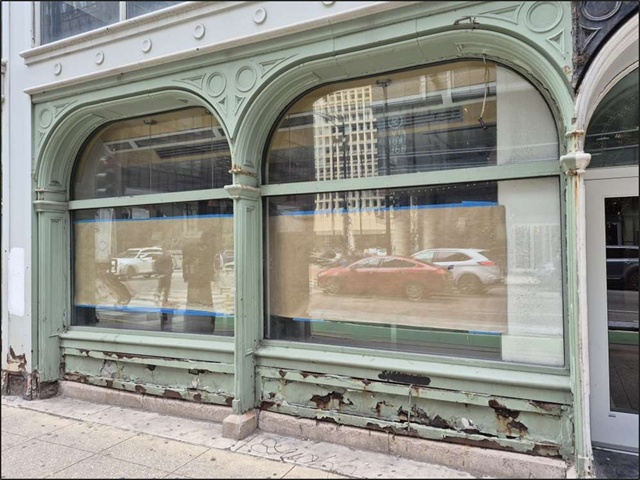
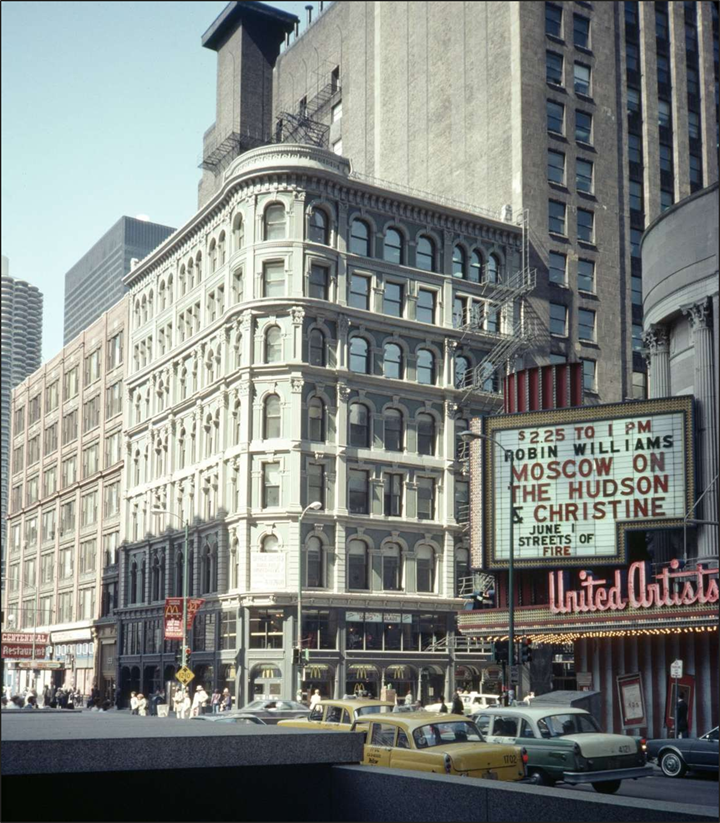
The two lower levels, originally featuring cast-iron façades, were periodically remodeled after 1889, with the most significant alternation occurring in the 1940s, when the façades were resurfaced with cement plaster, yet they remained largely composed of iron and glass. Today, they reflect the 1983 restoration directed by Hasbrouck, during which the cast-iron outer curvatures and decorative columns attached to structural steel were reconstructed based on archival photographs. The zinc-coated sheet-steel cladding on the two additional stories added in 1882
w a s a l s o p a r t i a l l y reconstructed due to severe deterioration. The interior was completely revisioned and reconfigured, with new HVAC systems installed as part of the restoration. Notably, the Delaware Building was the first structure renovated under t h e N o r t h L o o p Redevelopment Guidelines released in 1981. The restoration cost $2,193,000, equivalent to approximately
$7 million in today’s dollars.
Despite these and other alterations, the building remains a fine example of Italianate architecture and e a r l y p o s t – F i r e reconstruction. The upper stories of the building retain a high level of integrity, with t h e b r a c k e t e d a n d articulated cornice still in place. The significance of the building has been recognized through designation as both a Chicago Landmark and its listing on the National Register of Historic Places. U n f o r t u n a t e l y , t h i s remarkable building remains underutilized. McDonald’s, which continues to hold a lease on the two lower floors of the building, has slowed the building owners’ efforts to reuse and/or repurpose the property.
THREAT
McDonald’s Corporation holds a long-term, 99-year lease on the lower two floors of the Delaware Building. The fast food restaurant operated in the building for decades before closing down during the beginning of the COVID-19 pandemic. While the building’s owners have considered plans to revitalize the structure by converting the upper floor offices into new residences, or even offering it for sale, McDonald’s lease includes space needed to add a second means of egress. Its large, currently vacant footprint on the majority of the first-and-second-floor space likewise poses challenges to future reinvestment. Although the restaurant has been closed, leaving the building vacant for nearly four years without plans to reopen, the parent company has yet to agree to releasing the space. The Delaware Building has also had a list of building code violations pending for many years, which need to be addressed.

RECOMMENDATIONS
The Delaware Building already benefits from some of the highest and most protective recognition available for a historic property. Its status as a National Register-listed property makes any future rehabilitation potentially eligible for state and federal historic tax credits. Its further status as a designated Chicago Landmark protects it against demolition and insensitive alterations.
Amid a deeply challenging context for downtown commercial spaces, it is vital that the lower-floor commercial space be released and made available for renewed investment and adaptive reuse.
The upper floors could likewise accommodate a small hotel, multi-family residential units, or continued office space, all of which are in alignment with recent Department of Planning and Development initiatives. Reactivating this highly visible and active corner of the Loop could help the slow but steady economic recovery out of the COVID-19 pandemic, while addressing evolving needs in Chicago’s commercial business district.
Constructed in response to one of the greatest urban disasters of the nineteenth century, the Delaware Building, alongside its neighbors, was intended as a beacon for future commercial i n v e s t m e n t a n d a demonstration of the city’s resilience amid ruin.
In 2025, the Delaware Building can again signal a response to devastating change, and again demonstrate the value and adaptability of Chicago’s historic downtown spaces.