


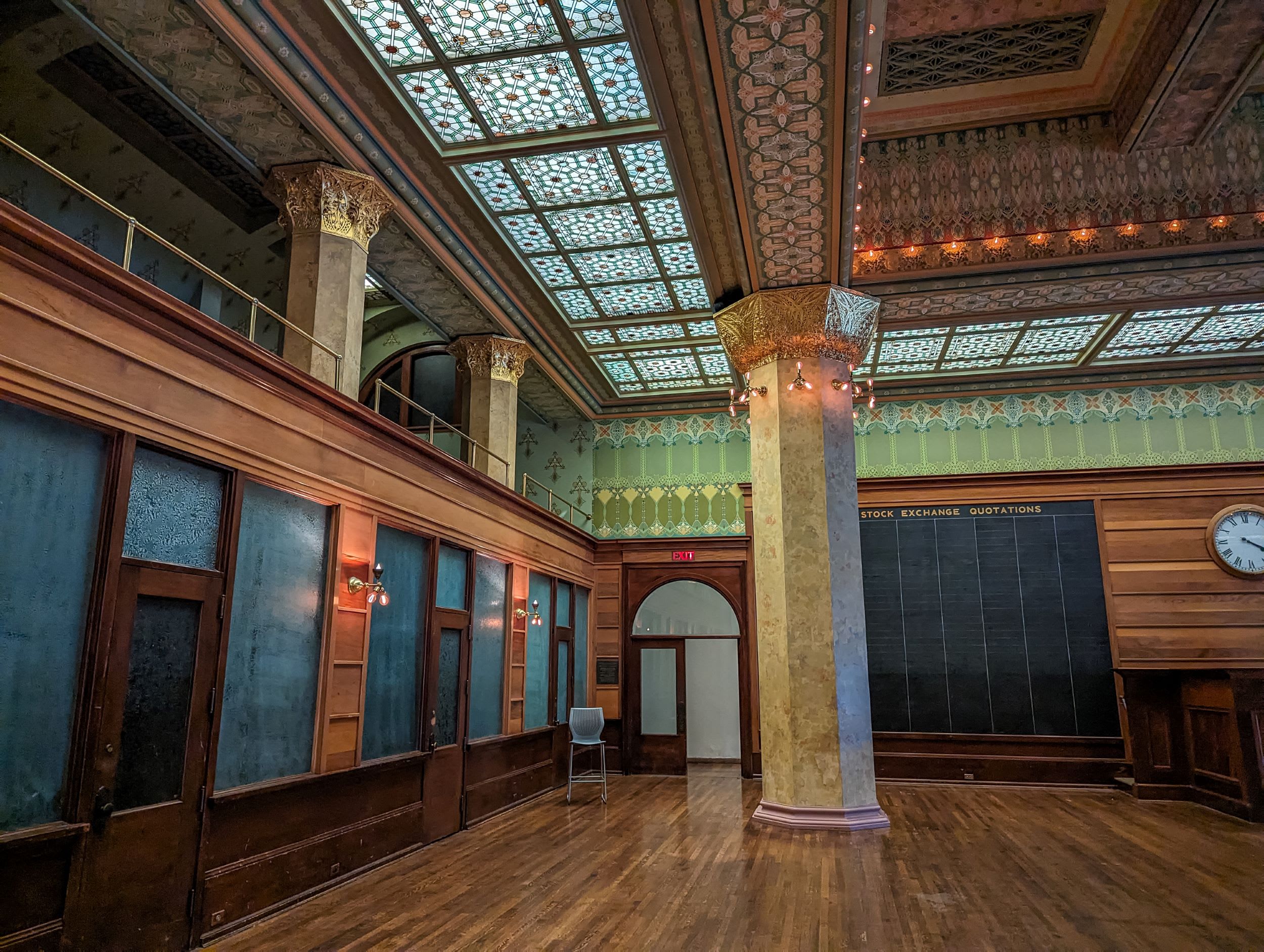

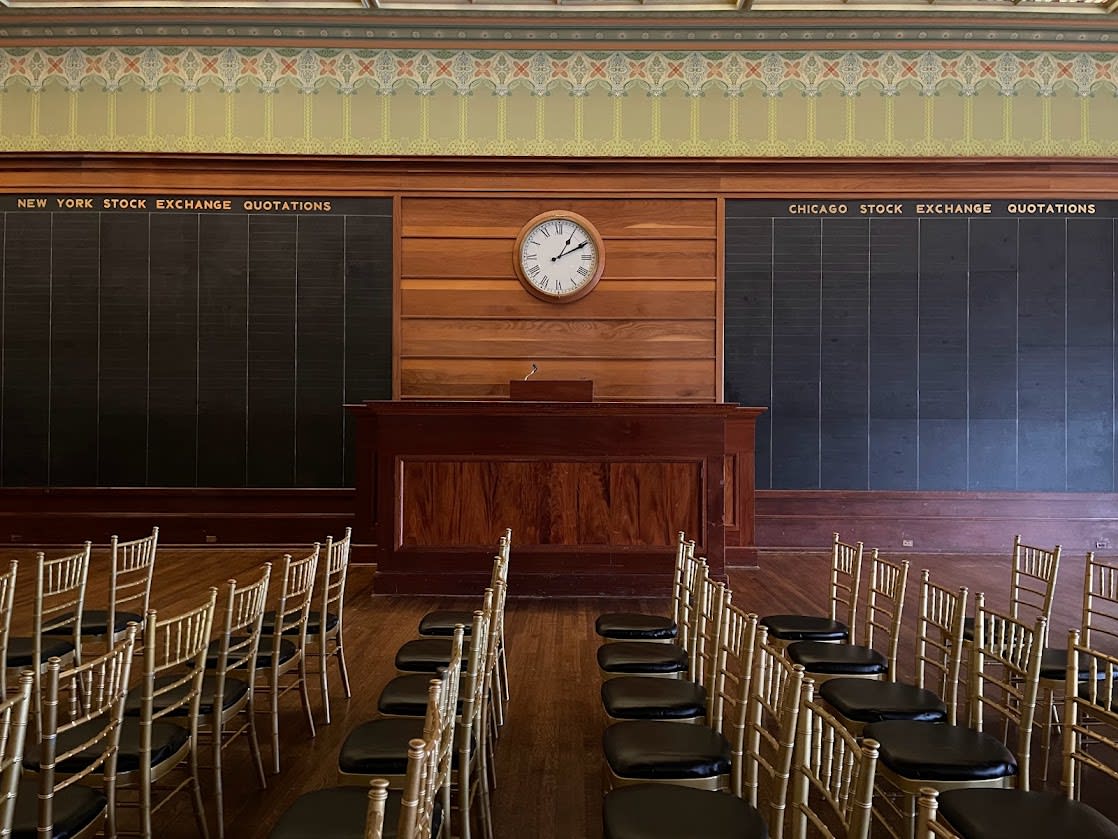
The Chicago Stock Exchange Trading Room at The Art Institute of Chicago
Address: 111 S. Michigan Avenue
Architect: Dankmar Adler and Louis Sullivan, Reconstructed by Vinci-Kenney Architects
Year: 1894, dismantled in 1972 and reconstructed 1977
Style: Sullivanesque/Modern
Neighborhood: Chicago Loop
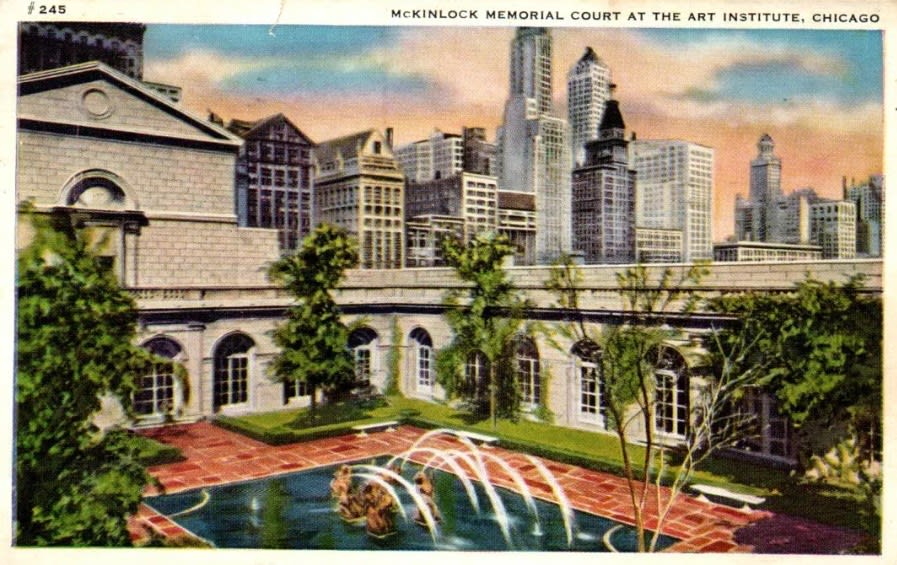
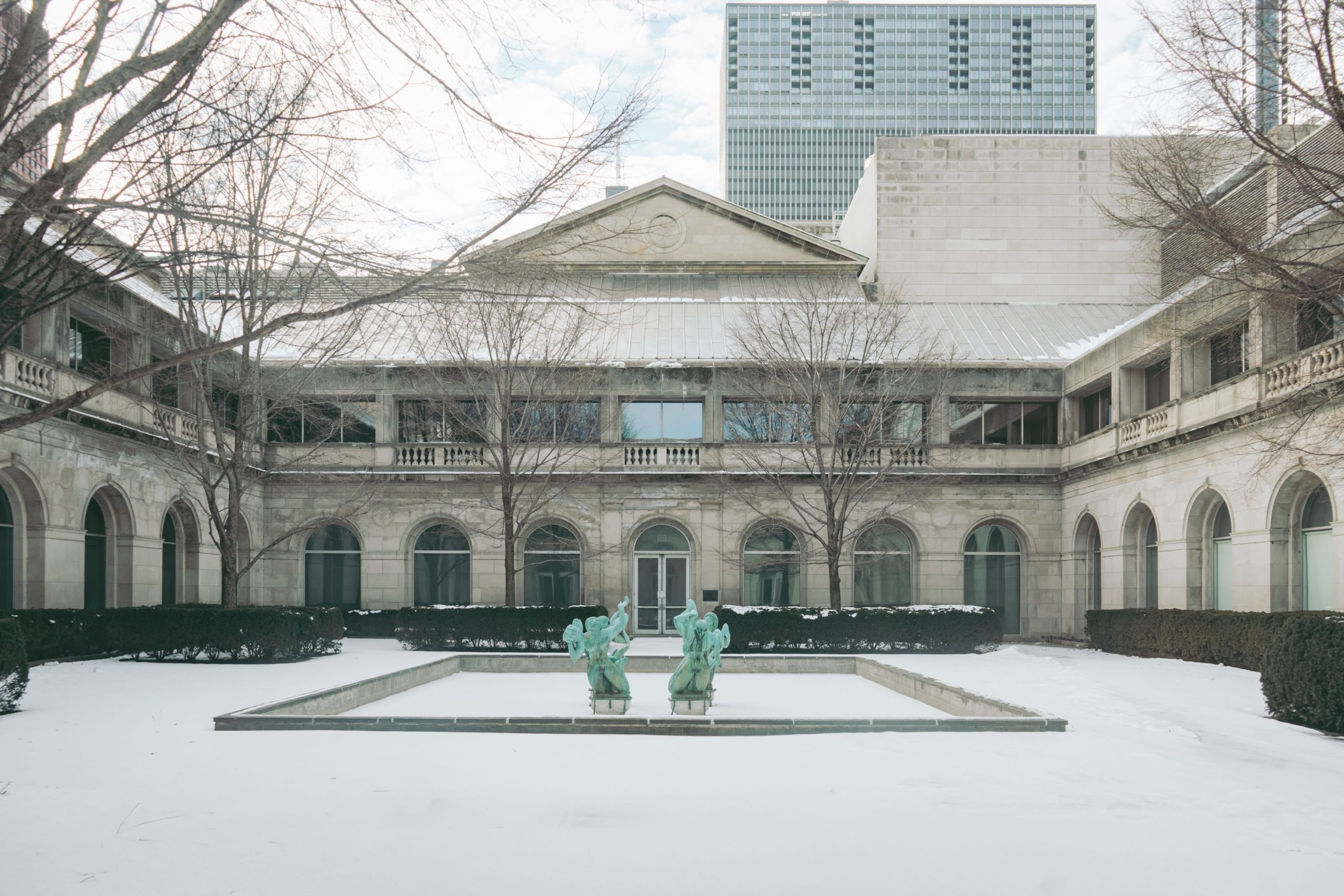
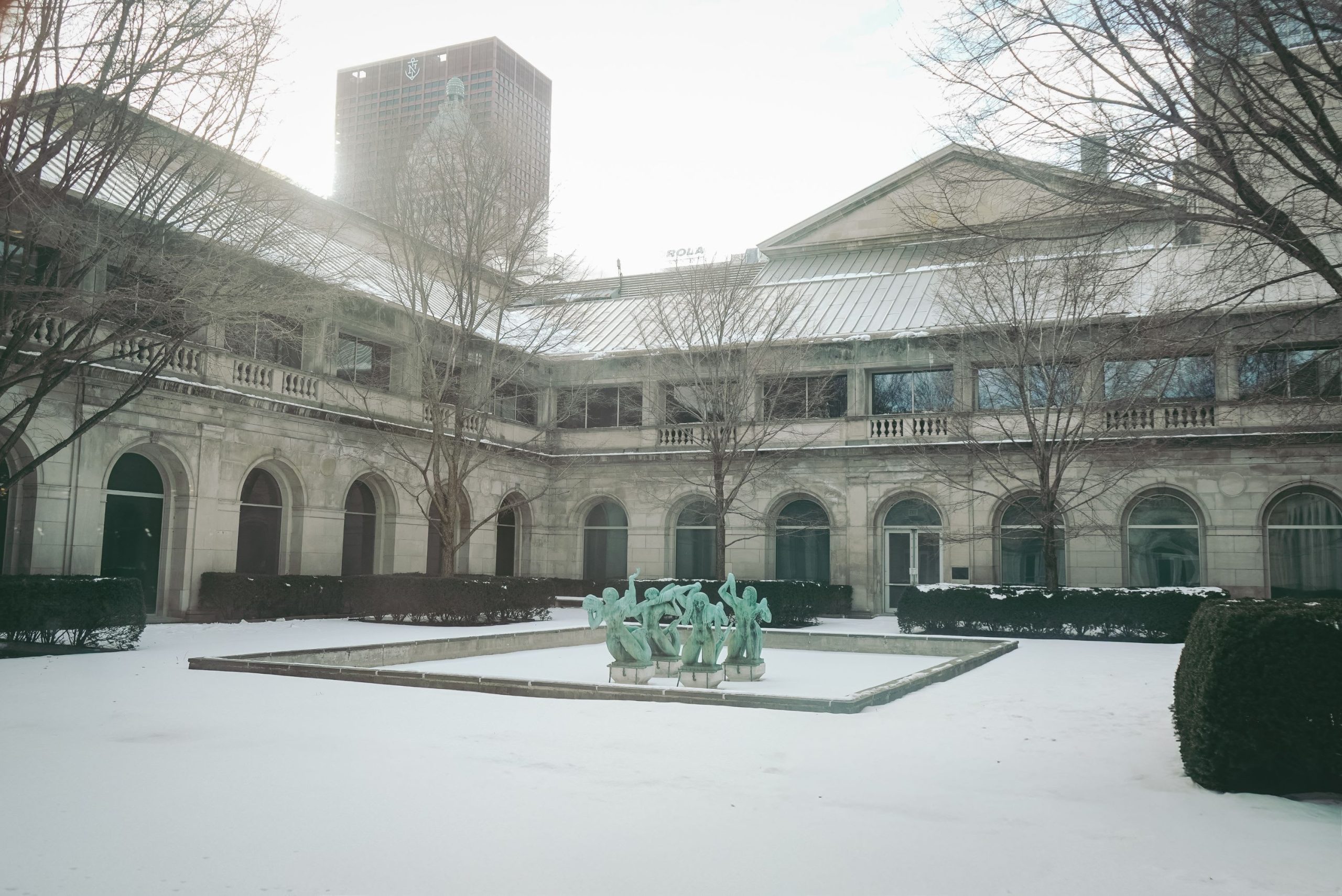
McKinlock Court Garden and Memorial Building at The Art Institute of Chicago
Address: 111 S. Michigan Avenue
Architect: Shepley, Rutan and Coolidge, Coolidge and Hodgdon, with rooftop addition by Walter Netsch, Skidmore Owings and Merrill
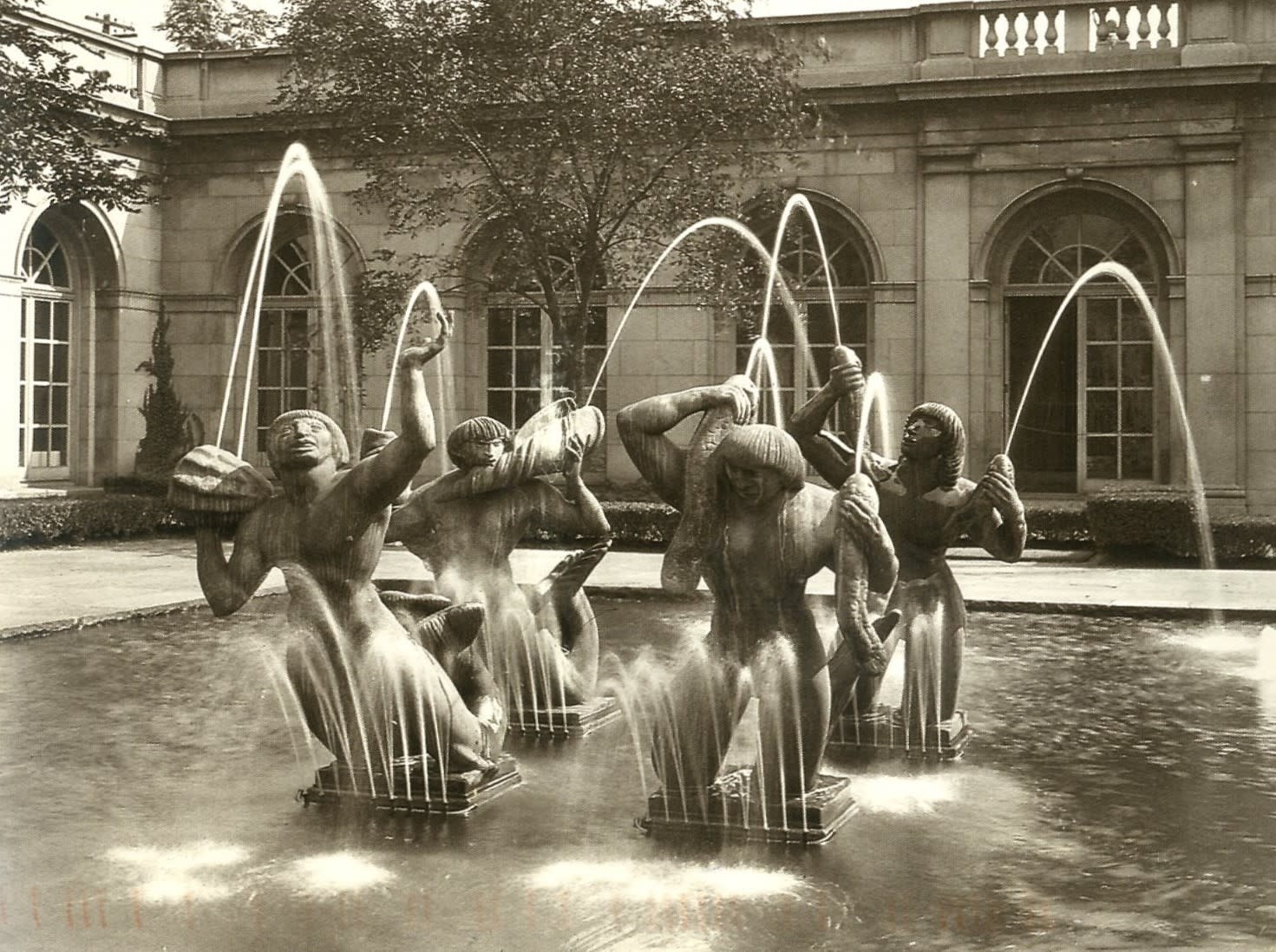
Sculptor: “Fountain of the Tritons” by Carl Milles
Year: McKinlock Court Building 1898; Triton Fountain 1931; additions by Walter Netsch, Skidmore Owings & Merrill (SOM) 1977
Style: Classical Revival/Renaissance Revival
Neighborhood: Chicago Loop
Overview
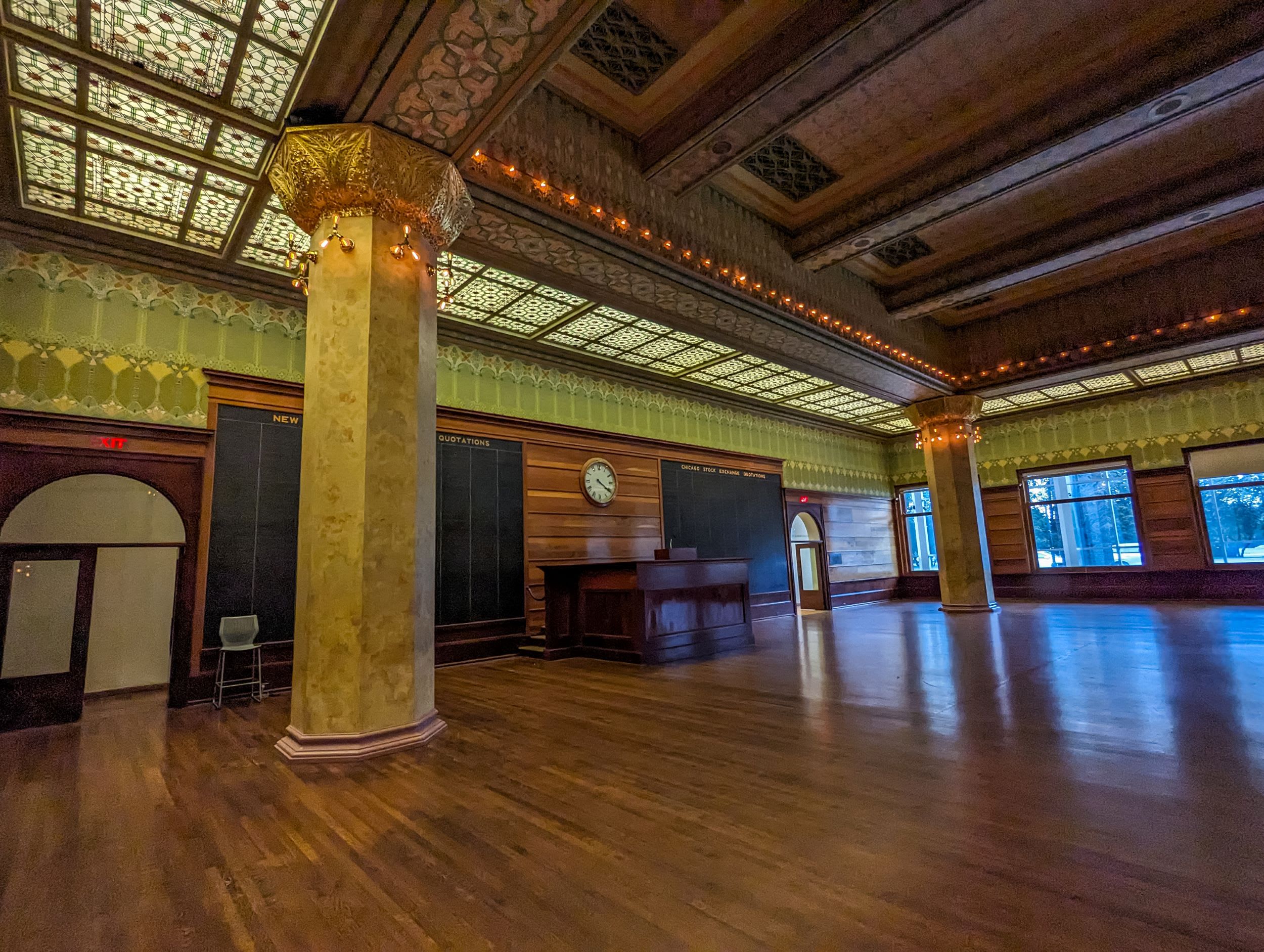
Designed in 1893 by architects Louis Sullivan and Dankmar Adler, the Chicago Stock Exchange Building was widely considered to be an architectural masterpiece of the highest caliber and its crown jewel was the ornate Chicago Stock Exchange Trading Room.
Despite widespread public opposition to demolition and a passionate advocacy effort to save it, the Chicago Stock Exchange Building was demolished in 1971-1972. When it became clear that the building would be lost, fearless leaders made the extraordinary decision to save the world-renowned Chicago Stock Exchange Trading Room and the elaborately ornamented entry arch fronting LaSalle Street and relocate them to The Art Institute of Chicago. The salvage effort was led by John Vinci, architectural photographer Richard Nickel, and others while the building was being demolished. Richard Nickel tragically lost his life during this process.
Reconstruction of the Chicago Stock Trading Room at the Art Institute was managed by John Vinci and Lawrence Kenney of the firm of Vinci-Kenney Architects. After a five-year effort, the Chicago Stock Trading Room at the Art Institute was rededicated in 1977 thanks to the visionary philanthropic visionary support of Mrs. Edwin (Alyce) Decosta, the Walter E. Heller Foundation, the Graham Foundation for the Arts and others. The grand opening was celebrated with much publicity and fanfare, however, nearly 50 years later, the Chicago Stock Exchange Trading Room is at high risk of demolition again for a proposed new wing for the The Art Institute of Chicago.
The Chicago Stock Exchange Building demolition in 1972 was considered an act of “cultural vandalism.” Though the building was ultimately lost, museums across the world recognized its importance. Precious architectural fragments and components such as ornate staircase balustrades, decorative elevator grilles, and polychrome stenciled panels made their way into the permanent collections of the top international museums, including MOMA, the Met, the Victoria and Albert Museum and Musée d’Orsay, where they remain prominently displayed today.
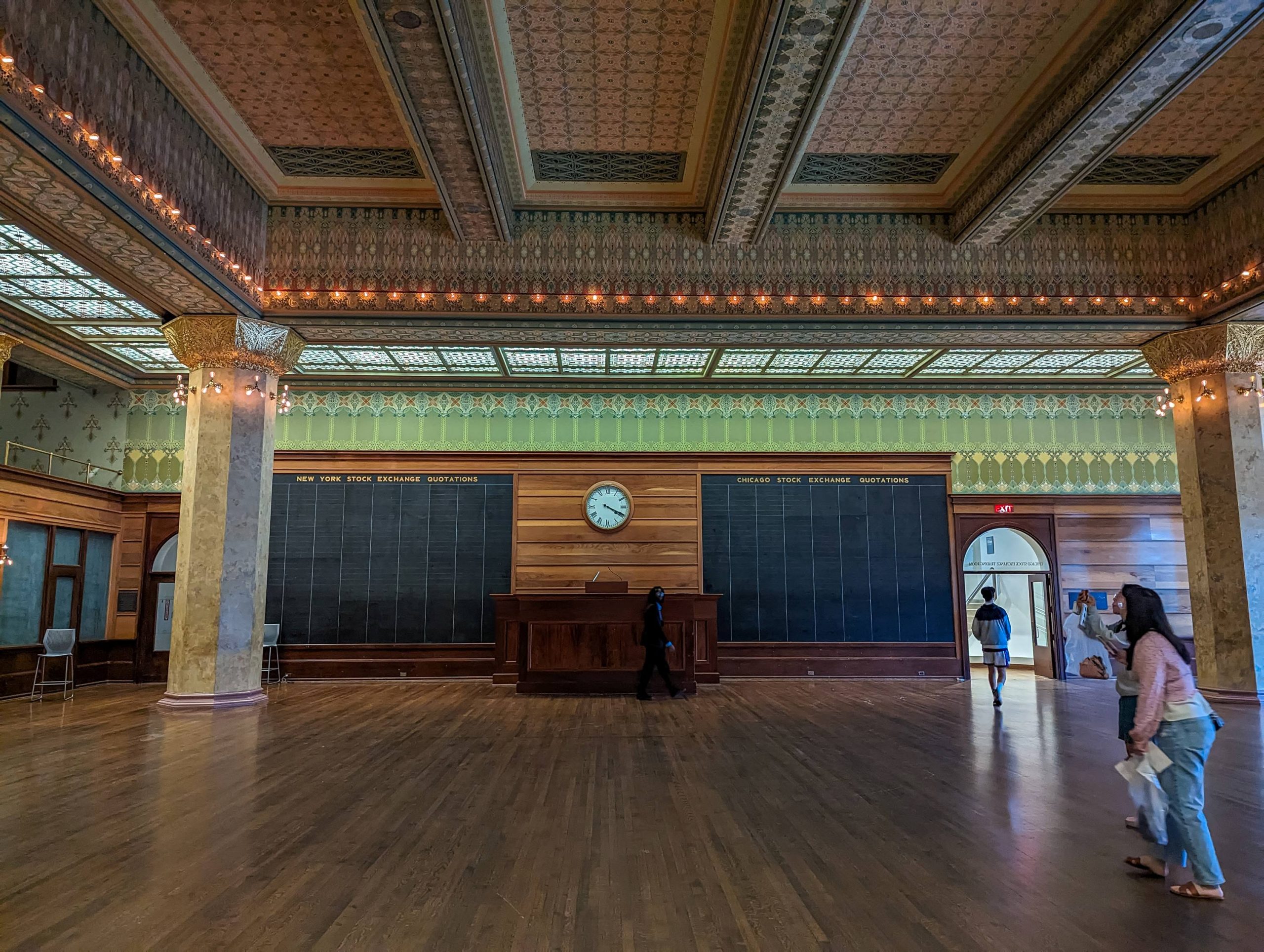
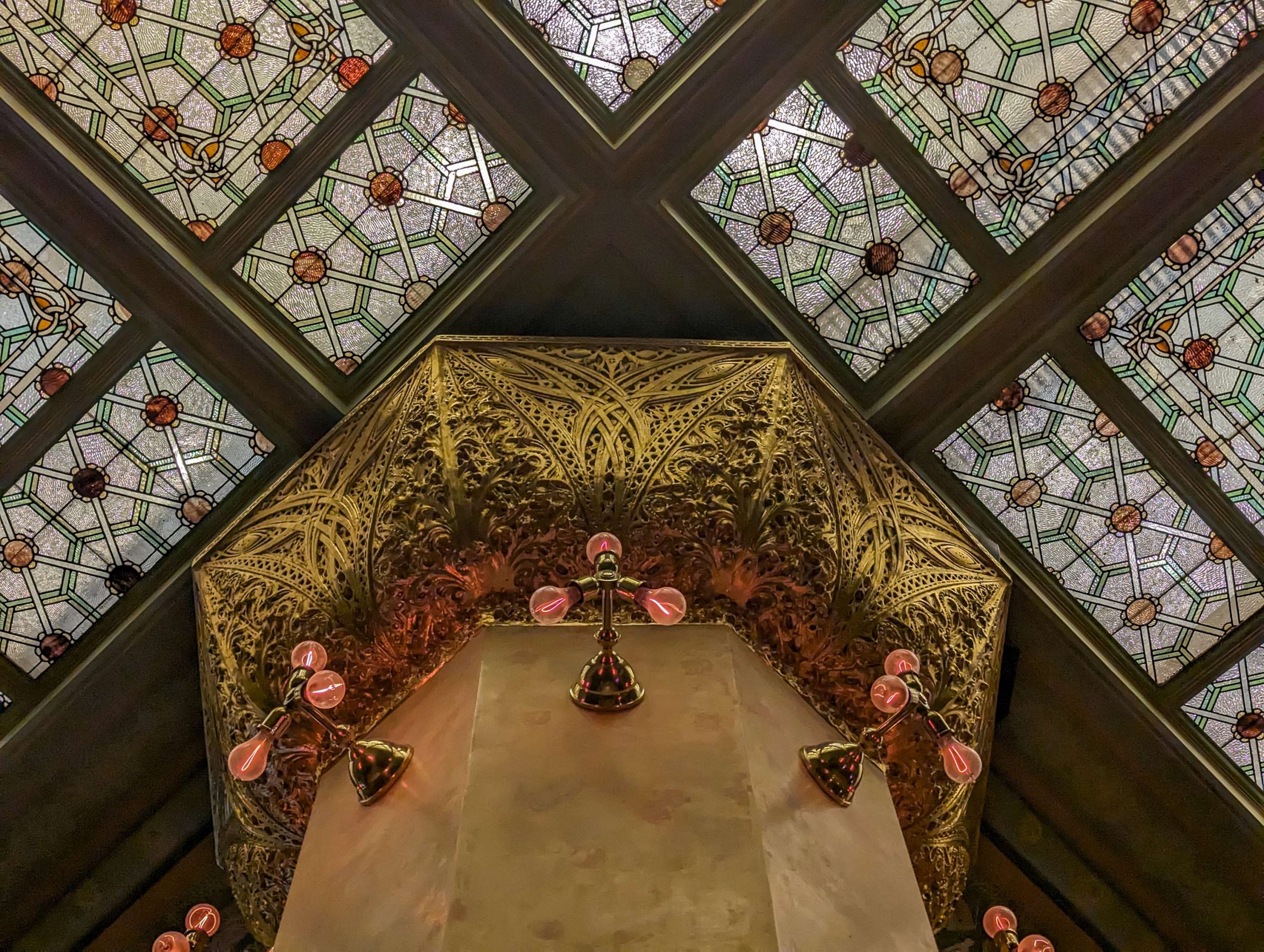
But none of the fragments can compare with the Chicago Stock Exchange Trading Room. The two-story, 100-foot by 75-foot trading hall includes massive Sullivan ornamented columns, intricate stained-glass skylights and a beautiful organic wall stenciling with 52 distinct hues in muted tones of gold, green and yellow in stylized patterns that reference the natural world.
While the world reveres what survives from the Chicago Stock Exchange Building today, perhaps the Art Institute of Chicago itself does fully appreciate or value the precious treasures that have been entrusted to its leaders.
McKinlock Memorial Building and Garden (with additions)
The McKinlock Court Garden and Memorial Building were designed by Coolidge and Hodgdon in 1924 as an addition to the original “Allerton Building.” The Allerton Building, the Art Institute’s first building, was designed by architects Shepley, Rutan and Coolidge and constructed as one of the permanent offsite buildings for the Columbian Exposition of 1893. This limestone-clad structure, with its graceful semicircular arches and lovely garden containing “The Fountain of the Tritons” by artist Carl Milles, has been a long-admired and well-loved space within The Art Institute of Chicago. This enclosed garden represents one of the museum’s few remaining public gardens and outdoor spaces and is the largest of those that once existed. It has also offered refreshing views from the 1976 SOM rooftop additions and a beautiful outdoor space for dining during warmer seasons. This magnificent courtyard may be significantly altered or even destroyed for the newly proposed addition to The Art Institute of Chicago.
History: The Chicago Stock Exchange Trading Room
The Chicago Stock Exchange Building was designed in 1893-1894 by architects Dankmar Adler (1844-1900) and Louis Sullivan (1856-1924) of the firm of Adler & Sullivan. It was a project for Ferdinand Peck (1848-1924), a prominent real estate developer, businessman, arts patron, philanthropist and civic father/leader. Peck had commissioned Adler & Sullivan for several previous projects, most notably remodeling the Inter-State Industrial Exhibition Building (1872-1892) at Michigan Avenue and Adams Street for the Chicago Grand Opera Festival (1885). Working with Adler & Sullivan on the Inter-State project led Peck to commission Adler & Sullivan to design The Chicago Auditorium Building (1886-1890). The Auditorium Building became the envy of many cities: a multi-use building that comprised a hotel, theater and offices. It established Adler & Sullivan as great designers of large, complex projects and one of America’s most influential architecture firms.
Ironically, the Art Institute of Chicago’s first building (later renamed the Allerton) was constructed on the site of the Inter-State, which was demolished in 1892 to make room for a prominent Columbian Exposition building (the fair was also known as the Chicago World’s Fair of 1893-1894). Today, a newer building adjacent to the Allerton is the site of Adler & Sullivan’s reconstructed Chicago Stock Exchange Trading Room, originally the central feature of the Stock Exchange Building. The Chicago Stock Exchange Trading Room is a grand space in the Art Institute. It’s a work of art and architecture. In some regards, it’s a “period room” – making it the Art Institute’s only full-scale period room (the Metropolitan Museum of Art in New York has 20 period rooms in its American Wing alone). And the Chicago Stock Exchange Trading Room can also serve as a splendid, multi-function room for events, presentations and receptions.
Located at 30 N. LaSalle Street in the very heart of Chicago’s Financial District, the Chicago Stock Exchange Building opened to much fanfare in 1894. It was one of the largest commissions of the Adler & Sullivan architectural firm. Another of Adler & Sullivan’s large commissions was the extraordinary Schiller/Garrick Theater and Building (1890-1961), which was tragically demolished and led to the founding and creation of the preservation movement in America (along with the destruction of Pennsylvania Station in New York City in 1963). Also, the aforementioned Auditorium Building, constructed between 1886 and 1890, the Wainwright Building of 1890-1891 in St. Louis, Missouri, and the Guaranty/Prudential Building of 1895-1896 in Buffalo, New York, are among Adler & Sullivan’s 256-plus commissions.
The 13-story Chicago Stock Exchange Building was a fine example of early skyscraper design, which employed metal framing and new construction techniques, including the first use of caisson foundations. In the decades following the Chicago Fire of 1871, the Chicago Stock Exchange Building rose as a seminal part of a groundbreaking construction movement during Chicago’s first golden age of architectural achievements, which would come to be called “the Chicago School of Architecture” and “the Chicago Commercial Style.”
The Chicago Stock Exchange Trading Room was located in the southeast corner of the second floor of its namesake building, fronting LaSalle Street and a portion of Calhoun Place, a small narrow street to the south. The Trading Room was considered one of the finest rooms in America when it opened and was hailed in its day as “unexcelled in the magnificence of its appointments and decoration by any room used for like purpose in the country.” And importantly, it was home to The Chicago Stock Exchange. The room, with a 30’ high ceiling, measured 64 by 81 feet, and the structure of the large steel trusses was designed to span a magnificently large space while supporting the 11 stories of offices above. This was an engineering feat and resulted in a luxurious and luminous space. Which you can still experience today at the Art Institute of Chicago!
Recognized for their extraordinary craftsmanship, the elaborate Trading Room stencils and art glass lay-lights/skylights were executed under the direction of Louis Healy of the firm of Healy & Millet in tandem with Louis Sullivan and the Adler & Sullivan offices. The Trading Room contained 15 elaborate stencils, the most detailed of them in the high coffers of the clerestory, containing 52 colors applied to the canvas.
The room was also illuminated by two walls of large windows and a large skylight, with the Trading Room’s perimeter wrapped with decorative art glass panels that softly diffused the natural sunlight. Within the upper vaults of the room were located a continuous plaster ornamental band with the initials “CSE” for the Chicago Stock Exchange worked into its design, studded with carbon filament bulbs, illuminating both the ornamental band wrapping the upper ceiling vaults, as well as the room below.
Brass sconces were also attached to the upper levels of the four massive octagonal columns, which supported the 11 floors of the building above and which were sheathed in scagliola with highly ornamented gilded capitals. Sconces were also interspersed between the small office entries and frosted glass panels on one wall of the Trading Room. For about a decade-and-a-half, the Chicago Stock Exchange operated from this room, rent-free per the original rental agreements, before it became the primary banking room for the Foreman Brothers’ Bank in 1908. Later, a series of remodelings for various tenants left the trading room subdivided and obscured.
When it became clear that advocacy efforts to protect the Chicago Stock Exchange Building had failed, it was determined that components of the building would be salvaged and saved for museums around the world. It was also determined that the Chicago Stock Exchange Trading Room would be uncovered – eliminating past remodelings that lowered ceilings and subdivided walls – so that its full splendor would be revealed again. Original features were carefully documented and then deinstalled and removed from the building. This was all accomplished while the structure was being demolished.
Under the direction of Vinci-Kenney Architects and others, including architectural photographer Richard Nickel, the Trading Room was disassembled as part of a lengthy process, but within a very compressed time frame. Architectural components of the Trading Room were removed and stored and later prepped for reinstallation at The Art Institute of Chicago as part of the museum’s expansion eastward to Columbus Drive and a larger “Centennial Project.” The Chicago Stock Exchange Trading Room project was sponsored in large part by the Walter E. Heller Foundation and Mrs. Edwin (Alyce) Decosta, along with the Graham Foundation for the Arts and others.
The large LaSalle Street entry arch to the Chicago Stock Exchange Building, composed of beautifully ornamented terra cotta, was salvaged by the City of Chicago and also gifted to The Art Institute of Chicago. The Chicago Stock Exchange Building Arch was installed on the museum grounds near Monroe Street and Columbus Drive.
As mentioned, the Trading Room has been used for almost 50 years as a reception room for events, lectures, celebrations and as a period room, representing a historic Chicago space that was crucial to preserve and restore so future generations would have access to its glory. The Chicago Stock Exchange Trading Room is a world-class work of art and architecture that represents one of Chicago’s most recognized firms and links back to the development of the skyscraper and metal framed building.
History: McKinlock Memorial Building and Courtyard
The McKinlock Memorial Building, Courtyard and Garden were constructed in 1924 as one of many extensions and additions to The Art Institute of Chicago. It was designed as a series of art galleries that wrapped a central open courtyard, with natural sunlight filtering into the exhibition spaces near the perimeter of the courtyard.
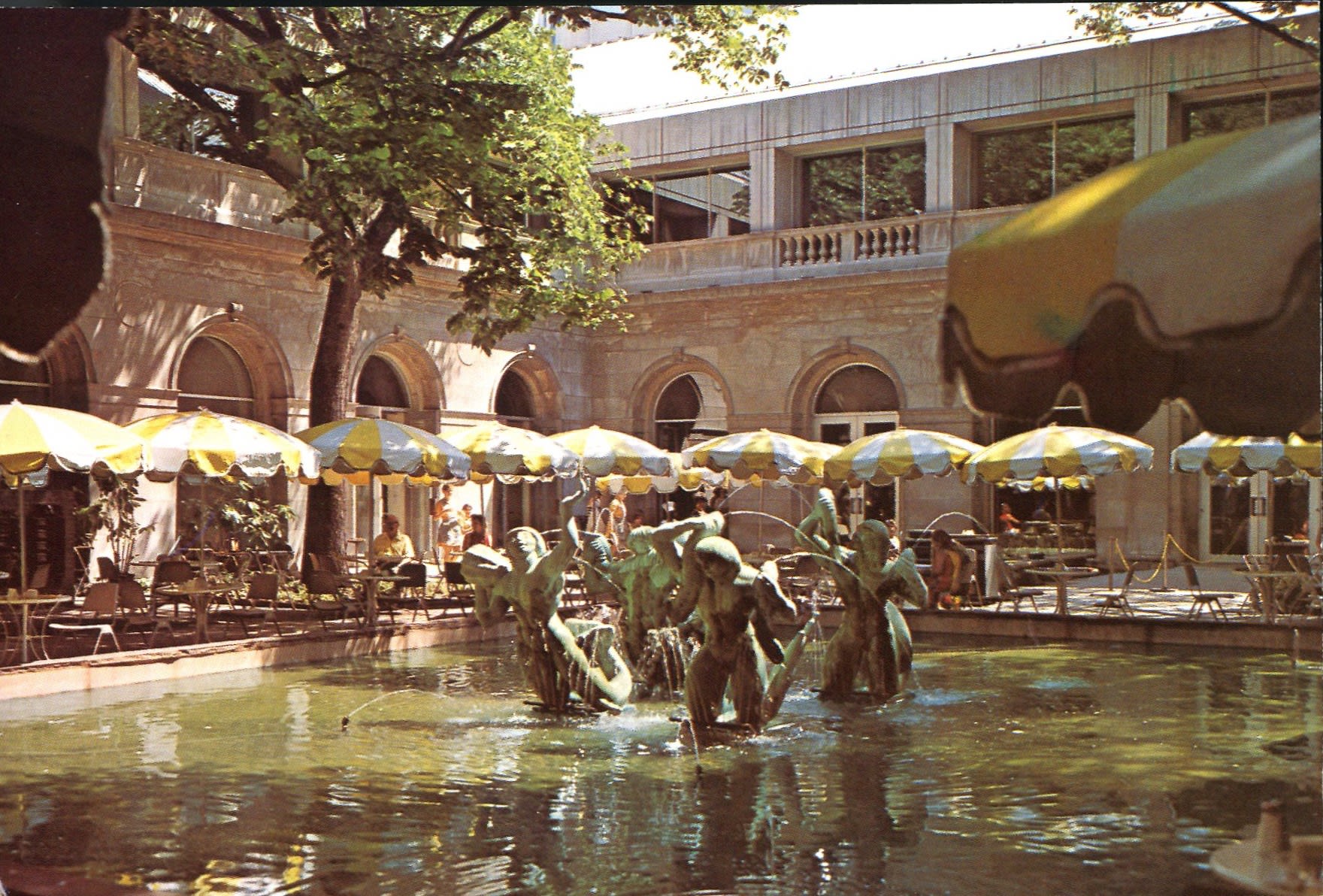
Located in the center of this courtyard is “The Fountain of the Tritons” by Carl Milles, a Swedish sculptor, that features bronze figures. This garden was organized in a formal way, with four trees located near each corner of the courtyard and other plantings reflecting a symmetrical pattern. This very much reflected the architecture of the courtyard and the many semi-circular arches of the McKinlock Building’s Classical-revival/Renaissance style. It also mirrored aspects of Grant Park and its formal and symmetrical gardens, which flank the Art Institute and continued to expand over time.
McKinlock Court’s formal garden continues to be a respite for relaxation and for dining under the shade of trees and umbrellaed tables. For many years, frequent evening concerts allowed visitors to experience an al-fresco dinner while relaxing and enjoying various musical art forms. McKinlock Court is one of Chicago’s finest enclosed outdoor spaces and a much beloved courtyard, despite an unfortunate reduction in programming and cuisine over the past decade.
The McKinlock Courtyard and its architecture continue to be a much sought after destination during the warmer seasons. In addition to being an important visual feature and source of natural light to the galleries and public spaces wrapping the perimeter of this open space, the design has an inviting European feel. The McKinlock Court Building was expanded in the 1970s with a second-floor addition by Skidmore Owings and Merrill (SOM), led by architect Walter Netsch. Out of deference to the beautiful features and proportions of this outdoor space, the new addition’s roof slopes at a sharp angle to allow for sunlight to reach the open courtyard and galleries. This addition was part of the “Centennial Project” by the museum and the adjoining school—The School of the Art Institute of Chicago, which included new space for the installation of the Chicago Stock Exchange Trading Room.
Threat
As part of upcoming expansion plans, the Art Institute of Chicago is considering the demolition of the Chicago Stock Exchange Trading Room by Adler & Sullivan, which was relocated from the original building destroyed in 1972. The expansion would also demolish the McKinlock Court Building and Courtyard Garden. All were highly celebrated central features of the 100-year “Centennial Project.” Nearly 50 years later, it’s unfortunate that demolition may be the result of The Art Institute of Chicago’s 150th anniversary and expansion plans.
The full extent and details regarding the alterations and demolition are not clear as they have not yet been shared with the general public and citizens of Chicago. The plans for a new wing were initially reported in the Chicago Tribune in 2019 (Chicago Tribune, Johnson, 9/11/19) and again in 2024 (Chicago Tribune, Channick, 9/10/24). Despite the secrecy, plans have been well underway for many years. The details of these plans remain closely guarded.
Since the Art Institute rests within the boundaries of Grant Park – a publicly owned property that belongs to the City of Chicago and is stewarded by the Chicago Park District – we at Preservation Chicago believe that all plans should be widely shared with the general public at each step and with full transparency.
Also, various important spaces and features of the museum should be considered for Chicago Landmark designation and protections. We have examples of other historic buildings and museums which have such protections, including the Griffin Museum of Science and Industry, the Chicago Cultural Center/former Central Library, and the front façade of The Art Institute of Chicago (which is within the historic Michigan Boulevard Chicago Landmark District).
Recommendations
Preservation Chicago encourages the Art Institute of Chicago to preserve and protect both the Chicago Stock Exchange Trading Room and McKinlock Court. These highly significant, seminal spaces are irreplaceable features of the Art Institute and our city. They have been a cherished destination for visitors to and patrons of the museum for decades. As the current stewards of these architectural treasures, the Art Institute of Chicago should prioritize their protection and preserve these spaces for future generations. Much like the iconic Allerton Building – the first of the Art Institute’s buildings, which is protected by the Michigan Boulevard Chicago Landmark District – these world-class architectural elements are worthy of preservation and protection.
Noting that the museum rests on City-owned land within Grant Park that are stewarded by the Chicago Park District, we consider these important features of the Art Institute of Chicago to belong to the people of Chicago. As such, we encourage ongoing preservation of the Trading Room and McKinlock Court so that they will be available to the people of Chicago for generations to come.
Both the Chicago Stock Exchange Trading Room and McKinlock Court are important spaces which qualify for Chicago Landmark Designation. Preservation Chicago encourages The Art Institute of Chicago to consider and pursue a Chicago Landmark Designation of the complex and to include all significant features of the building.
A Chicago Landmark designation with public access of a building that’s been constructed on public grounds in Grant Park, would be an excellent way of embracing these highly visible and semi-public spaces. The designation could include the Michigan Avenue lobby, grand stairwell, interior spaces and grand galleries in the Allerton Building, the Fullerton Hall Auditorium by Healy and Millet that features a Tiffany art glass dome, the Ryerson and Burnham Libraries, McKinlock Court and the Chicago Stock Exchange Trading Room. This could also extend to the reconstructed Chicago Stock Exchange terra cotta entry arch, located on the east side of the Rubloff Building, the McCormick Gardens, the Dan Kiley designed gardens with Loredo Taft’s Fountain of the Great Lakes, and the various structures comprising the museum. These various buildings have been designed by a variety of prominent architects of note, so further protection of these public assets is desirable.
We appreciate and respect the need for our Chicago institutions to grow, but these changes need to be handled with great sensitivity. Preservation Chicago supports a new wing addition to The Art Institute to be located within the railroad trench, which currently splits the museum building in two.
Millenium Park, directly across Monroe Street from the Art Institute of Chicago, covered the Metra Electric/South Shore/Former Illinois Central Tracks and proved to be an incredibly successful development. We consider this to be an excellent model for where the Art Institute of Chicago should be locating its new building campus expansion. The Art Institute of Chicago has already accomplished this on a smaller scale with the bridge for Gunsaulus Hall.
Construction of a new wing over the railroad trench would generate widespread support. With the support of the City of Chicago, the Chicago Park District, the railroads and the public, it could be a wonderful solution to vastly expand the galleries and spaces for the Art Institute’s collections. If this idea were adopted, the railroad trench, often viewed as an industrial eyesore, would be hidden and the many disconnected parts of the museum would be linked. This is a logical place to construct a new wing and would be of great public benefit.